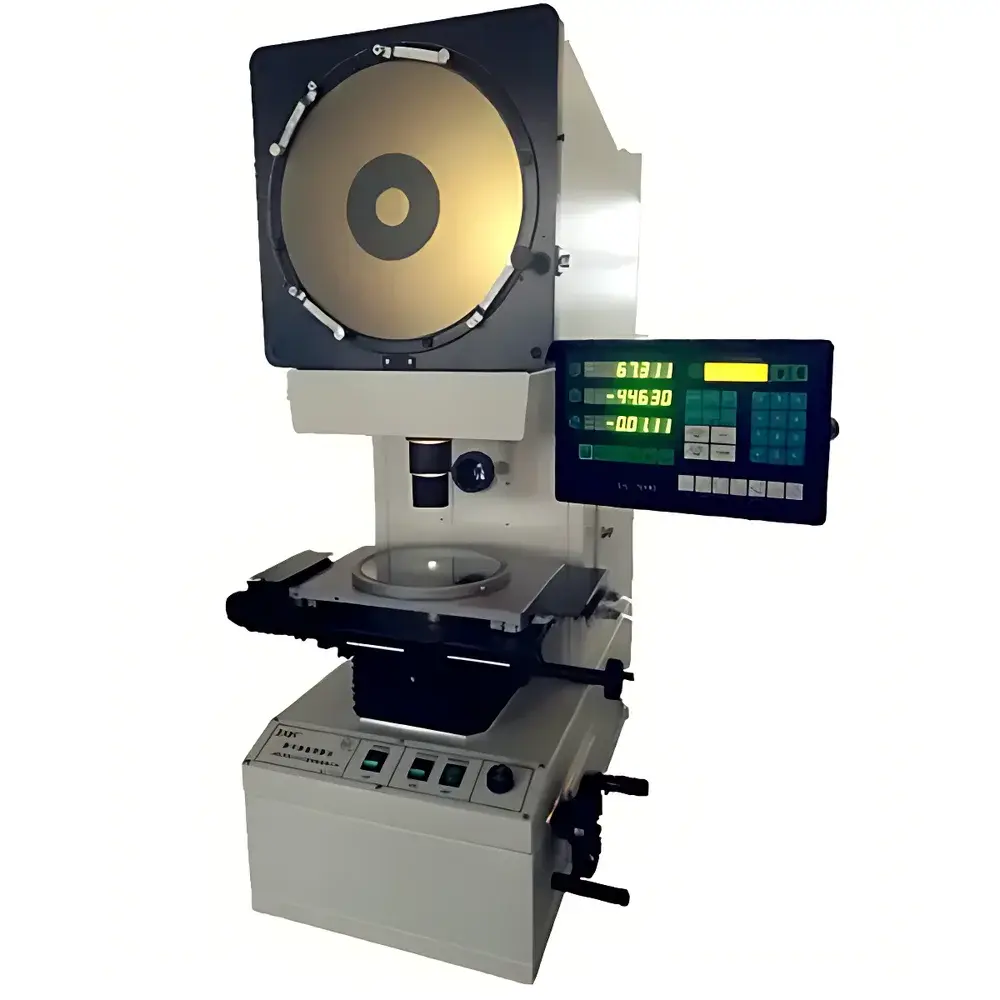
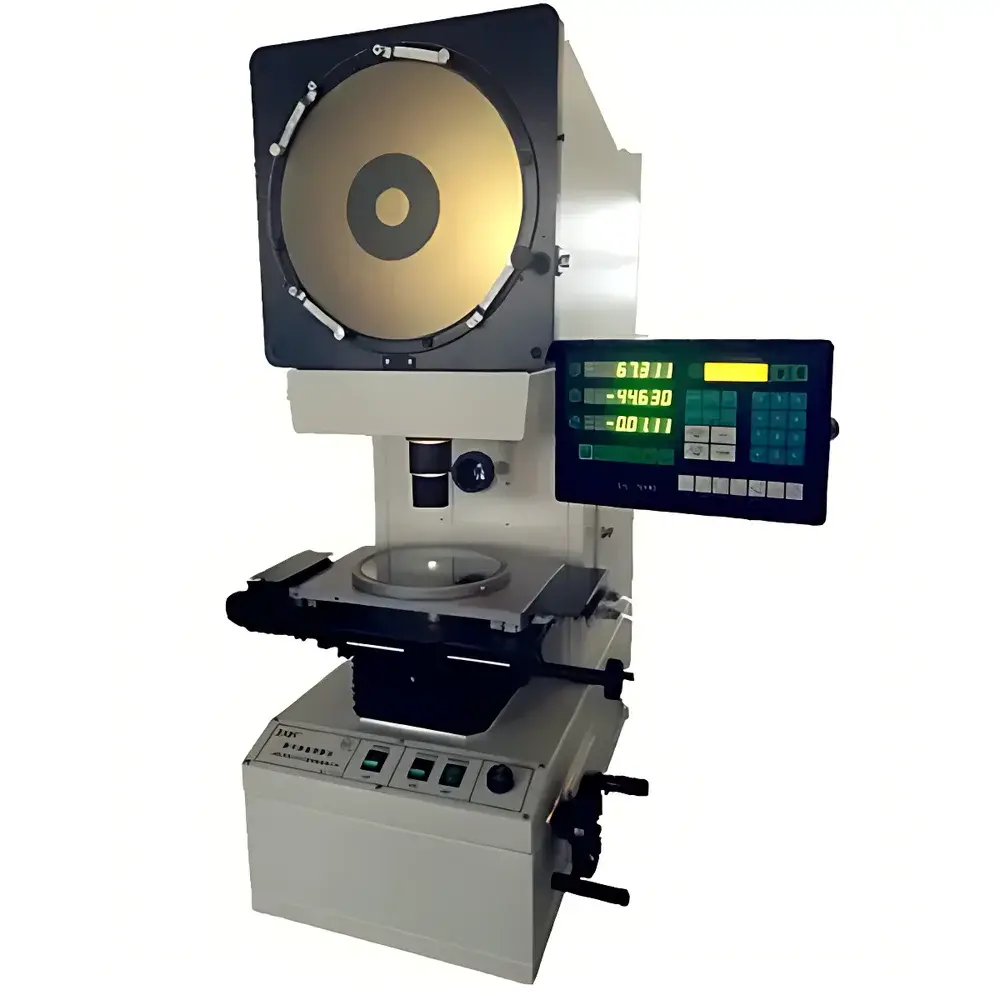
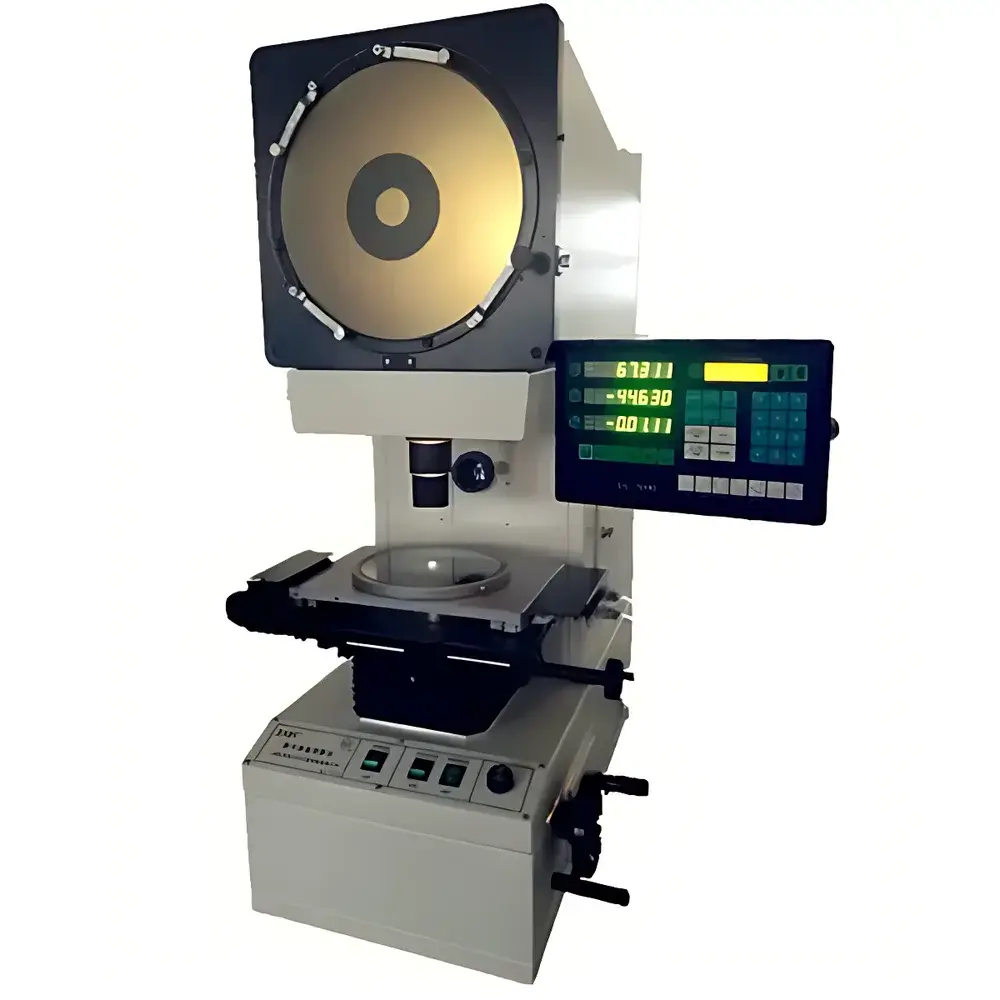
BM 23JC-1505 Benchtop Profile Projector
| Brand | BM |
|---|---|
| Origin | Shanghai, China |
| Model | 23JC-1505 |
| Objectives | 10× (standard), 20×/50×/100× (optional) |
| Field of View (object-side) | φ30 mm / φ15 mm / φ6 mm / φ3 mm |
| Working Distance | 85.25 mm / 81.94 mm / 16.99 mm / 16.35 mm |
| Projection Screen | φ308 mm (usable area >φ300 mm, crosshair reticle) |
| Screen Rotation | 0–360°, digital readout resolution: 1′ or 0.01° |
| Stage | 320 × 220 mm metal base, φ190 mm glass plate, X/Y travel: 150 mm × 50 mm, rotary stage: φ180 mm |
| Positional Resolution | 0.001 mm (X/Y), 0.001° (rotation) |
| Illumination | 24 V / 150 W halogen lamp (transmitted & reflected) |
| Cooling | Forced-air (3 axial fans) |
| Power | 220 V AC, 50/60 Hz, 350 W |
| Dimensions (W×D×H) | 730 × 400 × 1120 mm |
| Weight | ~160 kg |
| Measurement Accuracy | (3 + L/75) µm (L in mm), contour error < 0.08% under transmitted light |
Overview
The BM 23JC-1505 is a precision benchtop profile projector engineered for non-contact dimensional metrology of complex mechanical components. Utilizing telecentric optical design across all objective lenses and illumination paths, the system eliminates parallax-induced measurement uncertainty and minimizes focus-related errors—critical for high-reproducibility contour analysis. As a dual-mode instrument, it supports both transmitted-light silhouette projection for edge-based profile measurement and reflected-light inspection for surface topography, texture, and geometric feature assessment. Its rigid cast-iron frame, thermally stable optical train, and calibrated digital encoders ensure long-term stability and traceable measurement performance compliant with ISO 9022-3 (optical instruments — environmental testing) and ISO 10360-1 (coordinate measuring machines — acceptance and reverification tests). Designed for laboratory, QC lab, and calibration facility environments, the 23JC-1505 delivers metrological-grade data without mechanical probing forces—making it ideal for thin, delicate, or easily deformable parts such as stamped sheet metal, precision gears, threaded components, and miniature tooling.
Key Features
- Telecentric optical path across all standard and optional objectives (10×, 20×, 50×, 100×), ensuring consistent magnification regardless of object position within depth of field
- Dual-illumination system: 24 V / 150 W halogen source with independent transmitted and reflected channels, optimized for contrast-rich silhouette imaging and surface detail visualization
- High-resolution digital readout: 0.001 mm linear resolution on X/Y axes; 0.001° angular resolution on 360° motorized or manual screen rotation
- Large-format projection screen (φ308 mm) with engraved crosshair reticle and >φ300 mm usable area, supporting full-field evaluation of medium-sized parts
- Modular stage configuration: 320 × 220 mm metal base with interchangeable φ190 mm optical glass plate; integrated φ180 mm rotating platform for angular feature alignment
- Forced-air thermal management via three axial fans, maintaining optical alignment stability during extended operation cycles
- Compliance-ready mechanical architecture: designed to support future integration with ISO/IEC 17025-compliant calibration workflows and GLP documentation protocols
Sample Compatibility & Compliance
The BM 23JC-1505 accommodates a broad range of part geometries and materials, including metallic stampings, plastic injection-molded components, ceramic substrates, and precision-ground cutting tools. Its non-contact methodology enables measurement of fragile, soft, or heat-sensitive specimens—including thin films, elastomeric seals, and micro-machined features—without risk of deformation or surface damage. The instrument meets general requirements for optical measuring instruments per ISO 10360-7 (projection equipment) and aligns with dimensional verification practices referenced in ASME Y14.5-2018 (geometric dimensioning and tolerancing). While not inherently FDA 21 CFR Part 11-compliant, its digital encoder outputs are compatible with third-party validated software platforms that support audit trails, electronic signatures, and secure data archiving for regulated environments.
Software & Data Management
The 23JC-1505 operates with industry-standard USB-connected digital readout units capable of real-time streaming of X/Y/θ positional data to host PCs. It interfaces natively with common metrology software suites—including Metrolog IQ, Q-DAS qDAS, and open-source Python-based measurement frameworks—enabling automated reporting, GD&T evaluation (e.g., concentricity, circularity, profile of a line), and statistical process control (SPC) charting. All encoder data logs include timestamped metadata, supporting traceability per ISO/IEC 17025 clause 7.7. Optional upgrades include Ethernet-enabled controllers with Modbus TCP support for factory-floor integration into MES or SCADA systems. Raw coordinate data exports in CSV and DXF formats facilitate interoperability with CAD comparison workflows and FAIR (Findable, Accessible, Interoperable, Reusable) data principles.
Applications
- Contour verification of machined profiles: cams, turbine blades, gear tooth forms, and spline shafts
- Dimensional inspection of stamped and bent sheet metal parts (e.g., automotive brackets, connector housings)
- Tool and die metrology: cutting tool geometry, punch/die clearance analysis, and wear assessment
- Educational metrology labs: hands-on training in optical measurement principles, uncertainty analysis, and GD&T fundamentals
- Calibration laboratory support: reference standard verification, comparator validation, and inter-laboratory comparison exercises
- Electronics manufacturing: lead frame inspection, PCB stencil aperture verification, and MEMS component outline measurement
FAQ
What magnifications are supported, and how do working distances vary across objectives?
The standard 10× objective provides a 85.25 mm working distance and φ30 mm field of view; optional 20×, 50×, and 100× objectives reduce field size proportionally while decreasing working distance to 81.94 mm, 16.99 mm, and 16.35 mm respectively.
Is the projection screen rotation motorized or manual?
Screen rotation is manually actuated with digital angular readout; no motorized drive is included in the base configuration, though external stepper integration is feasible via encoder interface.
Can measurement data be exported directly to Excel or SPC software?
Yes—real-time X/Y/θ values stream via USB HID or virtual COM port; CSV export is supported through bundled or third-party applications for direct import into Excel, Minitab, or JMP.
Does the system meet ISO 10360-7 accuracy requirements for projection equipment?
Its stated measurement uncertainty of (3 + L/75) µm conforms to the maximum permissible error limits defined in ISO 10360-7 Annex B for Class 2 projection comparators at typical measurement ranges.
What maintenance is required for long-term optical performance?
Annual verification of screen centering, objective collimation, and encoder linearity is recommended; halogen lamp replacement every 500–800 operational hours ensures consistent illumination intensity and color temperature.
Related Products