
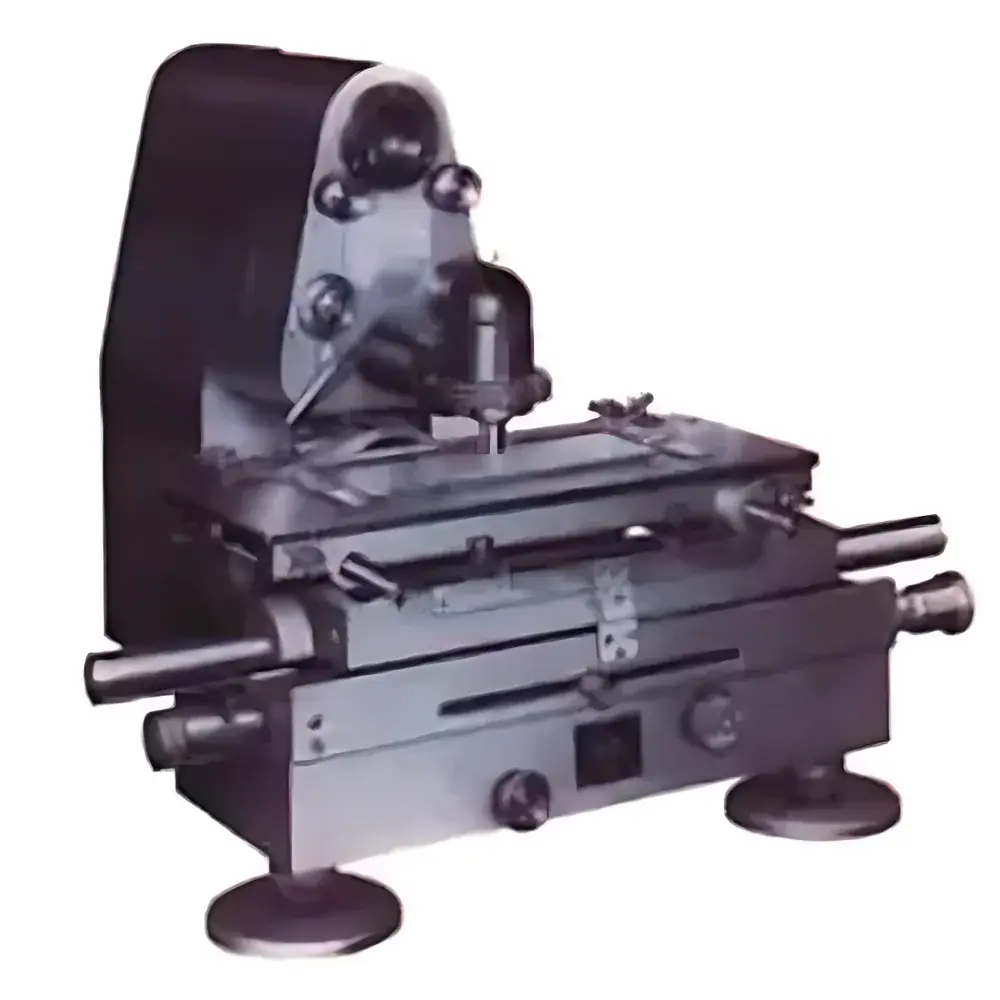
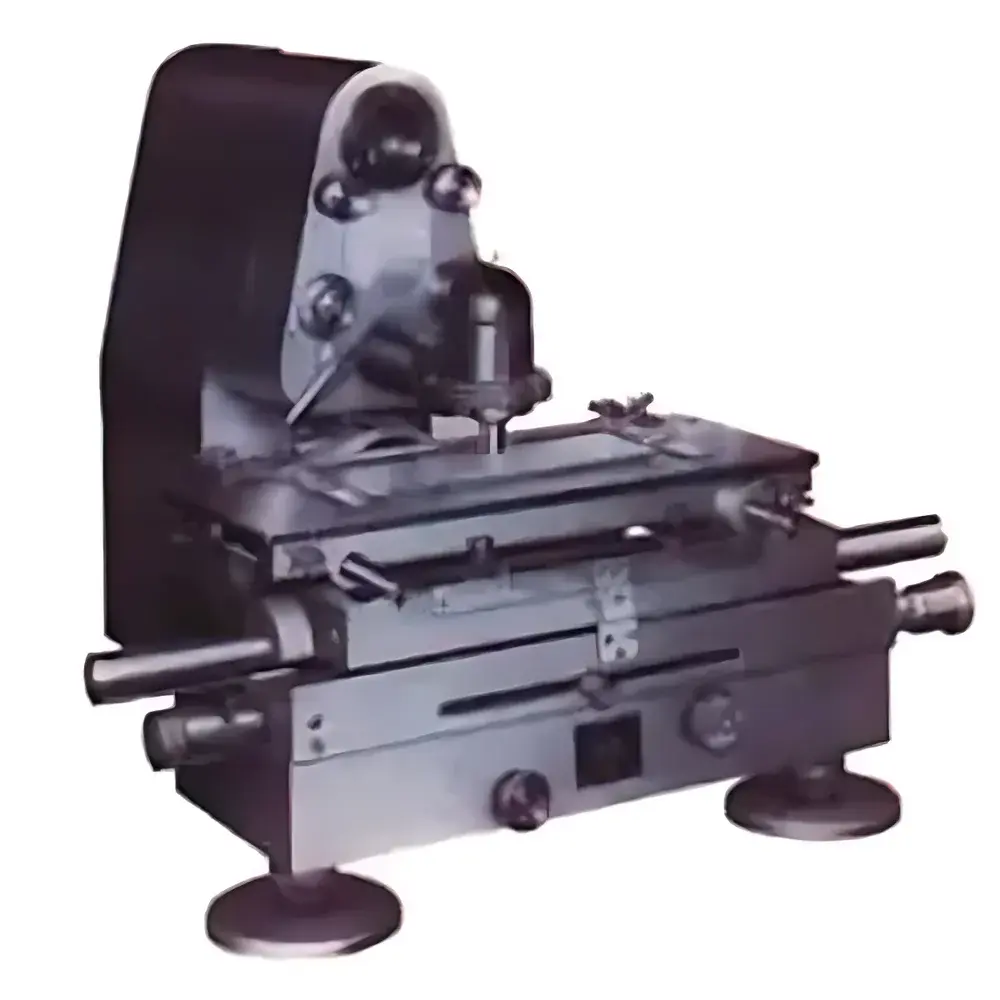
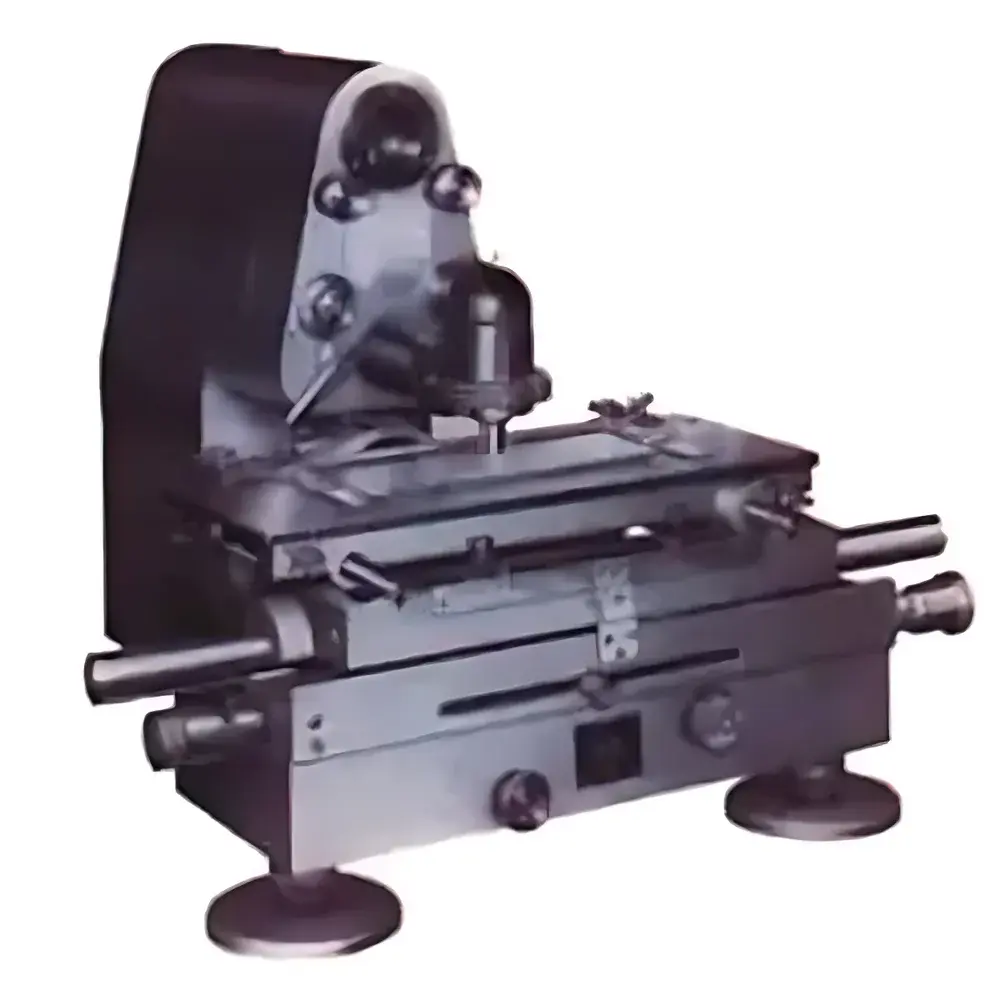
BM 9W Microdensitometer
| Brand | BM |
|---|---|
| Origin | Shanghai, China |
| Manufacturer Type | Authorized Distributor |
| Country of Origin | China |
| Model | 9W |
| Instrument Architecture | Single-Beam |
| Detector Type | Photomultiplier Tube (PMT) |
| Wavelength Range | 200–1000 nm |
| Wavelength Adjustment | Manual |
| Spectral Bandwidth | 2 nm |
| Wavelength Accuracy | ±0.5 nm |
| Wavelength Repeatability | ±0.2 nm |
| Stray Light | ≤0.5% |
| Objective Magnifications | 20× (NA 0.26), 23× (NA 0.30), 26× (NA 0.34), 29× (NA 0.38) |
| Projection Magnification | 21× |
| Illumination Source | 12 V / 50 W Tungsten-Halogen Lamp |
| Slit Width Adjustment | 0–3 mm (graduated to 0.01 mm) |
| Height Adjustment | 0–20 mm (graduated to 2 mm) |
| Stage Travel | Longitudinal 0–90 mm (1 mm scale), Transverse 0–220 mm (coarse) + 0–25 mm (fine, 0.01 mm resolution) |
| Selenium Photocell Active Area | Ø25 mm |
| Sensitivity | 400–500 µA/lm |
| Lifetime | ≥500 h |
| Galvanometer Sensitivity | 2.5 × 10⁻⁹ A/mm/m |
| Oscillation Period | 1 s |
| Net Weight | 50 kg |
| Dimensions (L × W × H) | 1500 × 900 × 800 mm |
Overview
The BM 9W Microdensitometer is a precision optical instrument engineered for quantitative microphotometric analysis of photographic emulsions, spectroscopic plates, and other light-sensitive media. Unlike conventional UV-Vis spectrophotometers, the 9W operates on the principle of micro-densitometry—measuring optical density (OD) at discrete spatial locations across a developed film or plate with high lateral resolution and photometric linearity. Its single-beam architecture integrates a stabilized tungsten-halogen illumination source, interchangeable high-NA objectives (20× to 29×), and a calibrated slit-based scanning aperture to isolate measurement zones as small as 10 µm in effective diameter. The system couples optical magnification with analog galvanometric detection via a selenium photocell and ultra-sensitive moving-coil galvanometer, enabling direct readout of transmission density (log₁₀(I₀/I)) without digital conversion artifacts. Designed for laboratory environments requiring traceable, reproducible densitometric data—particularly in emission spectroscopy laboratories performing elemental quantitative analysis—the BM 9W meets foundational metrological requirements for film-based spectral quantitation under ISO 5-3:2021 (Photography — Densitometry — Part 3: Calibration of transmission densitometers) and ASTM E131-22 (Standard Terminology Relating to Molecular Spectroscopy).
Key Features
- Precision mechanical stage with dual-axis travel: 90 mm longitudinal range (1 mm vernier scale) and 220 mm coarse + 25 mm fine transverse motion (0.01 mm micrometer resolution), ensuring repeatable positioning across large-format spectrograms.
- Four interchangeable apochromatic objectives (20×/NA 0.26, 23×/NA 0.30, 26×/NA 0.34, 29×/NA 0.38) optimized for uniform illumination and minimal chromatic aberration across the 200–1000 nm spectral band.
- Manually adjustable slit assembly with 0–3 mm width control (0.01 mm graduation) and 0–20 mm vertical height adjustment (2 mm graduation), enabling precise definition of measurement area geometry.
- High-stability 12 V / 50 W tungsten-halogen lamp with regulated DC power supply, delivering consistent radiant flux over extended operational cycles and minimizing thermal drift during multi-point scans.
- Galvanometer-based analog detection system with 2.5 × 10⁻⁹ A/mm/m sensitivity and 1-second oscillation period—engineered for low-noise, high-dynamic-range response to minute optical density variations (0.01–3.0 OD).
- Rugged cast-iron base and vibration-damped optical bench (1500 × 900 × 800 mm footprint, 50 kg mass) minimizing environmental perturbation during long-duration densitometric profiling.
Sample Compatibility & Compliance
The BM 9W is compatible with standard 35 mm, 90 mm, and 140 mm spectroscopic plates; glass- or polyester-supported photographic films (e.g., Kodak SO-212, Ilford Q-Series); and calibration step tablets traceable to NIST SRM 2134. It supports both transmission-mode density mapping and relative intensity ratio analysis for multi-element spectral lines. While not designed for reflectance measurements, optional accessories include neutral-density reference wedges and calibrated gray scales compliant with ISO 5-2:2021. The instrument satisfies essential requirements for GLP-compliant spectrographic analysis workflows when operated within documented SOPs—including manual wavelength verification (±0.5 nm accuracy), stray light validation (≤0.5% at 220 nm), and periodic galvanometer zero-drift checks. Its analog signal path avoids digitization-related uncertainties, making it suitable for legacy method validation where historical comparability with archival spectrogram datasets is critical.
Software & Data Management
The BM 9W operates as a standalone analog instrument with no embedded firmware or proprietary software. All measurements are recorded manually or interfaced via third-party analog-to-digital acquisition systems (e.g., National Instruments USB-6009 with 16-bit resolution). Users may integrate output signals into validated platforms such as LabVIEW, MATLAB, or Python-based analysis pipelines supporting ASTM E178-23 (Standard Practice for Dealing with Outlying Observations) and ISO/IEC 17025:2017 clause 7.7 (Ensuring validity of results). Audit trails require external logging of operator identity, calibration date, slit settings, objective used, and ambient temperature/humidity per GLP Annex III. No FDA 21 CFR Part 11 compliance is inherent; however, full electronic record integrity can be achieved through validated LIMS integration using timestamped CSV exports from synchronized DAQ hardware.
Applications
- Quantitative emission spectroscopy: Measuring blackening intensity on spectroscopic plates to calculate elemental concentrations via reciprocity law (Schwarzschild’s law) and calibration curves.
- Film sensitivity characterization: Determining gamma (contrast), speed (ISO), and D-log H curves for photographic emulsions used in astronomical or analytical imaging.
- Optical system evaluation: Assessing point-spread function (PSF) and modulation transfer function (MTF) by scanning knife-edge or star-test images with sub-micron spatial sampling.
- Archival document densitometry: Non-destructive assessment of ink fade, toner adhesion, and substrate aging in cultural heritage conservation labs.
- Educational spectroscopy: Teaching fundamental principles of photometry, optical density, Beer-Lambert law limitations in heterogeneous media, and analog signal conditioning.
FAQ
Is the BM 9W compatible with modern digital data acquisition systems?
Yes—its galvanometer output (0–100 µA full-scale) is compatible with standard current-input DAQ modules. Signal conditioning (I/V conversion, filtering) must be implemented externally per application-specific noise floor requirements.
Can it measure reflectance density?
No—the BM 9W is strictly a transmission densitometer. Reflectance applications require supplementary illumination geometry and calibrated diffuse reflectance standards, which are outside its design scope.
What maintenance is required for long-term calibration stability?
Annual verification of slit width calibration with certified gauge blocks, galvanometer zero and sensitivity check using traceable current sources, and lamp filament alignment inspection are recommended. Selenium photocells should be replaced after 500 hours of cumulative use or if sensitivity drops >15% against baseline.
Does the instrument support automated scanning?
Not natively. Motorized stage integration is possible via third-party XYZ translation stages controlled by external programmable logic controllers or microstepping drivers—but this requires custom mechanical adaptation and is not covered under warranty.
How is wavelength accuracy verified without internal monochromator?
Using NIST-traceable holmium oxide or didymium glass filters at known absorption peaks (e.g., 241.5 nm, 279.4 nm, 360.9 nm), referenced against the manual wavelength scale and calibrated against a certified wavemeter.






