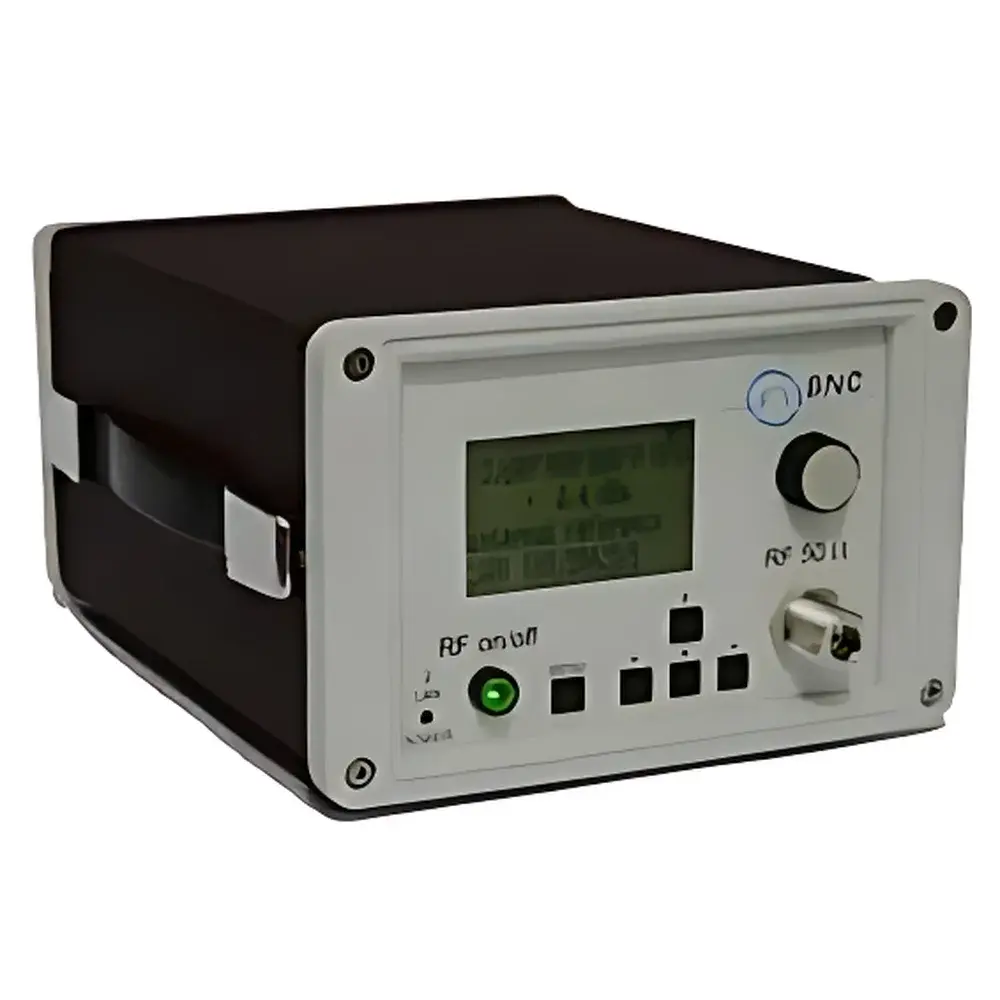
BNC 835-3 Microwave/Radio Frequency Signal Generator
| Brand | BNC |
|---|---|
| Origin | USA |
| Manufacturer Type | Authorized Distributor |
| Origin Category | Imported |
| Model | BNC 835-3 |
| Pricing | Available Upon Request |
Overview
The BNC 835-3 Microwave/Radio Frequency Signal Generator is a high-performance, benchtop RF source engineered for precision timing-critical applications in research laboratories, defense electronics test environments, and biomedical instrumentation development. Operating across a continuous frequency range extending from DC to 3 GHz (with harmonic-rich output up to 6 GHz), the instrument leverages direct digital synthesis (DDS) architecture combined with analog voltage-controlled oscillator (VCO) stages to deliver exceptional spectral purity, sub-nanosecond edge fidelity, and deterministic phase behavior. Its core design emphasizes low-jitter triggering (< 25 ps RMS typical), fast rise/fall times (< 1 ns into 50 Ω), and stable amplitude control—making it particularly suitable for time-domain reflectometry (TDR), pulsed radar simulation, laser diode driver synchronization, and ultrafast photodetector characterization. Unlike general-purpose function generators, the 835-3 implements true microwave-grade signal integrity through impedance-matched 50 Ω BNC outputs, internal temperature-compensated reference oscillators, and rigorous EMI-shielded RF section layout.
Key Features
- DC–3 GHz fundamental output range with harmonics usable up to 6 GHz
- Programmable pulse width (1 ns–10 s), delay (0–10 s), and repetition rate (1 mHz–100 MHz)
- Low-jitter trigger input/output (< 25 ps RMS jitter, 50 Ω terminated)
- AM, FM/PM, and pulse modulation with independent depth, rate, and shape control
- Internal battery option enabling portable operation without AC line dependency
- Full SCPI 1999-compliant command set over USB, Ethernet (LXI Class C), and RS-232 interfaces
- Graphical user interface (GUI) with real-time waveform preview, multi-channel timing correlation, and script-based sequence generation
- External reference locking capability (1–10 MHz or 10 MHz sine/square) supporting phase-coherent multi-instrument synchronization
- Auto-calibrating output level compensation across frequency and temperature (±0.3 dB typical accuracy from –40 dBm to +13 dBm)
Sample Compatibility & Compliance
The BNC 835-3 is designed for integration into automated test equipment (ATE) platforms and regulated R&D workflows. Its hardware and firmware comply with IEC 61000-4 electromagnetic compatibility standards, UL 61010-1 safety requirements for laboratory equipment, and RoHS 2 Directive 2011/65/EU material restrictions. For traceable calibration, the unit supports NIST-traceable adjustment points accessible via service mode; factory calibration certificates include uncertainty budgets per ISO/IEC 17025 guidelines. In regulated environments—including those adhering to FDA 21 CFR Part 11, DoD MIL-STD-461G, or ISO 13485—the device supports audit-ready logging of all remote commands, user authentication events, and configuration changes when operated in secure GUI mode with role-based access control enabled.
Software & Data Management
BNC provides the proprietary SignalStudio software suite, compatible with Windows 10/11 (64-bit) and macOS 12+, which enables full instrument control, waveform editing (including arbitrary waveform import in CSV, MATLAB .mat, or binary formats), and batch sequence scripting using Python 3.9+ bindings. All generated waveforms and instrument states are saved in HDF5 format with embedded metadata (timestamp, user ID, calibration epoch, environmental sensor readings). The software includes built-in FFT analysis, eye diagram overlays, and jitter decomposition tools aligned with IEEE Std 181-2011. Remote sessions maintain full audit trail integrity, including timestamped command logs, parameter change history, and exportable PDF reports compliant with GLP/GMP documentation standards.
Applications
- Synchronization of ultrafast optical components (e.g., EO modulators, streak cameras, superconducting nanowire single-photon detectors)
- Stimulus generation for RF component characterization (filters, amplifiers, mixers) under pulsed bias conditions
- Time-of-flight measurement systems requiring sub-nanosecond trigger alignment across distributed sensors
- Neurostimulation waveform development for preclinical electrophysiology studies
- Calibration source for time-interval analyzers and high-speed digitizers (≥ 1 GS/s)
- EMI immunity testing using modulated RF carriers per IEC 61000-4-3 and -4-6
- Quantum computing control stack validation (qubit gate timing, flux pulse shaping)
FAQ
Does the BNC 835-3 support external clock synchronization?
Yes—it accepts variable-frequency external references from 1 MHz to 10 MHz via dedicated BNC input, enabling phase-locked operation across multiple instruments in a synchronized testbed.
Is arbitrary waveform generation available on all output channels?
The primary RF output channel supports full arbitrary waveform synthesis up to 500 MSa/s sample rate; secondary TTL/CMOS outputs provide synchronized gating and trigger signals derived from the same timing engine.
Can the instrument be integrated into LabVIEW or MATLAB environments?
Yes—NI-VISA-compatible SCPI drivers and native MATLAB Instrument Control Toolbox support are provided, along with example scripts for waveform streaming and closed-loop feedback control.
What is the standard calibration interval recommended by BNC?
Annual calibration is recommended for metrology-grade use; however, internal self-diagnostics and reference oscillator drift monitoring allow extended intervals up to 18 months under controlled lab conditions per ISO/IEC 17025 Annex A.3 guidance.
Related Products