
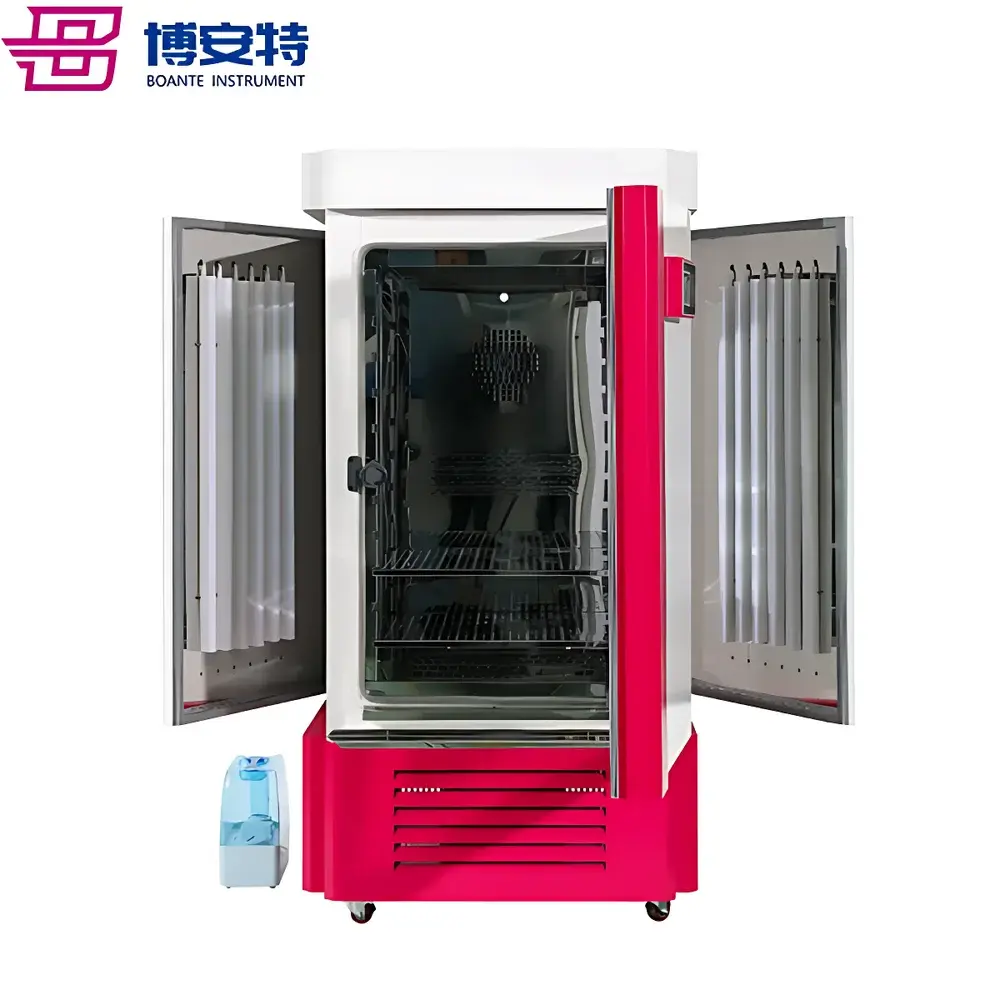
Boante BAT-Series Multi-Dimensional Programmable Light-Intensity & Environmental Control Incubator
| Brand | Boante |
|---|---|
| Model | BAT180/280/360/460/600GZ-4M & BAT180/280/360/460/600QH-4M |
| Temperature Range | 5–50 °C (10–50 °C with illumination) |
| Temperature Uniformity | ±1.0 °C (at same shelf level) |
| Humidity Range | 40–80 %RH (with lights ON) |
| Humidity Control Accuracy | ±1 %RH |
| Illuminance Range | 0–20,000 lx (7-step programmable intensity, measured at 100 mm from LED source) |
| Light Spectrum | 4000 K white LED, mounted on three inner door surfaces |
| Chamber Volume | 180 / 280 / 360 / 460 / 600 L |
| Control System | BAT200PG embedded OS with 5-inch color touchscreen interface |
| Programming | 24-segment time-based profile (real-time clock synchronized) for simultaneous independent control of temperature, humidity, and light intensity |
| Cooling Method | Thermal bypass refrigeration system |
| Safety Protections | Compressor overheat, fan overheat, overtemperature, high-pressure cut-off, overload protection |
| Construction | Double-glazed inner observation door |
Overview
The Boante BAT-Series Multi-Dimensional Programmable Light-Intensity & Environmental Control Incubator is engineered for precision life science applications requiring tightly coordinated regulation of temperature, relative humidity, and spectrally stable illumination. Unlike conventional photoperiod incubators, this system implements a tri-variable closed-loop control architecture—where temperature, humidity, and light output are not operated in isolation but dynamically co-regulated across programmable 24-segment time profiles. Its core measurement and actuation framework relies on high-stability Pt100 temperature sensors, capacitive humidity transducers calibrated per ISO 17025 traceable standards, and factory-calibrated silicon photodiode arrays for illuminance feedback. The system operates on a thermally isolated chamber with triple-layer insulation and a patented thermal-bypass refrigeration circuit that eliminates compressor cycling during steady-state operation—ensuring continuous thermal stability and extending service intervals. Designed for GLP-compliant laboratories, the incubator supports audit-ready environmental logging and meets structural requirements for long-term cell culture, plant phenotyping, microbial growth studies, and circadian rhythm research under reproducible photobiological conditions.
Key Features
- Tri-variable programmable control: Independent yet synchronized scheduling of temperature (5–50 °C), humidity (40–90 %RH, conditional on illumination state), and light intensity (0–20,000 lx, 7-step resolution)
- BAT200PG embedded operating system with 5-inch capacitive touchscreen interface, supporting real-time parameter visualization and touch-responsive profile editing
- Adaptive three-stage fuzzy logic PID algorithm for temperature regulation—minimizing overshoot and maintaining uniformity of ±1.0 °C across any single shelf plane
- Thermal bypass refrigeration architecture enabling uninterrupted cooling without compressor start-stop cycles, reducing mechanical wear and acoustic emission
- Triple-surface 4000 K white LED array (mounted on left, right, and front inner doors) with spatially uniform irradiance distribution and minimal radiant heat transfer to samples
- Double-glazed observation door with low-emissivity coating preserves internal thermal integrity during visual monitoring
- Four-point humidity calibration routine accessible via service mode; humidity control validated across full operational temperature band (15–45 °C)
- Comprehensive safety suite including compressor overheat detection, evaporator freeze protection, fan failure monitoring, and dual-stage overtemperature cutoff (mechanical + electronic)
Sample Compatibility & Compliance
The BAT-Series accommodates standard ISO/IEC 60068-2 environmental test protocols and is routinely deployed in applications involving Petri dishes, multi-well plates, Erlenmeyer flasks, tissue culture vessels, and hydroponic trays. Its adjustable stainless-steel shelving system (up to four tiers depending on model) permits vertical spacing optimization from 60 mm to 120 mm per shelf, supporting both high-density microplate stacking and volumetric bioreactor placement. All internal surfaces are electropolished 304 stainless steel, compliant with ISO 14644-1 Class 7 cleanroom material specifications. Humidity control performance has been verified per ASTM E104-20 for saturated salt solution validation across the 40–90 %RH range. The unit conforms to IEC 61000-6-3 (EMC emissions) and IEC 61010-1 (safety for laboratory equipment), with CE marking and RoHS compliance documented in the technical file. Optional CO₂ integration (via external module) enables future expansion into pH-stabilized mammalian cell culture workflows.
Software & Data Management
Data acquisition and configuration management are handled through the embedded BAT200PG OS, which logs timestamped environmental records at user-selectable intervals (10 s to 60 min). Logged parameters include chamber air temperature, setpoint deviation, relative humidity, light intensity (lx), compressor duty cycle, and fault event codes. Raw data exports via USB mass storage in CSV format support post-acquisition analysis in MATLAB, Python (Pandas), or LabChart. RS485 Modbus RTU interface allows integration into centralized BMS or LIMS platforms—enabling remote supervision, alarm forwarding, and automated report generation. Optional thermal printer module provides hard-copy verification of critical process windows (e.g., temperature excursions >±1.5 °C for >5 min). Audit trail functionality complies with FDA 21 CFR Part 11 requirements when paired with optional user authentication and electronic signature modules.
Applications
- Plant photomorphogenesis studies under controlled spectral irradiance and diurnal temperature/humidity cycles
- Algal biomass production with dynamic light ramping to optimize photosynthetic efficiency
- Fungal and bacterial colony development assays requiring precise moisture gradients synchronized with light-dark transitions
- Seed germination testing per ISTA guidelines with programmable stratification phases
- Stability testing of biologics and diagnostics reagents under ICH Q1A(R3) intermediate storage conditions
- Circadian clock entrainment experiments in Drosophila or zebrafish larvae using tunable photoperiod waveforms
- Quality control of light-sensitive pharmaceutical intermediates per USP photostability protocol
FAQ
Does the incubator support independent control of light intensity and spectrum?
Yes—the current BAT-Series uses fixed-color 4000 K white LEDs with 7-step digital dimming. Spectral flexibility (e.g., red/blue ratio tuning) requires the optional LED multi-spectral module, available as BAT-QS add-on.
Can humidity be maintained while lights are active?
Yes—humidity range is specified as 40–80 %RH with illumination ON, validated at all temperature setpoints between 15–45 °C.
Is the system compatible with networked lab infrastructure?
Standard RS485 Modbus RTU enables integration with building management systems; Ethernet/WiFi connectivity is available via optional gateway module (BAT-NET-01).
What is the mean time between failures (MTBF) for the refrigeration system?
Based on accelerated life testing under continuous 25 °C/60 %RH operation, MTBF exceeds 32,000 hours for the hermetic compressor and thermal bypass valve assembly.
Are calibration certificates provided with shipment?
Each unit ships with a factory calibration report traceable to NIM (National Institute of Metrology, China) for temperature and humidity sensors; third-party ISO/IEC 17025 calibration is available upon request.




