
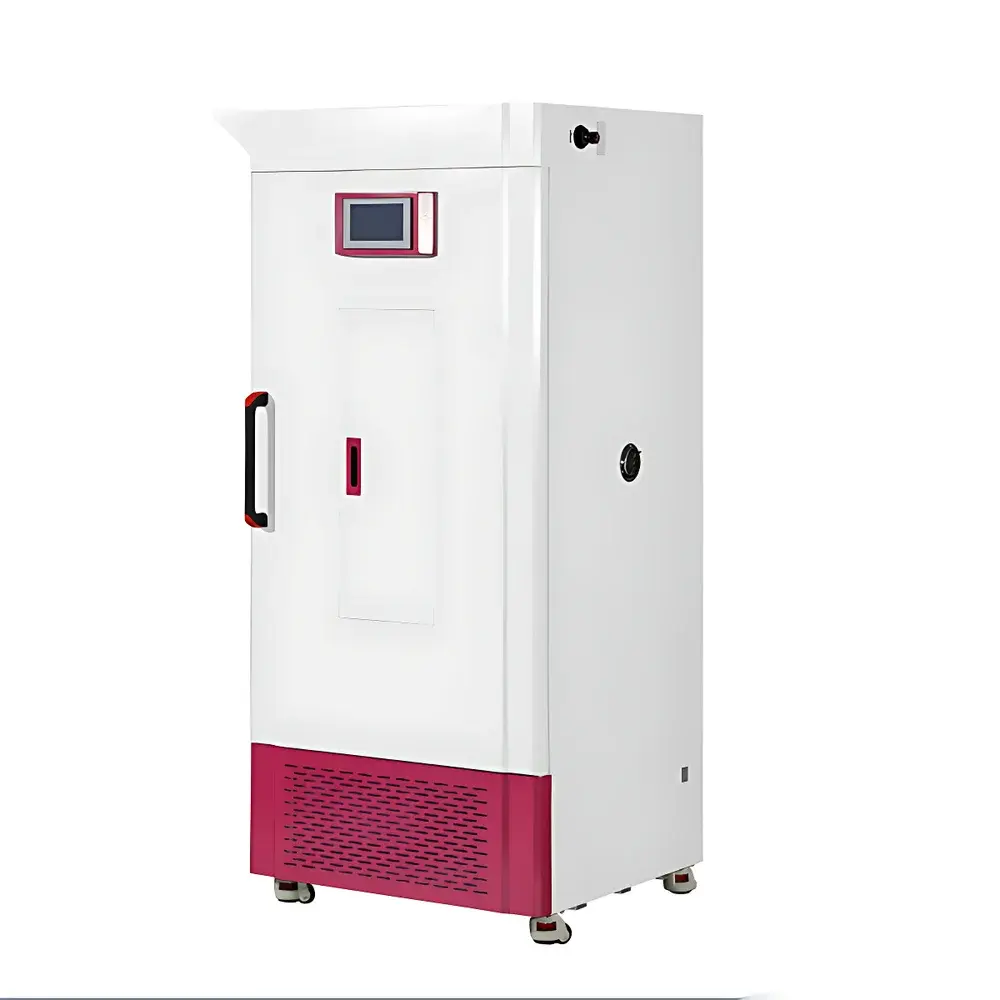
Boante BAT360-GZ Top-Mount LED Dimmable Plant Growth Chamber
| Brand | Boante |
|---|---|
| Model | BAT360-GZ |
| Temperature Range | 5–50 °C |
| Illumination Intensity | 0–600 μmol/m²/s (0–100% stepless dimming) |
| Uniformity | ±1 °C (within same shelf level) |
| Temperature Accuracy | ±0.1 °C |
| Control System | BAT200PG OS with 7-inch color touchscreen |
| Programmability | 24-segment time-temperature-light-humidity profile |
| Cooling Method | Hot-gas bypass refrigeration |
| Light Source Mounting | Top-mounted, horizontal, per-shelf independent control |
| Shelf Configuration | Adjustable spacing and quantity |
| Safety | Dual-limit temperature protection, compressor/fan overheat, overpressure, overload, and short-circuit safeguards |
| Data Logging | Internal storage ≥5 years |
| Compliance | Supports GLP-compliant audit trails (via optional USB/R485 data export), meets ISO 17025 environmental monitoring prerequisites for plant physiology labs |
Overview
The Boante BAT360-GZ Top-Mount LED Dimmable Plant Growth Chamber is a precision-engineered environmental control system designed for reproducible, long-term plant phenotyping, seed germination studies, photobiology research, and controlled-environment agriculture (CEA) trials. It operates on the principle of active thermal regulation combined with spectrally tunable, spatially isolated photosynthetic photon flux density (PPFD) delivery. Unlike conventional side- or rear-illuminated chambers, its top-mounted LED array ensures vertical light incidence—mimicking natural solar geometry—and eliminates shadowing artifacts across multi-tier cultivation zones. The chamber integrates a dual-loop thermal management architecture: a primary PID-controlled refrigeration circuit with hot-gas bypass modulation enables continuous cooling without compressor cycling, while a secondary adaptive fuzzy logic algorithm suppresses thermal overshoot and maintains intra-chamber uniformity within ±1 °C at any setpoint between 5 °C and 50 °C. This stability is critical for circadian rhythm studies, vernalization protocols, and stress-response assays where microthermal deviations directly impact gene expression profiles.
Key Features
- Top-mounted, horizontally aligned LED lighting system with per-shelf independent dimming (0–600 μmol/m²/s PPFD, 0–100% stepless control)
- BAT200PG operating system with 7-inch capacitive touchscreen interface and intuitive graphical programming environment
- 24-segment programmable protocol engine supporting concurrent scheduling of temperature, illumination intensity, and relative humidity (for QH-series variants)
- Adaptive three-stage fuzzy PID temperature controller with anti-overshoot compensation and real-time thermal mapping feedback
- Hot-gas bypass refrigeration technology enabling uninterrupted operation, reduced mechanical wear, and extended compressor service life
- Modular shelf design: height-adjustable, load-rated aluminum layer plates with standardized mounting rails for custom payload distribution
- Dual safety architecture: primary electronic limit thermostat + secondary hardware-based thermal cutoff (independent of main controller)
- Comprehensive fault diagnostics: self-identifying error codes for compressor, fan, sensor, and power anomalies; on-screen troubleshooting guidance
- Four-tier password hierarchy (Factory Admin / Lab Manager / Operator / Service Engineer) enforcing role-based access control per GLP/GMP requirements
- Internal non-volatile memory storing ≥5 years of timestamped temperature, light intensity, and operational status logs (1-min resolution)
Sample Compatibility & Compliance
The BAT360-GZ accommodates standard plant growth vessels—including Petri dishes, Magenta boxes, square pots (up to 15 cm × 15 cm footprint), hydroponic rafts, and tissue culture racks—across two independently addressable shelves (540 mm W × 600 mm D × 1200 mm H internal volume). Its top-illumination geometry ensures uniform photon distribution across flat-surface samples without edge falloff or inter-shelf optical crosstalk. For regulatory environments, the system supports traceable data integrity via optional R485/USB interfaces compliant with ASTM E2500-21 (Good Practice in Equipment Qualification) and ISO/IEC 17025:2017 Clause 7.7 (Data Management). When configured with humidity control (QH variant), it satisfies USP environmental stability testing criteria for botanical extract storage validation. All firmware versions undergo periodic verification against NIST-traceable reference sensors during factory calibration.
Software & Data Management
Data acquisition and configuration are managed exclusively through the embedded BAT200PG OS—no external PC dependency required for routine operation. The controller records all critical parameters (chamber air temperature, LED drive current, ambient pressure, runtime hours) at user-defined intervals (1 sec to 60 min), with automatic timestamping synchronized to GPS-derived UTC via optional Wi-Fi module. Export options include encrypted CSV via USB flash drive or real-time streaming over RS485 to SCADA or LIMS platforms. Audit trail functionality complies with FDA 21 CFR Part 11 Annex 11 requirements when paired with third-party electronic signature modules. Remote monitoring is supported via Boante’s secure cloud portal (accessed through authenticated web browser or dedicated iOS/Android app), enabling push notifications for alarm conditions and historical trend visualization with linear regression overlays.
Applications
- Photomorphogenesis studies requiring precise spectral and temporal light control (e.g., phytochrome A/B activation kinetics)
- Controlled abiotic stress screening: drought simulation (via integrated RH control in QH models), cold acclimation, and heat shock response profiling
- Seed dormancy release assays under defined thermoperiods and photoperiods
- Microgreen and sprout production optimization under GMP-aligned environmental documentation
- Algal biomass cultivation with wavelength-specific LED spectra (optional multi-channel RGB+FR+UV configurations)
- Pre-clinical botanical drug stability testing per ICH Q1A(R2) guidelines
- University teaching labs conducting inquiry-based plant physiology experiments with repeatable environmental replication
FAQ
What is the maximum PPFD achievable at the bottom shelf surface?
Measured at 100 mm below the LED panel (standard working distance), the BAT360-GZ delivers up to 600 μmol/m²/s. Actual values at sample level depend on shelf height adjustment and reflectivity of container surfaces.
Can the system maintain temperature stability during extended power interruptions?
Yes—the controller retains program state and clock time for up to 72 hours after power loss. Upon restoration, it resumes operation from the exact point of interruption with no manual reinitialization required.
Is third-party calibration certification available?
Boante provides optional UKAS-accredited calibration certificates (traceable to NPL standards) for temperature and irradiance sensors, including uncertainty budgets per ISO/IEC 17025.
Does the chamber support CO₂ enrichment integration?
CO₂ control is available as a factory-installed option (BAT360-GZ-CO₂ model) featuring mass flow controllers, infrared gas analyzers, and fail-safe venting logic compliant with EN 61000-6-4 EMC standards.
How is light uniformity validated across the cultivation area?
Each unit undergoes factory PPFD mapping using calibrated quantum sensors at 9-point grid (per shelf), with reportable uniformity ≤±5% across central 80% of the illuminated area.




