
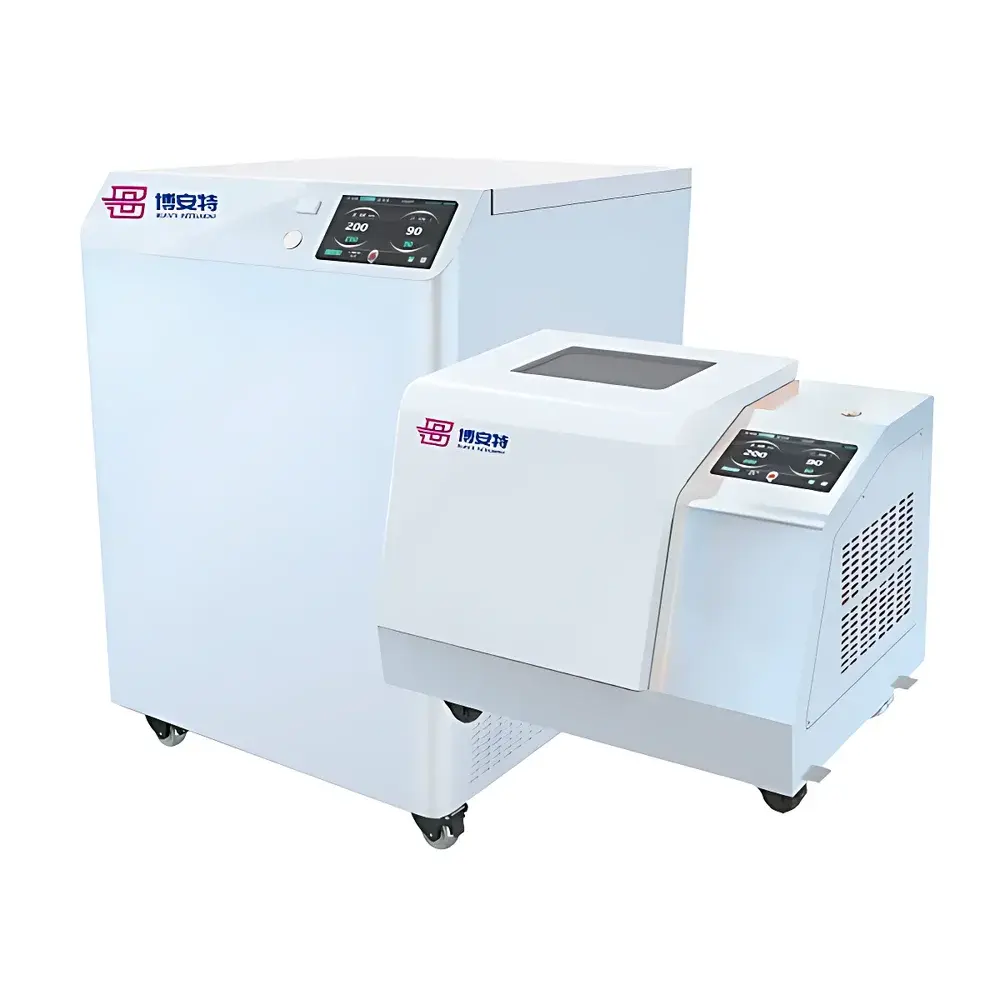
Boante Grind-4GLD Intelligent Planetary Cryogenic Ball Mill
| Brand | Boante |
|---|---|
| Origin | Hubei, China |
| Model | Grind-4GLD |
| Instrument Type | Planetary Ball Mill |
| Maximum Sample Volume | 4 × 1000 mL |
| Minimum Final Particle Size | 0.1 µm |
| Feed Size | ≤10 mm (soil), ≤3 mm (other materials) |
| Main Disc Speed | 50–400 rpm |
| Grinding Jar Speed | 100–800 rpm |
| Transmission Ratio (Main Disc | Jar): 1 : −2 |
| Direction Control | Forward/Reverse |
| Emergency Stop | Yes |
| Continuous Operation Time Range | 1–9999 min |
| Pause Duration Range | 1–9999 min |
| Programmable Steps | 30-segment bidirectional sequence |
| Grinding Modes | Dry, Wet, Cryogenic (optional liquid nitrogen jacket or chiller integration) |
| Inert Atmosphere Compatibility | Yes (via sealed jar with gas inlet/outlet) |
| Compliance | CE |
Overview
The Boante Grind-4GLD Intelligent Planetary Cryogenic Ball Mill is an engineered solution for high-efficiency, reproducible mechanical comminution of temperature-sensitive and heterogeneous samples across life science, materials research, and industrial quality control laboratories. Operating on the principle of planetary motion—where grinding jars rotate around their own axes while simultaneously revolving around a central sun wheel—the system generates intense kinetic energy through combined impact, shear, and friction forces. This multi-force mechanism enables rapid size reduction of hard, brittle, fibrous, or elastic materials without thermal degradation, especially when coupled with cryogenic cooling (−196 °C via optional liquid nitrogen jacket or integrated chiller). Unlike conventional vibratory or centrifugal mills, the Grind-4GLD’s dual-axis kinematics deliver superior homogeneity and scalability, supporting both analytical-scale preparation (e.g., RNA/DNA extraction from frozen tissue) and process development (e.g., alloying of metallic powders or synthesis of nanocomposites).
Key Features
- Intelligent bidirectional programmability: 30-step sequences with independent forward/reverse rotation control per step, enabling optimized energy input distribution and reduced agglomeration in cohesive samples.
- Cryogenic compatibility: Integrated mounting interface for liquid nitrogen cooling jackets or external recirculating chillers (−40 °C to −196 °C), preserving thermolabile biomolecules and inhibiting phase transformation in metastable materials.
- Dual-stage vibration isolation: Patented double-layer damping structure minimizes transmission of operational vibrations (<65 dB(A) at 1 m), ensuring stability in shared lab environments and preventing interference with adjacent sensitive instrumentation (e.g., electron microscopes or mass spectrometers).
- High-integrity sample containment: Quick-clamp tube fixation system with calibrated torque feedback reduces jar breakage probability to <5 × 10⁻⁵ per run—critical for hazardous, regulated, or irreplaceable biospecimens.
- Modular grinding vessel ecosystem: Interchangeable jars (100–500 mL) and media made from stainless steel, zirconia, agate, tungsten carbide, PTFE, or polyurethane—selected based on hardness, chemical inertness, and contamination thresholds per application.
- Safety-certified architecture: CE-marked design incorporating hardware-based emergency stop, real-time motor current monitoring, lid-open interlock, and overheat protection for continuous unattended operation up to 9999 minutes.
Sample Compatibility & Compliance
The Grind-4GLD accommodates diverse sample classes—including plant/animal tissues, microbial cultures (bacteria, yeast, spores), soil, pharmaceutical excipients, polymers, ceramics, alloys, and geological matrices—without cross-contamination or compositional alteration. Its cryogenic capability meets ISO 20387:2018 requirements for biobanking sample integrity and supports GLP-compliant workflows under FDA 21 CFR Part 11 when paired with audit-trail-enabled software (see Software & Data Management). All wet-grinding configurations comply with ASTM E2934–22 for particle size analysis sample preparation, while inert-gas purging (N₂, Ar) ensures oxygen-sensitive reactions (e.g., Li-ion battery cathode synthesis) proceed under controlled atmospheres.
Software & Data Management
The embedded controller supports USB export of full operational logs—including speed profiles, direction transitions, elapsed time, pause intervals, and thermal status (when equipped with PT100 sensor)—formatted as CSV for traceability. Optional PC-based software (Boante MillControl Suite v3.2) provides remote scheduling, parameter validation against predefined SOP templates, electronic signature capture, and automated report generation aligned with ISO/IEC 17025 documentation standards. Audit trails record user ID, timestamp, parameter changes, and execution outcomes—fully compliant with GMP Annex 11 and 21 CFR Part 11 data integrity requirements.
Applications
- Molecular biology: Homogenization of flash-frozen tissues for downstream nucleic acid and protein isolation (e.g., TRIzol-compatible protocols).
- Pharmaceutical development: Milling of API-excipient blends for dissolution testing; amorphous solid dispersion preparation.
- Materials science: Mechanochemical synthesis of MOFs, perovskites, and high-entropy alloys; grain refinement of metal powders prior to SLM/EBM additive manufacturing.
- Environmental analysis: Preparation of certified reference materials (CRMs) for heavy metal speciation in soils and sediments (EPA Method 6010D).
- Food safety: Rapid cell lysis of pathogenic bacteria (e.g., Salmonella, Listeria) for PCR-based detection without enzymatic pretreatment.
- Geosciences: Pulverization of rock cores and mineral aggregates for XRD/XRF quantitative analysis per ASTM D7581.
FAQ
What types of cryogenic cooling are supported?
Liquid nitrogen jackets (manual fill) and closed-loop recirculating chillers (−40 °C minimum) are both compatible via standardized flange interfaces.
Can the instrument operate under inert atmosphere?
Yes—sealable grinding jars with gas inlet/outlet ports enable N₂ or Ar purging to prevent oxidation during milling of reactive metals or air-sensitive catalysts.
Is method validation support available?
Boante provides IQ/OQ documentation templates and collaborates with third-party labs for PQ protocol development per ISO/IEC 17025.
What maintenance intervals are recommended?
Gearbox lubrication every 1,000 operating hours; vibration damper inspection every 6 months; jar sealing ring replacement after 500 cycles or visible wear.
Does the system meet electromagnetic compatibility (EMC) standards?
Yes—CE certification includes EN 61326-1:2013 for laboratory equipment EMC and EN 61000-6-3:2011 for emission limits.



