
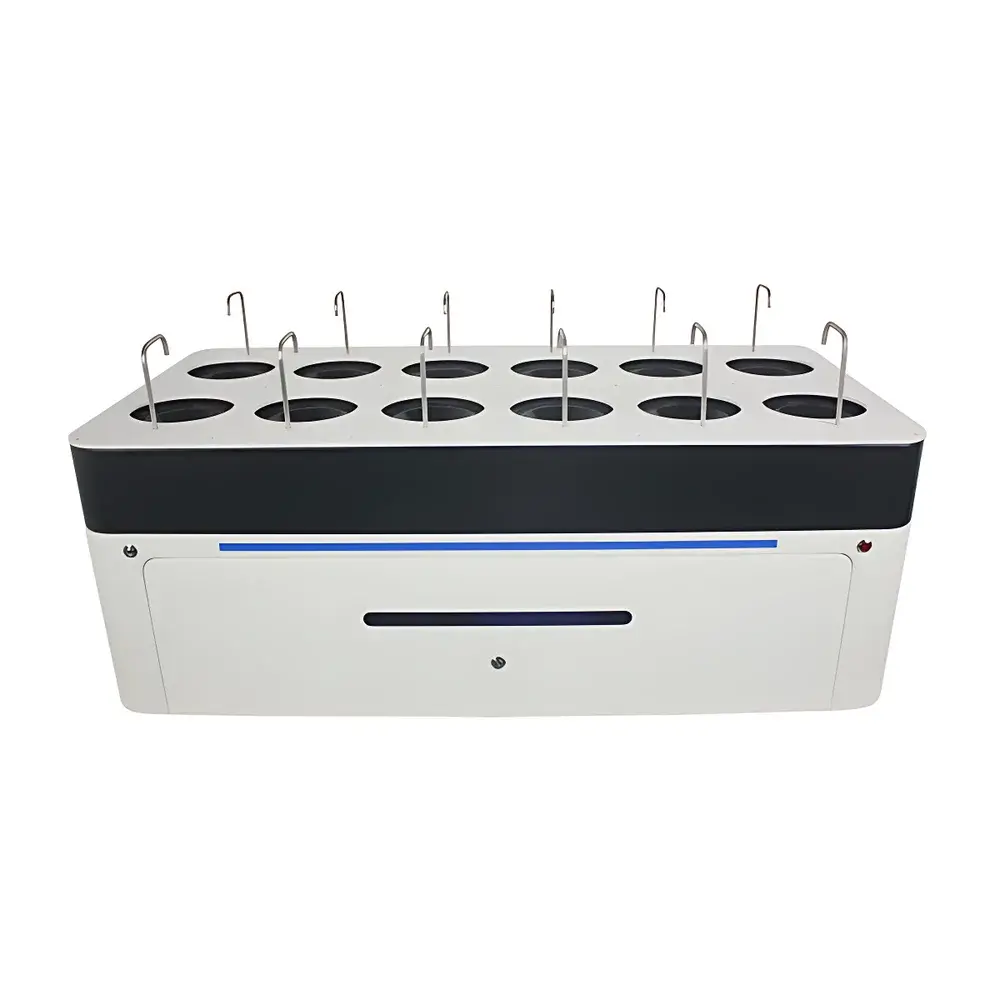
Bode BLC-12 Automated Alpha/Beta Total Radioactivity Water Sample Evaporator
| Brand | Bode |
|---|---|
| Origin | Beijing, China |
| Manufacturer Type | Direct Manufacturer |
| Region Classification | Domestic (China) |
| Model | BLC-12 |
| Pricing | Available Upon Request |
Overview
The Bode BLC-12 Automated Alpha/Beta Total Radioactivity Water Sample Evaporator is a purpose-engineered, 12-channel benchtop system designed for unattended, quantitative evaporation and acid digestion (‘acid removal’) of large-volume aqueous samples prior to gross alpha and beta radioactivity analysis. It operates on the principle of controlled far-infrared radiant heating—providing uniform thermal energy distribution across sample vessels without direct contact or convective turbulence—thereby minimizing isotopic volatilization loss and ensuring high reproducibility in residue mass recovery. The system integrates three core functional modules: a digitally regulated far-infrared heating array, a programmable peristaltic liquid handling station for sequential or parallel sample introduction, and a gravimetric or volumetric endpoint detection system for precise concentration termination (e.g., to fixed residual volume or dryness). It complies with the operational requirements of national standard methods including GB/T 5750.13–2023 (Standard Methods for Examination of Drinking Water – Radioactivity), HJ 898–2017 (Environmental Monitoring Technical Specification for Gross Alpha and Beta Activity in Water), and ISO 9697:2022 (Water quality — Test method for gross alpha and gross beta activity concentrations).
Key Features
- 12 independent, simultaneously operable evaporation channels with individual thermal zoning and real-time temperature monitoring (range: ambient to 250 °C, resolution ±1 °C)
- Far-infrared heating elements with adjustable power output (0–100% in 1% increments), enabling optimized thermal profiles for volatile radionuclides (e.g., 210Po, 222Rn progeny) and non-volatile isotopes (e.g., 90Sr, 137Cs)
- Automated sample loading via programmable peristaltic pump manifold—supports up to 12 × 1000 mL water samples or 24 × 250 mL aliquots per batch
- Endpoint control options: gravimetric (integrated high-precision balance, readability 0.1 mg) or volumetric (optical level sensing + meniscus detection)
- Integrated acid fume management: built-in PTFE-lined exhaust duct with optional connection to central lab ventilation or activated carbon filtration unit
- Industrial-grade PLC-based control architecture with IP65-rated enclosure, emergency stop circuitry, overtemperature cutoff, and door-interlocked safety shutdown
- Full audit trail logging compliant with GLP and ISO/IEC 17025 requirements—including user ID, timestamp, setpoints, actual temperatures, mass/volume readings, and error codes
Sample Compatibility & Compliance
The BLC-12 accommodates standard 100–1000 mL quartz, borosilicate glass, or PFA evaporating dishes (diameter 60–120 mm). It is validated for use with drinking water, surface water, groundwater, industrial effluents, seawater, precipitation, airborne dust leachates, and low-activity nuclear process waters. All wetted materials are chemically inert and low-background—certified for radiometric traceability (U/Th ≤ 0.1 pg/g). The system supports method validation per ASTM D7283–22 (Standard Test Method for Gross Alpha and Gross Beta Radioactivity in Water) and fulfills data integrity requirements under FDA 21 CFR Part 11 when paired with Bode’s optional LIMS-integrated software module.
Software & Data Management
The embedded HMI interface (7″ color touchscreen) provides intuitive batch programming, real-time channel status visualization, and deviation alerts. Optional Bode EvapControl™ PC software enables remote monitoring, multi-user role-based access control (administrator/operator/auditor), electronic signature capture, and automated report generation (PDF/CSV) compliant with ISO 17025 Clause 7.8. All raw sensor data—including temperature curves, mass trends, and pump actuation logs—are stored locally on encrypted SD card and synchronized to network drives with configurable retention policies (default: 36 months). Audit trails are immutable and exportable for regulatory review.
Applications
- Gross alpha/beta radioactivity determination in environmental and potable water per national regulatory frameworks (e.g., China’s MEE Order No. 48, US EPA Method 900 series)
- Pre-concentration of large-volume samples (up to 12 L total per run) for subsequent alpha spectrometry or liquid scintillation counting (LSC)
- Automated TDS (Total Dissolved Solids) determination in compliance with ISO 25662:2021 and GB/T 5750.4–2023
- Controlled evaporation of air particulate filter leachates (e.g., PM10, PM2.5) for gamma spectroscopy or radiochemical separation
- Acid matrix removal (HNO3, HCl, HF) from digested environmental solids prior to ICP-MS or radiometric assay
FAQ
Does the BLC-12 support method validation documentation for ISO/IEC 17025 accreditation?
Yes—factory-issued IQ/OQ documentation, calibration certificates traceable to NIM (National Institute of Metrology, China), and performance verification reports against reference standards (e.g., KCl solutions of known activity) are provided.
Can the system be integrated into an existing laboratory information management system (LIMS)?
Yes—via OPC UA or HL7-compliant API; Bode provides documented interface specifications and supports custom field mapping for result ingestion.
What maintenance intervals are recommended for long-term operational reliability?
Heating element inspection every 12 months; peristaltic pump tubing replacement every 6 months or 500 cycles; annual full-system calibration and background radiation verification.
Is the instrument suitable for Class II radiochemistry laboratories handling >10 Bq/mL activity levels?
Yes—the enclosed design, negative-pressure operation, and optional lead-shielded viewing window meet IAEA SSG-46 requirements for low-to-intermediate activity sample processing.



