
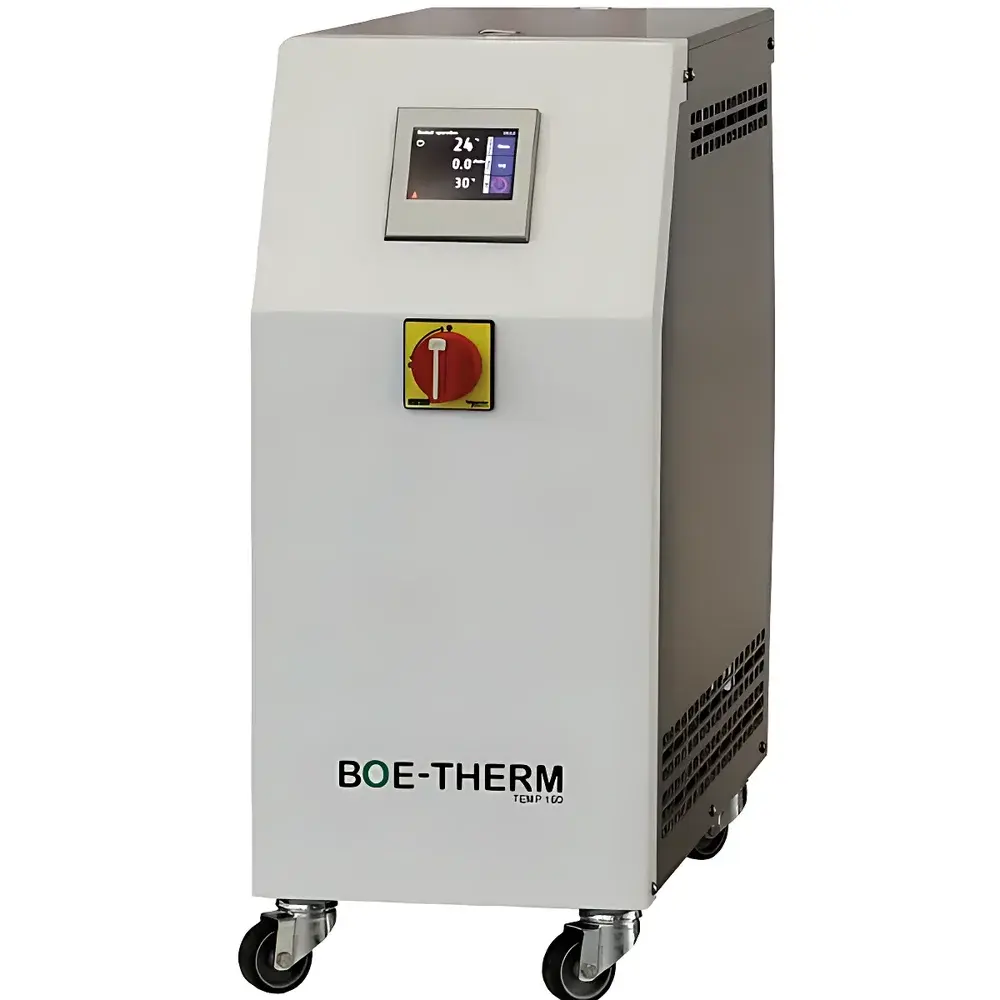
BOE-THERM TEMP 350 High-Temperature Thermal Oil Temperature Control Unit
| Brand | BOE-THERM |
|---|---|
| Origin | Denmark |
| Model | TEMP 350 |
| Max. Operating Temperature | 350°C (±1.2°C PID control) |
| Heating Power Options | 9–36 kW |
| Thermal Fluid | YD-450 series synthetic heat transfer oil |
| Insulation Efficiency | <2.5% heat loss |
| System Pressure | Micro-positive pressure ≤4.5 bar |
| Noise Level | ≤55 dB(A) |
| Protection Rating | IP54 (control cabinet) / IP66 (heating chamber) |
| Pump Types | P3 (≤18 kW) / P4 (≤36 kW) |
| Max. Flow Rate | 66 L/min |
| Max. Discharge Pressure | 3.4 bar (P3) / 4.4 bar (P4) |
| Cooling Capacity at ΔT=250°C | 36 kW (I2) / 72 kW (I4) |
| Heat Exchange Area | 3.2 m² (I2) / 6.4 m² (I4) |
| Electrical Supply | 3-phase 400 V, 50 Hz (optional 480 V, 60 Hz) |
| Certifications | CE (EN 60204-1:2018, EN 60519-1:2015), ATEX II 2G Ex db IIC T4, PED 2014/68/EU, ISO 9001:2015 |
Overview
The BOE-THERM TEMP 350 is a high-performance thermal oil temperature control unit engineered for industrial processes requiring precise, stable, and repeatable thermal management at extreme operating temperatures up to 350°C. Based on closed-loop conduction heating principles, it circulates specially formulated synthetic heat transfer fluid (YD-450 series) through external process equipment—such as molds, reactors, or test chambers—while maintaining tight temperature regulation via advanced PID control with ±1.2°C accuracy. Its design integrates aerospace-grade insulation materials and a micro-positive pressure circulation system (≤4.5 bar), minimizing thermal losses to less than 2.5% under continuous operation. The unit complies with stringent European safety and pressure equipment directives, including PED 2014/68/EU and ATEX Zone 1 explosion protection requirements (II 2G Ex db IIC T4), making it suitable for use in chemical processing, composite curing, high-temperature material testing, and aerospace component heat treatment applications where thermal integrity and operational safety are non-negotiable.
Key Features
- Ultra-high temperature capability: Continuous operation at 350°C with robust thermal stability and low drift over extended cycles
- Aerospace-derived multilayer insulation architecture reducing standby and operational heat loss to <2.5%
- Micro-positive pressure hydraulic system ensuring consistent flow dynamics, eliminating vapor lock and enhancing pump longevity
- Explosion-proof operator interface (ATEX-certified) with tactile feedback controls and emergency stop integration
- Industrial-grade acoustic optimization achieving ≤55 dB(A) noise emission—compatible with controlled laboratory and cleanroom-adjacent environments
- Dual-pump configuration support: P3-type (max. 3.4 bar, ≤18 kW) and P4-type (max. 4.4 bar, ≤36 kW), both delivering up to 66 L/min flow rate
- Modular cooling system options (I2 standard / I4 reinforced) with scalable heat rejection capacity (36–72 kW at ΔT = 250°C) and enlarged heat exchange surface area (3.2–6.4 m²)
- Full electrical compliance: CE-marked per EN 60204-1:2018 (safety of machinery) and EN 60519-1:2015 (electrical equipment for industrial heating)
Sample Compatibility & Compliance
The TEMP 350 is designed to interface with externally mounted process loops using standardized BSP connections: 1/2″ BSP for high-temperature fluid supply/return and 3/8″ BSP for cooling water inlet/outlet. It supports integration with third-party instrumentation—including external PT100 sensors (via dedicated input terminals)—enabling synchronized monitoring across distributed thermal systems. All internal wetted components are constructed from stainless steel 316L and high-temp elastomers rated for continuous exposure to YD-450 synthetic oil. The unit meets ISO 9001:2015 quality management standards and is fully traceable per PED 2014/68/EU requirements for pressure-bearing assemblies. Documentation packages include EU Declaration of Conformity, risk assessment reports, and technical files available upon request for GMP/GLP audit readiness.
Software & Data Management
While the TEMP 350 operates primarily via its embedded PLC-based controller, it provides comprehensive digital connectivity for supervisory integration and regulatory compliance. Standard communication interfaces include 4–20 mA analog outputs (for temperature, pressure, and power status), 20 mA current loop for remote alarm signaling, and optional fieldbus protocols: Profibus-DP, Profinet (IRT-capable), EtherNet/IP, and DeviceNet. All digital I/O channels support configurable scaling and fail-safe behavior mapping. The system logs runtime parameters—including cumulative operating hours, thermal cycle counts, and alarm event timestamps—with non-volatile storage supporting FDA 21 CFR Part 11-compliant electronic record retention when deployed with validated SCADA or MES platforms. Audit trails are timestamped, user-identifiable, and immutable post-recording.
Applications
- High-temperature composite autoclave preheating and cure cycle control
- Precision thermal aging of polymer composites and ceramic matrix materials
- Calibration and validation of high-range temperature sensors and reference standards
- Thermal simulation of engine component stress testing under realistic exhaust manifold conditions
- Process heating for specialty chemical synthesis requiring sustained >300°C reaction environments
- Die-casting mold temperature stabilization in aluminum and magnesium alloy production
- Research-scale pyrolysis and thermal decomposition studies in academic and national laboratories
FAQ
What is the maximum allowable setpoint deviation during steady-state operation at 350°C?
The system maintains ±1.2°C tolerance under full-load conditions, verified per EN 60519-1 Annex D thermal performance testing protocol.
Can the TEMP 350 be integrated into a central plant SCADA system?
Yes—standard 4–20 mA outputs and optional Profinet/EtherNet/IP modules enable direct integration with most industrial automation platforms without gateway hardware.
Is external oil expansion tank mounting supported?
Yes. External reservoir configurations are factory-configured per heating power tier (e.g., 11 L for 24–36 kW models) and include level-sensing interlock circuits.
Does the unit support gradient cooling profiles?
Yes. Programmable ramp-down sequences (including multi-step linear and logarithmic gradients) are enabled via optional software license and external HMI configuration.
What maintenance intervals are recommended for the P4 high-pressure circulation pump?
First service inspection at 2,000 operating hours; thereafter every 4,000 hours or annually—whichever occurs first—per ISO 13374 condition monitoring guidelines.
Related Products






