
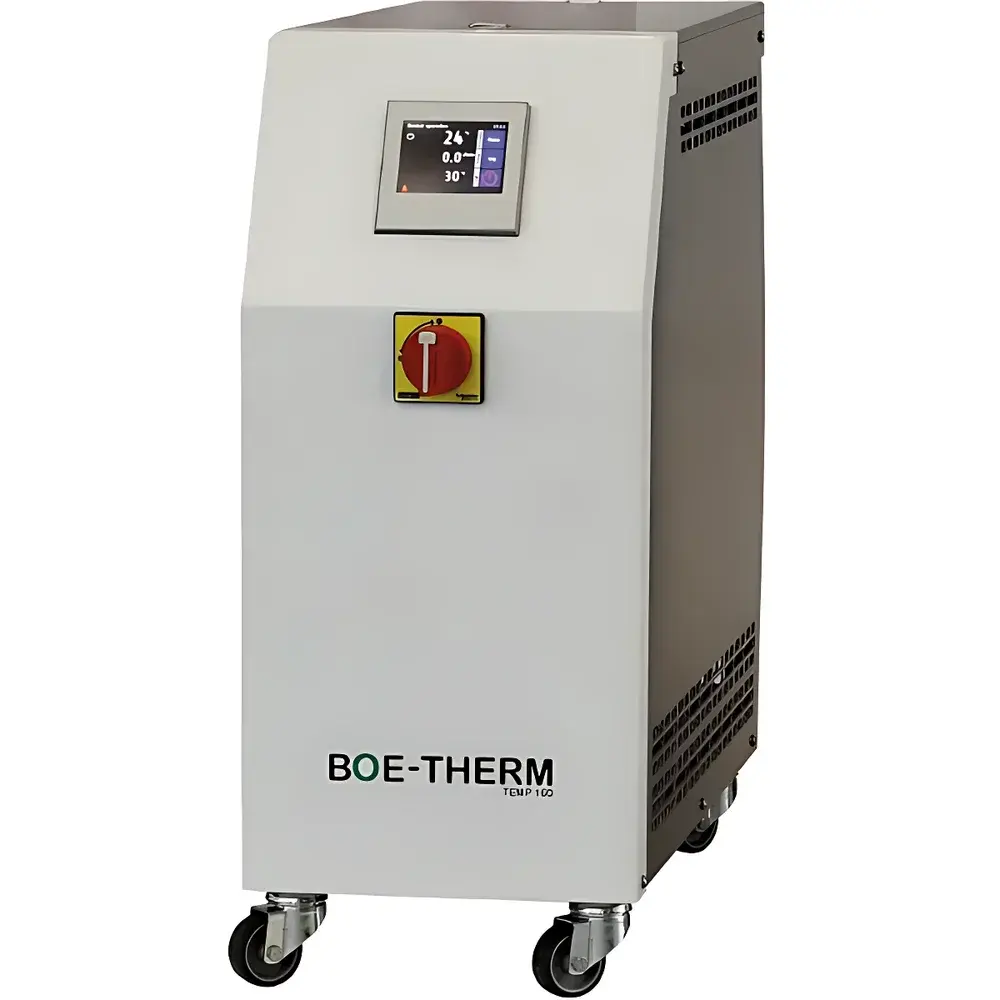
BOE-THERM Temp_160S_Touch High-Temperature Pressurized Circulating Chiller
| Brand | BOE-THERM |
|---|---|
| Origin | Denmark |
| Model | Temp_160S_Touch |
| Max. Operating Temperature | 160°C (±0.5°C) |
| Heating Power | 4.5 kW (expandable to 9/13.5/18 kW) |
| Pump Type | Magnetically Driven Centrifugal Pump (Q9) |
| Max. Flow Rate | 90 L/min |
| Max. Pressure | 8.0 bar |
| Cooling Capacity (B4) | 81 kW |
| Heat Transfer Medium | Ultrapure Water (>15 MΩ·cm) |
| System Volume | 6 L (with expansion compensation) |
| Power Supply | 3-phase 400 V / 50 Hz or 460 V / 60 Hz |
| Dimensions (L×W×H) | 680 × 270 × 640 mm |
| Noise Level | ≤65 dB(A) at 1 m |
| Certifications | CE (2014/35/EU), UL (E492831), ISO 9001:2015 |
Overview
The BOE-THERM Temp_160S_Touch is a high-precision, pressurized circulating temperature control unit engineered for demanding laboratory and industrial applications requiring stable thermal management at elevated temperatures—up to 160°C under pressure. Unlike conventional water baths or low-temperature chillers, this system operates on a closed-loop thermodynamic principle: it circulates ultrapure water (resistivity >15 MΩ·cm) as the heat transfer medium within a sealed, pressure-rated circuit. The integration of a magnetically coupled centrifugal pump (Q9 model) eliminates mechanical seals, ensuring zero fluid leakage—a critical requirement for cleanroom environments, semiconductor process validation, and pharmaceutical R&D where contamination must be avoided. Thermal stability is maintained via solid-state relay (SSR) heating control and an integrated automatic pressure relief mechanism, enabling safe, repeatable operation across extreme ΔT conditions. Designed and manufactured in Denmark, the unit complies with stringent European safety directives and supports continuous operation under GLP/GMP-aligned workflows.
Key Features
- Magnetically driven Q9 centrifugal pump delivering up to 90 L/min flow at 8.0 bar maximum working pressure—ideal for high-thermal-load systems such as laser diode cooling, reactor jacketing, or calorimeter calibration.
- Precision temperature control with ±0.5°C accuracy at 160°C, achieved through PID-regulated SSR heating and real-time feedback from dual Pt100 sensors (one in reservoir, one in return line).
- Modular cooling architecture supporting multiple configurations (I2/I4/B2/B4); B4 variant provides 81 kW cooling capacity at 120°C differential—enabling rapid cooldown after high-temperature setpoints.
- Touchscreen HMI with intuitive navigation, multilingual interface (English, German, French, Chinese), and onboard data logging (timestamped temperature, pressure, flow, power consumption).
- Acoustically optimized enclosure achieving ≤65 dB(A) at 1 meter—suitable for shared lab spaces without dedicated mechanical rooms.
- Expansion-compensated 6 L reservoir with integrated degassing and level monitoring; compatible only with ultrapure water to prevent scaling, corrosion, or conductivity drift.
Sample Compatibility & Compliance
The Temp_160S_Touch is not a sample analysis instrument but a thermal control platform—its compatibility is defined by the thermal interface between the unit and external equipment. It interfaces seamlessly with jacketed reactors, spectroscopic cells, material testing chambers, and optical benches requiring precise, pressurized liquid circulation. As a Class I electrical device conforming to EN 61000-6-3 (EMC) and EN 61000-6-4 (immunity), it carries CE marking under Directive 2014/35/EU (Low Voltage Directive) and UL certification (E492831). Manufacturing quality follows ISO 9001:2015 procedures. While not intrinsically rated for hazardous areas, its leak-free magnetic drive and pressure-relief design support use in ISO Class 5–7 cleanrooms and USP compliant analytical instrument qualification protocols.
Software & Data Management
The embedded controller supports Modbus RTU (RS485) and optional Ethernet/IP communication for integration into SCADA or LIMS environments. Logged operational data—including temperature setpoint deviation, pump runtime, cooling duty cycle, and alarm history—is exportable via USB stick in CSV format. Audit trail functionality meets basic FDA 21 CFR Part 11 requirements when paired with user-defined access controls and electronic signature policies implemented at the facility level. No cloud connectivity or proprietary SaaS platform is included; all firmware updates are delivered as signed .bin files with SHA-256 verification.
Applications
- Calibration of high-temperature reference sensors (e.g., Pt1000, thermocouples) per ASTM E230/E1137 standards.
- Thermal conditioning of optical components during interferometric testing where refractive index stability depends on sub-0.1°C uniformity.
- Process simulation for chemical synthesis reactors operating above 100°C, particularly in flow chemistry and catalysis studies.
- Accelerated aging tests per IEC 60068-2-14 (change of temperature) and MIL-STD-810H Method 502.7.
- Support of high-power LED and VCSEL thermal testing in photonic packaging labs requiring dynamic load cycling between 20°C and 160°C.
FAQ
What heat transfer fluid is required—and why is ultrapure water mandatory?
Ultrapure water with resistivity >15 MΩ·cm is strictly required to prevent electrochemical corrosion, mineral deposition, and dielectric breakdown in high-voltage or ultra-low-noise instrumentation environments. Glycols or oils are incompatible due to thermal degradation above 120°C and viscosity-induced pump cavitation.
Can the unit operate continuously at 160°C?
Yes—provided ambient conditions remain within specified limits (max. 35°C ambient, 60% RH), cooling capacity is matched to thermal load (e.g., B4 configuration for >60 kW dissipation), and maintenance intervals (every 6 months) are observed per the service manual.
Is remote monitoring supported out of the box?
Standard RS485 Modbus RTU enables third-party SCADA integration; optional Ethernet/IP module adds TCP/IP capability. No built-in web server or mobile app is provided.
How does the automatic pressure relief function integrate with facility safety systems?
The mechanical pressure relief valve (set at 8.5 bar) operates independently of electronics and vents directly to a designated drain line. Electrical interlocks can be configured via dry-contact outputs to halt downstream processes upon activation.
What documentation is supplied for IQ/OQ validation?
Factory test reports (including temperature uniformity maps, pressure decay tests, and calibration certificates traceable to DKD/DAkkS), user manual, and FAT/SAT checklists are included. Protocol templates for GxP environments are available upon request.





