
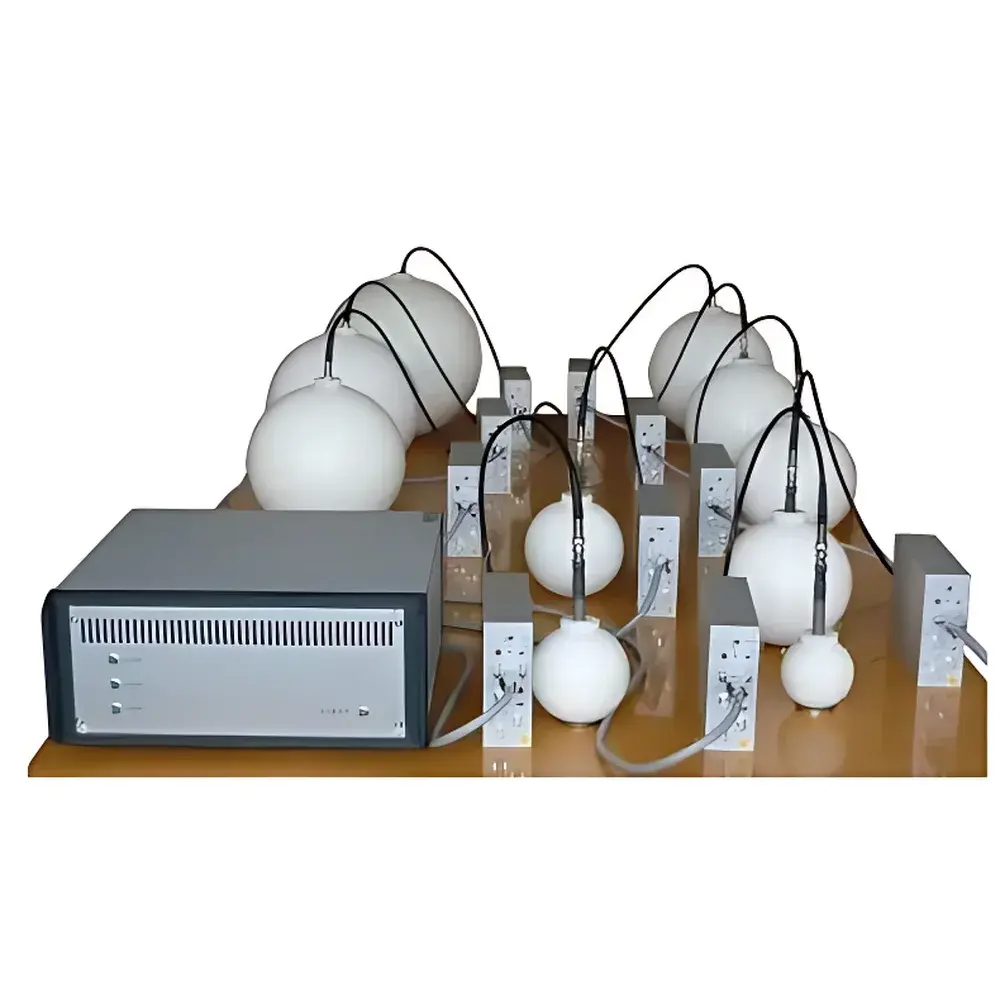
Bonner Sphere Spectrometer (BSS) – Bonner Model by Bonner Instruments (Italy)
| Origin | Italy |
|---|---|
| Manufacturer Type | Authorized Distributor |
| Origin Category | Imported |
| Model | Bonner |
| Instrument Type | Laboratory-Based Neutron Spectrometer |
| Detector Material | Lithium-Based (e.g., ⁶LiI, ⁶Li-glass, ⁶Li-doped plastic scintillator) |
| Radiation Type | Neutron |
| Energy Range | 0.05 MeV – 20 MeV |
| Sensitivity | 0.05 cps/(n·cm⁻²·s⁻¹) |
| Moderator Geometry | Spherical polyethylene shells (5–18 spheres, diameters 0–35 cm) |
| Central Thermal Neutron Detector | ⁶LiI(Eu), ⁶Li-glass, BF₃ or ³He proportional counter |
| Application Domain | Workplace neutron dosimetry, calibration reference, spectral unfolding |
Overview
The Bonner Sphere Spectrometer (BSS) – Bonner Model is a laboratory-grade neutron energy spectrometer engineered for precise characterization of unknown neutron fields in mixed-radiation environments. Based on the well-established Bonner sphere principle, this instrument employs a set of spherical polyethylene moderators of varying diameters (0–35 cm), each enclosing a thermal neutron-sensitive detector—typically ⁶LiI(Eu) scintillators, ⁶Li-glass, boron- or lithium-doped plastic scintillators, BF₃, or ³He proportional counters. When exposed to a neutron field, neutrons are moderated to thermal energies within each sphere; the resulting thermal neutron count rate is recorded and used as input for spectral unfolding algorithms. The system’s response matrix—calibrated against monoenergetic and quasi-monoenergetic neutron sources—is essential for reconstructing the incident neutron energy distribution from the multisphere measurement set. This capability is critical where radiation protection relies on accurate ambient dose equivalent H*(10) estimation, as the radiation weighting factor wR for neutrons varies significantly with energy—from ~2.5 below 100 keV to ~20–30 between 1 MeV and 10 MeV per ICRP Publication 103.
Key Features
- Modular spherical moderator design: 5–18 interchangeable polyethylene spheres (diameters 0–35 cm), enabling broad energy coverage from 0.05 MeV to 20 MeV
- Lithium-based thermal neutron detection: High intrinsic efficiency and gamma discrimination via pulse-shape analysis or spectral gating (depending on detector variant)
- Traceable calibration: Response functions validated against ISO 8529-1:2008 reference neutron fields and NIST-traceable sources
- Robust mechanical architecture: Precision-machined aluminum support frames and alignment fixtures ensure reproducible detector positioning and minimal perturbation of neutron fluence
- Low-background shielding options: Optional cadmium or borated polyethylene collars for enhanced thermal neutron suppression in high-background environments
Sample Compatibility & Compliance
The Bonner Model BSS is designed for use in controlled laboratory and health physics settings—including nuclear research facilities, accelerator laboratories, reactor halls, and regulatory metrology institutes. It complies with key international standards governing neutron spectrometry and dosimetry: ISO/IEC 17025:2017 (general requirements for competence of testing and calibration laboratories), ISO 8529-2:2021 (reference neutron radiations—procedures for characterization), and IEC 61000-4-3 (EMC immunity for radiation measurement instrumentation). Its application supports compliance with occupational exposure limits defined in IAEA Safety Standards Series No. GSR Part 3 and EU Directive 2013/59/Euratom. While not intended for real-time personal monitoring, it serves as a primary reference for validating albedo-type personal dosimeters and calibrating survey meters in neutron fields above 10 keV—where conventional TLD or CR-39 etch-track detectors exhibit strong energy dependence.
Software & Data Management
The system integrates with industry-standard spectral unfolding software packages—including MAXED, GRAVEL, and FRUIT—via ASCII or binary export of count-rate vectors and associated uncertainty matrices. Raw acquisition data is timestamped and stored with full metadata (sphere ID, detector type, HV setting, live time, background subtraction flag). Software workflows support iterative regularization, covariance propagation, and uncertainty quantification per ANSI/ANS-6.1.2 guidelines. Audit trails comply with GLP/GMP principles: all processing steps—including detector efficiency corrections, dead-time compensation, and background subtraction—are logged with user ID, timestamp, and version-controlled algorithm parameters. Export formats include IAEA NEA/NSC-compliant .SPC files and CSV-compatible dose conversion coefficient tables aligned with ICRP 74 and ICRU Report 57.
Applications
- Ambient neutron spectrum characterization around medical LINACs, proton therapy nozzles, and BNCT facilities
- Reference calibration of neutron rem meters (e.g., Andersson-Braun, WENDI-II) and electronic personal dosimeters
- Validation of Monte Carlo transport simulations (MCNP, GEANT4, FLUKA) in complex geometries
- Dose reconstruction for retrospective assessment following accidental neutron exposures
- Supporting accreditation audits for ISO/IEC 17025 neutron calibration laboratories
FAQ
What neutron energy range does the Bonner Model cover, and how is low-energy sensitivity ensured?
The instrument measures neutrons from 0.05 MeV to 20 MeV. Sub-keV sensitivity is achieved through the smallest moderator spheres (≤5 cm diameter) combined with high-efficiency ⁶Li-based scintillators optimized for thermal neutron capture cross-section and light yield.
Can the system be used for field measurements outside the laboratory?
While primarily designed for laboratory use, portable configurations—with lightweight moderator shells and battery-powered DAQ units—are available under custom configuration (subject to local regulatory approval for transport of radioactive calibration sources).
Is spectral unfolding performed onboard or externally?
Unfolding is performed externally using validated PC-based software. The spectrometer itself provides only raw, energy-independent count rates per sphere; no proprietary firmware-based inversion is embedded.
How often must the system be recalibrated?
Annual calibration against reference neutron fields is recommended. Detector gain stability and moderator dimensional integrity are verified quarterly via check-source measurements (e.g., ²⁴¹Am–Be) and intercomparison exercises.
Does the system meet FDA 21 CFR Part 11 requirements for electronic records?
Yes—when deployed with compliant LIMS integration and configured with electronic signatures, audit trails, and role-based access control, the data acquisition and processing chain satisfies 21 CFR Part 11 for regulated pharmaceutical and medical device applications involving neutron irradiation validation.







