
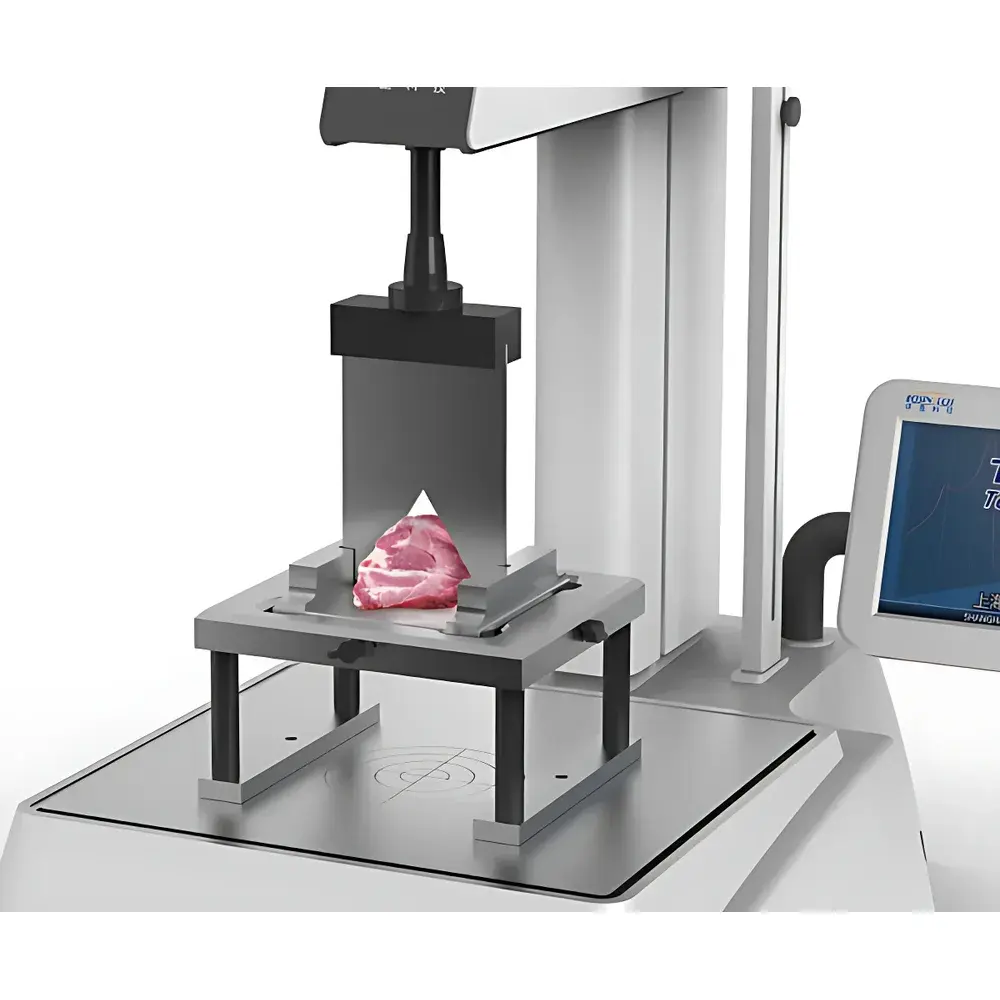
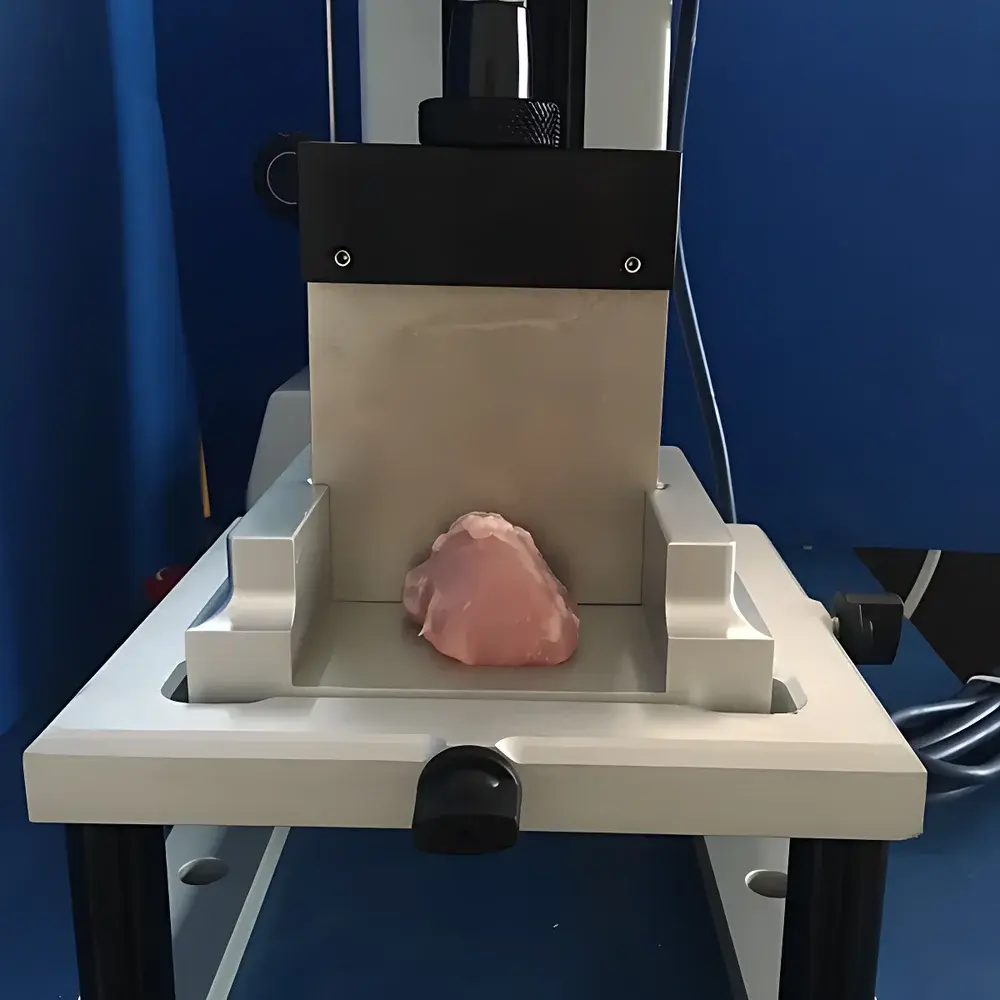
Bosin BS Warner-Bratzler Shear Force Texture Analyzer
| Brand | Bosin |
|---|---|
| Model | BS |
| Origin | Shanghai, China |
| Compliance | NY/T 1180–2006 (PRC Agricultural Industry Standard) |
| Max Load Capacity | ≥49 N |
| Force Resolution | ≤0.0098 N |
| Force Accuracy | ±0.02% FS |
| Shear Blade Thickness | 3.0 ± 0.2 mm |
| Blade Included Angle | 60° |
| Triangular Cut Height | ≥35 mm |
| Core Sampler Aperture Width | 4.0 ± 0.2 mm |
| Shear Speed | 1.0 mm/s |
| No-Load Shear Force | ≤0.147 N |
| Calibration Traceability | Certified Standard Weights (±0.1% deviation) |
Overview
The Bosin BS Warner-Bratzler Shear Force Texture Analyzer is a dedicated mechanical testing instrument engineered for objective quantification of meat tenderness in accordance with the Chinese agricultural industry standard NY/T 1180–2006. It operates on the fundamental principle of Warner-Bratzler shear (WBS), a globally recognized biomechanical method that measures the peak force required to cut through a standardized cylindrical meat core perpendicular to its muscle fiber orientation. This measurement directly correlates with sensory perception of tenderness and serves as a critical quality control metric across beef, pork, lamb, and large avian species processing facilities. The system integrates a high-fidelity load cell, precision-controlled linear actuation, and geometrically specified WBS blade geometry—ensuring metrological consistency, inter-laboratory reproducibility, and compliance-ready documentation.
Key Features
- High-resolution force transduction system with ≤0.0098 N minimum detectable force and ≤0.02% full-scale accuracy, validated using NIST-traceable certified weights (±0.1% deviation tolerance).
- Warner-Bratzler shear blade manufactured to strict dimensional tolerances: 3.0 ± 0.2 mm thickness, 60° included angle, and ≥35 mm internal triangular cut height—ensuring uniform stress distribution during shearing.
- Standardized 4.0 ± 0.2 mm diameter core sampler compatible with ASTM E1847 and ISO 11015 reference protocols for sample preparation.
- Programmable crosshead speed of 1.0 mm/s—aligned with NY/T 1180–2006 and widely adopted international tenderness testing practices.
- Integrated no-load verification routine; maximum residual shear force during unloaded operation remains ≤0.147 N, minimizing baseline drift and ensuring measurement integrity.
- Modular design supporting seamless integration with auxiliary equipment including circulating water baths (for temperature-controlled sample conditioning), thermocouple-based temperature monitoring systems, and vacuum packaging units for pre-test sample stabilization.
Sample Compatibility & Compliance
The Bosin BS analyzer is optimized for cylindrical meat cores (typically 1.27 cm diameter × ≥2.5 cm length) excised from longissimus dorsi, semimembranosus, or pectoralis major muscles following standardized post-mortem aging and thermal equilibration protocols. It complies explicitly with NY/T 1180–2006 for domestic Chinese agricultural certification and aligns functionally with key international frameworks including ASTM E1847 (Standard Test Method for Tenderness of Cooked Meat), ISO 11015 (Sensory analysis—Methodology—General guidance), and USDA-FSIS guidelines for meat quality evaluation. While not inherently 21 CFR Part 11 compliant, its data output structure supports integration into validated LIMS environments where audit trails, electronic signatures, and user access controls are implemented at the enterprise software layer.
Software & Data Management
The analyzer interfaces with Bosin’s proprietary texture analysis software, which captures real-time force–displacement curves at ≥100 Hz sampling rate. Raw data are exported in CSV and Excel-compatible formats, preserving timestamp, operator ID, sample ID, environmental temperature (if linked to external thermocouple input), and calibration metadata. All force values undergo automatic subtraction of no-load baseline (X₀), followed by arithmetic mean calculation across n valid replicates—directly implementing the NY/T 1180–2006 tenderometer equation: X = (ΣXᵢ − X₀)/n. Software logs include version-stamped calibration history, user login records, and parameter lockout functionality to prevent unauthorized test configuration changes—supporting GLP-aligned laboratory documentation requirements.
Applications
- Objective tenderness grading in commercial abattoirs and meat processing plants for beef carcass classification and value-based marketing.
- Research applications in animal science laboratories evaluating genetic selection effects, feed formulation impacts, electrical stimulation efficacy, and post-slaughter aging kinetics.
- Quality assurance workflows for ready-to-eat (RTE) products, marinated meats, and value-added cuts requiring consistent textural performance.
- Method validation studies supporting regulatory submissions to CNCA (China National Certification and Accreditation Administration) and provincial agricultural commodity inspection centers.
- Inter-laboratory proficiency testing programs coordinated under the Ministry of Agriculture and Rural Affairs (MARA) framework.
FAQ
What standard does the Bosin BS Texture Analyzer follow for meat tenderness testing?
It is designed and validated specifically for NY/T 1180–2006, the official People’s Republic of China agricultural industry standard for meat tenderness determination using the Warner-Bratzler shear method.
Can this instrument be used for non-muscle food products such as cheese or tofu?
While mechanically capable of measuring compressive or shear forces on other viscoelastic solids, its blade geometry, test protocol, and software calculation logic are calibrated exclusively for mammalian and avian skeletal muscle tissue per NY/T 1180–2006. Alternative applications require full method revalidation.
Is force calibration traceable to national metrology institutes?
Yes—calibration must be performed using certified standard weights accredited by the China National Institute of Metrology (CNIM) or equivalent NMI-level bodies, with documented uncertainty budgets and certificate retention per ISO/IEC 17025 requirements.
Does the system support automated sample loading or high-throughput operation?
The BS model is a benchtop manual-loading unit. High-throughput configurations require integration with third-party robotic sample handlers, which is feasible via analog/digital I/O ports but falls outside factory-supplied scope.
How frequently should no-load verification be performed?
Per NY/T 1180–2006 Annex B, no-load verification must be conducted before each test session and after any mechanical adjustment or environmental shift exceeding ±2°C—documented in the raw test log.




