
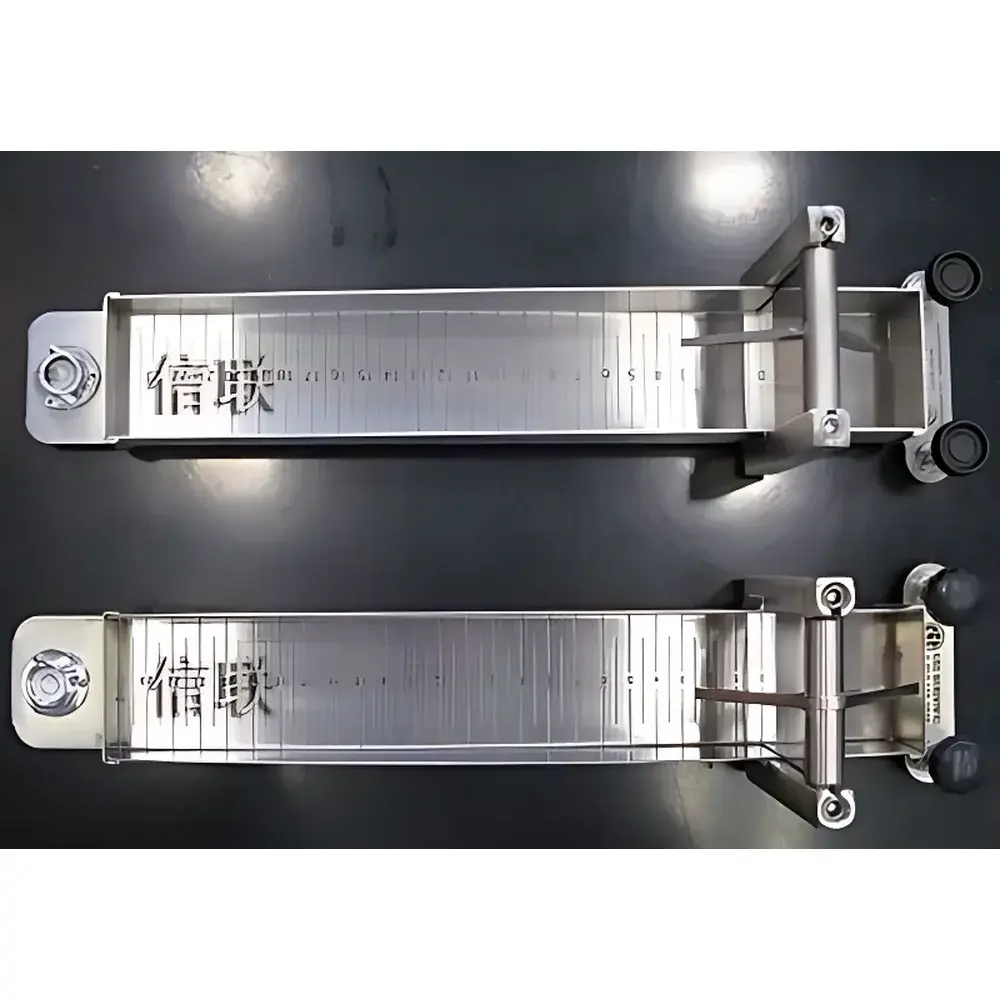
Bostwick Consistometer by Endecotts (UK)
| Origin | UK |
|---|---|
| Manufacturer Type | Authorized Distributor |
| Origin Category | Imported |
| Model | Bostwick Consistometer |
| Instrument Type | Efflux Flow Viscometer |
| Viscosity Range | 0.1–1000 Bostwick units (dimensionless, empirical scale) |
| Construction | Stainless Steel Body |
| Scale Resolution | 0.5 cm per division |
| Leveling | Integrated spirit level with dual adjustable leveling feet |
| Compliance | Designed per ASTM D2196 and ISO 3219 (for flow consistency assessment of semi-solids) |
Overview
The Bostwick Consistometer, manufactured by Endecotts Ltd. (UK), is a precision-engineered, gravity-driven efflux flow instrument designed for rapid, repeatable assessment of consistency and flow behavior in semi-solid, paste-like, and highly viscous materials. Unlike rotational or capillary viscometers that report absolute viscosity in SI units (e.g., Pa·s), the Bostwick method delivers an empirical consistency index—expressed in Bostwick units—based on the distance (in centimeters) a sample flows under its own weight across a calibrated stainless-steel trough within a standardized 30-second interval. This principle aligns with fundamental principles of gravity-driven deformation and yield-controlled flow, making it especially suitable for products exhibiting yield stress, thixotropy, or non-Newtonian behavior—common characteristics in food matrices such as ketchup, yogurt, peanut butter, soy protein isolates, and fruit spreads. Developed in the mid-20th century and refined over decades of industrial use, the instrument embodies robust mechanical design, minimal operator dependency, and high inter-laboratory reproducibility when operated under controlled temperature and conditioning protocols.
Key Features
- Stainless-steel construction ensures corrosion resistance, long-term dimensional stability, and compliance with food-grade hygiene requirements (FDA 21 CFR 178.3570 compatible surfaces).
- Precision-machined trough with engraved scale divisions at 0.5 cm intervals, traceable to NPL (National Physical Laboratory, UK) calibration standards.
- Integrated spirit level and dual-threaded leveling feet enable rapid, accurate horizontal alignment—critical for minimizing gravitational vector error and ensuring measurement repeatability (RSD < 2.5% for homogeneous samples).
- No external power, electronics, or consumables required—ideal for factory-floor QC stations, pilot plants, or field laboratories where portability and operational simplicity are essential.
- Compliant with standardized test durations (typically 30 s) and sample loading protocols defined in ASTM D2196 “Standard Test Methods for Rheological Properties of Non-Newtonian Materials by Rotational (Brookfield) or Efflux (Bostwick) Methods” and referenced in ISO 3219 for consistency evaluation of polymer dispersions and analogous systems.
Sample Compatibility & Compliance
The Bostwick Consistometer is widely adopted across food manufacturing, dairy R&D, and nutraceutical production for routine quality control of products with yield stress > ~10 Pa and apparent viscosity > 10 Pa·s. It accommodates samples with particle loadings up to 40% w/w and solids content ranging from 15% (e.g., low-fat yogurts) to >70% (e.g., concentrated tomato pastes). Sample temperature must be stabilized prior to testing (typically 20 °C or 25 °C per method SOP), as thermal history significantly influences flow onset and spread rate. While not a primary regulatory instrument for pharmacopeial submissions, its data supports internal specification setting aligned with USP (Rheological Measurements) and serves as a documented process parameter in GMP-compliant environments where audit trails for physical property verification are required.
Software & Data Management
The Bostwick Consistometer operates as a standalone mechanical device and does not incorporate embedded firmware or digital output interfaces. However, its measurements integrate seamlessly into modern LIMS and electronic lab notebook (ELN) workflows via manual entry or barcode-scanned SOP execution. Endecotts provides validated paper-based test record templates compliant with GLP documentation standards—including fields for operator ID, ambient temperature/humidity, sample lot number, pre-test equilibration time, and observed flow distance. For automated data capture, third-party vision-based measurement systems (e.g., machine-vision cameras with calibrated pixel-to-mm mapping) may be deployed in high-throughput settings to digitize spread endpoints and calculate Bostwick values with timestamped metadata—enabling full 21 CFR Part 11–compliant audit trails when paired with validated software platforms.
Applications
- Batch release testing of tomato-based sauces against internal specifications (e.g., 8–12 cm flow in 30 s for Grade A ketchup).
- Monitoring texture stability during shelf-life studies of fermented dairy products (e.g., acid-set yogurts, skyr).
- Optimizing hydrocolloid dosage (e.g., xanthan, guar, pectin) in plant-based spreads and meat analogues.
- Verifying consistency of soy protein isolate slurries prior to extrusion or spray-drying.
- Supporting HACCP critical control point (CCP) monitoring for viscosity-sensitive processes in co-packing facilities.
FAQ
What is the difference between Bostwick units and centipoise (cP)?
Bostwick units are dimensionless empirical values representing linear flow distance (cm) in 30 s; they do not convert directly to cP or Pa·s. Correlation requires product-specific calibration against rotational rheometry.
Can the Bostwick Consistometer measure yield stress?
It indirectly indicates yield behavior—if no flow occurs within 30 s, the sample’s yield stress exceeds the gravitational driving force under the test geometry.
Is temperature control built into the instrument?
No—sample temperature must be stabilized externally using water baths or climate-controlled rooms per ASTM D2196 Section 7.2.
How often should the trough be cleaned and recalibrated?
Thorough cleaning with warm water and food-safe detergent after each use is mandatory; annual verification of scale linearity and leveling accuracy against certified reference gauges is recommended.
Does Endecotts provide ISO/IEC 17025-accredited calibration certificates?
Yes—traceable calibration services are available through Endecotts’ UK service center, with certificates issued per ISO/IEC 17025:2017 and referencing UKAS-assigned uncertainty budgets.



