
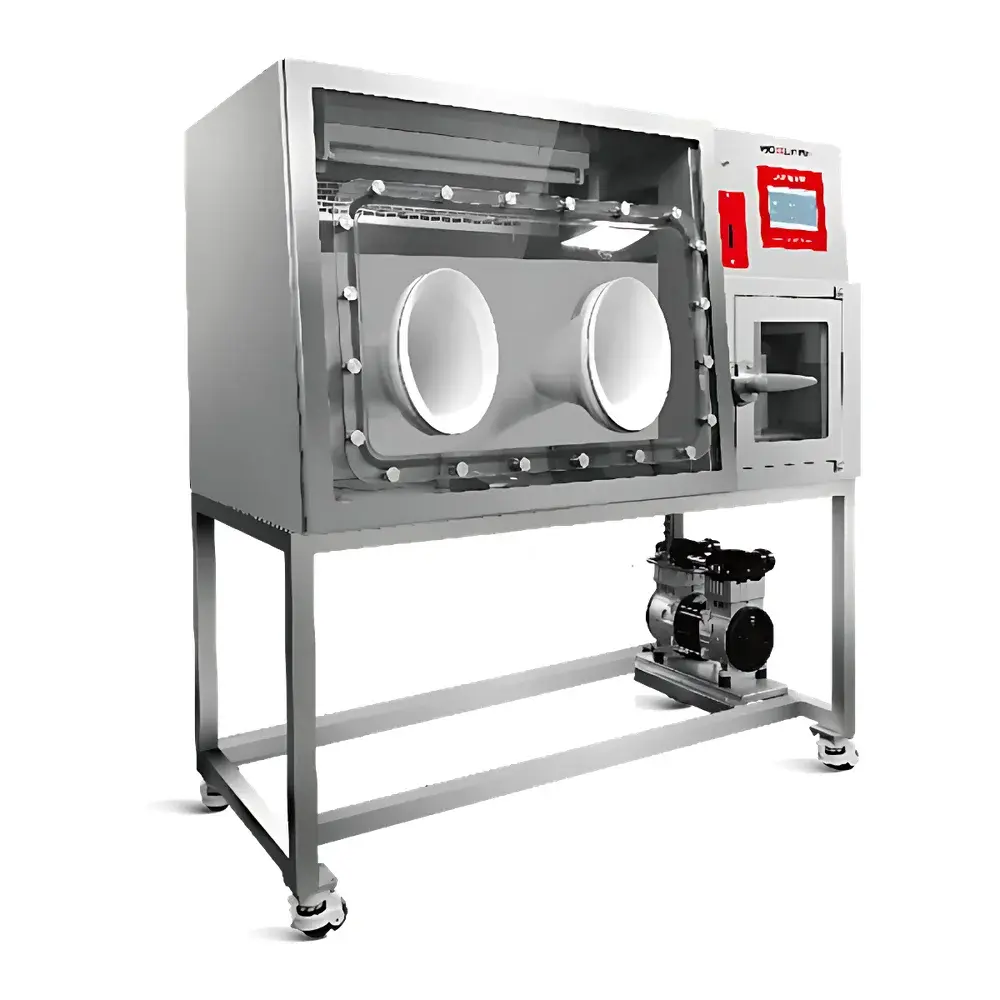
BOXUN BGAW-TS Automated Anaerobic Incubator
| Brand | BOXUN |
|---|---|
| Origin | Shanghai, China |
| Manufacturer Type | Direct Manufacturer |
| Instrument Type | Automated Anaerobic Incubator |
| Oxygen Concentration Range | 0–21% (anaerobic mode ≤0.1%) |
| Temperature Control Range | Ambient +3°C to 60°C |
| Temperature Uniformity | ≤±0.8°C |
| Temperature Fluctuation | ≤±0.3°C |
| Gas Supply Options | 99.99% N₂ |
| Chamber Dimensions (L×W×H, mm) | 425×305×505 |
| Operating Chamber Volume | ~66 L |
| Sample Chamber Dimensions (L×W×H, mm) | 405×335×325 |
| Overall Dimensions (L×W×H, mm) | 1410×740×1380 |
| Power Supply | 220 V, 50 Hz |
| Max Power Consumption | 1500 W |
| Data Logging Interval | 1 s–user configurable |
| Storage Capacity | ≥30 days at default logging interval |
| Vacuum Pump | Oil-free rotary vane pump |
| Safety Features | Dual independent temperature protection, overpressure relief valve, power-loss memory, UV sterilization lamp, internal lighting, 220 V socket |
Overview
The BOXUN BGAW-TS Automated Anaerobic Incubator is an engineered platform for precise, reproducible cultivation of obligate anaerobes, facultative anaerobes, microaerophiles, and capnophiles under rigorously controlled atmospheric conditions. It operates on a dual-chamber vacuum-assisted gas replacement principle—combining sequential evacuation and targeted gas injection—to establish and maintain defined oxygen partial pressures without continuous gas flow. This method ensures high efficiency in gas usage while minimizing operational overhead and environmental impact. The system supports three primary atmospheric configurations: strict anaerobiosis (O₂ ≤0.1%), microaerophilic (O₂ 2–10%), and capnophilic (CO₂-enriched, O₂-adjustable), all programmable via the BRIGHTⅡ operating system. Its design adheres to core requirements for GLP-compliant microbiological research, clinical diagnostics, and pharmaceutical QC workflows where oxygen-sensitive strain viability, metabolic fidelity, and colony morphology integrity are critical.
Key Features
- Automated atmosphere generation: One-touch initiation of anaerobic/microaerophilic environment setup—no manual valve sequencing or vacuum-gas cycling required.
- BRIGHTⅡ touchscreen interface: Full-color 7-inch capacitive display showing real-time O₂, CO₂, temperature, humidity, pressure, and system status with intuitive navigation.
- Dual-chamber architecture: Separated operating chamber (66 L) and sample transfer chamber (43 L) with independent atmosphere control; sample chamber achieves anaerobiosis in ≤15 minutes.
- Precision environmental control: PID-regulated heating with high-uniformity airflow (via efficient axial fan and optimized duct geometry); temperature uniformity ≤±0.8°C, fluctuation ≤±0.3°C across working volume.
- Gas economy optimization: Vacuum-assisted gas exchange reduces total gas consumption by up to 40% compared to continuous-flow systems; stable atmosphere maintained without replenishment post-equilibration.
- Robust safety infrastructure: Independent overtemperature cutoff (mechanical + electronic), pressure-controlled venting valve (settable upper/lower limits), automatic UV decontamination cycle, and fail-safe power-loss memory retaining all user-defined parameters.
- Human-centered ergonomics: Bulletproof acrylic front panel for unobstructed visual monitoring; medical-grade butyl gloves with extended wear comfort; rounded SUS304 stainless steel interior corners for complete cleanability.
Sample Compatibility & Compliance
The BGAW-TS accommodates standard microbiological culture formats—including Petri dishes (up to 150 mm), agar plates, anaerobic jars, test tubes, and small benchtop instruments (e.g., colony pickers, mini-centrifuges) via its integrated 220 V outlet. Its interior chamber complies with ISO 13485-aligned manufacturing practices and meets structural and material requirements specified in CLSI M22-A3 for anaerobic culture systems. While not certified for FDA 21 CFR Part 11 out-of-the-box, the device supports audit-ready data management when paired with validated third-party software—enabling traceable timestamped logs essential for GMP/GLP documentation. All gas lines conform to ASTM D6167 standards for purity verification; hydrogen-containing mixtures are handled per NFPA 55 guidelines with integrated leak detection logic.
Software & Data Management
The embedded BRIGHTⅡ OS provides granular control over incubation protocols—including ramp/soak profiles, multi-step gas transitions, and conditional triggers (e.g., “initiate UV cycle after O₂ <0.2% sustained for 5 min”). Internal flash memory stores ≥30 days of time-stamped sensor data (O₂, CO₂, T, P, RH) at user-selectable intervals (1 s to 60 min). Data export is supported via USB 2.0 port in CSV format, enabling direct import into LIMS, Excel, or statistical analysis platforms. Audit trail functionality records operator ID (via optional RFID login), parameter changes, alarm events, and maintenance timestamps—meeting baseline ALCOA+ principles for data integrity.
Applications
- Clinical microbiology: Isolation and identification of Clostridioides difficile, Bacteroides spp., Fusobacterium nucleatum, and other fastidious anaerobes from stool, wound, and blood cultures.
- Pharmaceutical testing: Anaerobic antimicrobial susceptibility testing (AST) per CLSI M11-A9; sterility testing of injectables and implants under simulated anaerobic bioburden conditions.
- Gut microbiome research: Cultivation of unculturable or oxygen-sensitive strains from fecal microbiota transplants (FMT) and human gut organoids.
- Food safety validation: Enumeration of spoilage anaerobes (Clostridium botulinum, Desulfovibrio spp.) in low-oxygen packaged products.
- Vaccine development: Propagation of anaerobic bacterial vectors and adjuvant stability studies under controlled redox environments.
FAQ
What gas mixtures are supported for anaerobic operation?
The BGAW-TS accepts two certified gas blends: (1) 5% H₂ + 10% CO₂ + 85% N₂ (for catalytic O₂ removal), and (2) ultra-high-purity N₂ (99.99%) for nitrogen-flushed microaerophilic or CO₂-only environments.
Is the system compatible with ISO/IEC 17025-accredited laboratories?
Yes—when operated with documented SOPs, calibrated external sensors (e.g., O₂ analyzers traceable to NIST), and backed by full data export and audit logs, it satisfies technical requirements for accredited microbial testing facilities.
Can the incubator be integrated into a laboratory automation network?
It features RS-485 Modbus RTU and optional Ethernet (TCP/IP) ports for integration with central building management systems (BMS) or lab-wide monitoring platforms.
How is internal contamination prevented between runs?
The system includes a programmable UV-C (254 nm) sterilization cycle (duration/user-defined), combined with smooth-welded SUS304 surfaces and removable drip trays—all validated per EN 17111 for surface bioburden reduction.
Does the device support remote monitoring or alarm notification?
Local audible/visual alarms are standard; remote email/SMS alerts require connection to an external IoT gateway or SCADA system via its serial or Ethernet interface.




