
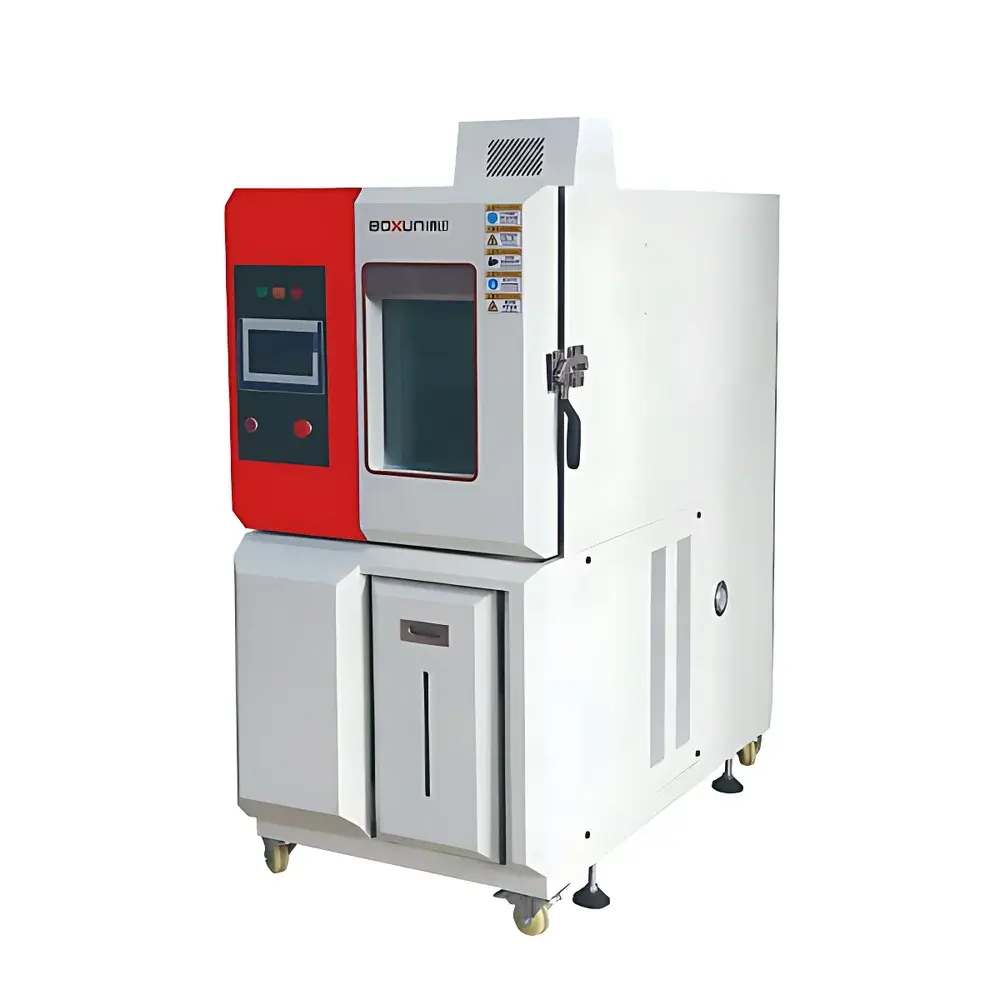
BOXUN BGDS-250A High-Low Temperature Alternating Humidity Chamber
| Brand | BOXUN |
|---|---|
| Origin | Shanghai, China |
| Manufacturer Type | Direct Manufacturer |
| Model | BGDS-250A |
| Temperature Control Range | −20 °C to +150 °C |
| Temperature Resolution | 0.1 °C |
| Temperature Uniformity | ≤ ±2 °C (at 37 °C) |
| Temperature Fluctuation | ≤ ±0.5 °C (at 37 °C) |
| Heating Rate | ≥ 3 °C/min |
| Cooling Rate | ≥ 0.7 °C/min |
| Humidity Range | 20–98 %RH |
| Humidity Resolution | 0.1 %RH |
| Humidity Fluctuation | ±2–3 %RH |
| Inner Chamber Dimensions (W×D×H) | 600 × 550 × 750 mm |
| External Dimensions (W×D×H) | 800 × 1180 × 1850 mm |
| Net Volume | 250 L |
| Power Supply | 220 V AC |
| Rated Power | 5 kW |
| Sound Pressure Level | ≤ 70 dB(A) |
| Compliance Standard | GB/T 10586–2006, GB/T 2423.1–2423.4 |
Overview
The BOXUN BGDS-250A High-Low Temperature Alternating Humidity Chamber is an engineered environmental test system designed for precise simulation of dynamic thermal and hygrometric stress conditions in accordance with international and national standards—including GB/T 2423.1 (cold), GB/T 2423.2 (dry heat), GB/T 2423.3 (constant damp heat), and GB/T 2423.4 (cyclic damp heat). Its dual-zone refrigeration architecture—featuring imported energy-efficient compressors and high-efficiency axial fans—enables stable, repeatable control across a wide operational envelope: −20 °C to +150 °C and 20–98 %RH. The chamber employs a surface-evaporation humidification system physically isolated from the test chamber interior, minimizing contamination risk and eliminating condensate carryover into the workspace. This design ensures long-term reliability, low maintenance frequency, and consistent humidity delivery under continuous operation protocols required by GLP and GMP-aligned laboratories.
Key Features
- 7-inch high-resolution capacitive touchscreen interface with intuitive icon-based navigation and real-time graphical display of temperature/humidity profiles
- BRIGHT II adaptive control algorithm—dynamically adjusts PID parameters based on ambient load variations and chamber thermal inertia to maintain setpoint fidelity
- Integrated data logging system with non-volatile memory storing ≥10,000 timestamped records; exportable via USB in read-only .CSV format compliant with 21 CFR Part 11 audit trail requirements
- Multi-segment programmable cycling (up to 99 segments per program) with user-defined ramp rates, dwell times, and transition logic between temperature/humidity states
- Independent airflow modulation system with adjustable vane diffusers ensuring uniform air distribution (≤ ±2 °C spatial deviation at 37 °C) and zero dead zones
- Multi-point temperature calibration capability—supports up to 5 independent offset corrections across the operating range without requiring factory recalibration
- Comprehensive safety architecture: dual-stage overtemperature cutoff, door-open interlock, sensor fault detection, compressor overheating protection, fan thermal shutdown, low-water alarm, and leakage current monitoring
- Dedicated validation port (Φ25 mm) for traceable NIST-traceable probe insertion during IQ/OQ/PQ qualification
Sample Compatibility & Compliance
The BGDS-250A accommodates a broad spectrum of sample types—including electronic assemblies, polymer components, pharmaceutical packaging, automotive ECUs, and aerospace composites—within its 250 L stainless-steel 304 inner chamber. All structural and control subsystems comply with GB/T 10586–2006 “Technical Specifications for Damp Heat Test Chambers” and meet the mechanical, thermal, and humidity performance criteria defined in IEC 60068-2 series and MIL-STD-810H Method 502.6 (low temperature), Method 503.6 (high temperature), and Method 507.6 (humidity). Optional accessories—including stainless-steel shelves, cable ports, and internal lighting—support customization for regulatory validation workflows under ISO/IEC 17025 or FDA QSR environments.
Software & Data Management
The embedded controller firmware supports local data visualization (real-time curve overlay, historical trend replay) and secure external communication via RS485 Modbus RTU protocol for integration into centralized lab management systems (e.g., LabVantage, STARLIMS). USB exports generate tamper-evident files with embedded timestamps, operator IDs, and checksum metadata—enabling full data integrity verification per ALCOA+ principles. Audit trails record all parameter modifications, program starts/stops, and alarm events with immutable timestamps. Firmware updates are delivered via signed binary packages verified through SHA-256 hashing to prevent unauthorized code injection.
Applications
This chamber is routinely deployed in quality assurance labs for accelerated aging studies of moisture-sensitive electronics; in R&D departments evaluating thermal expansion coefficients of composite laminates; in pharmaceutical stability testing per ICH Q1A(R3); and in automotive Tier-1 supplier validation of infotainment module resilience to seasonal climate cycling. Its programmable ramp-and-soak sequences replicate real-world environmental transients—such as diurnal desert-to-coastal transitions or aircraft cargo hold thermal shock—making it suitable for failure mode analysis, material compatibility screening, and reliability growth testing per JEDEC JESD22-A104.
FAQ
Does the BGDS-250A support remote monitoring and control?
Yes—via optional Ethernet gateway module (sold separately), enabling secure HTTPS access to live chamber status, historical logs, and program management through standard web browsers.
What is the recommended calibration interval for routine use?
Per ISO/IEC 17025 guidance, temperature and humidity sensors should be verified annually using traceable reference standards; multi-point calibration is advised after any major maintenance event or relocation.
Can the chamber operate continuously at 98% RH and 85°C?
Yes—the surface-evaporation humidifier and reinforced insulation design enable sustained operation at maximum humidity/temperature combinations without condensation on test specimens or chamber walls.
Is the data export format compatible with LIMS validation requirements?
Yes—USB-exported .CSV files include digital signatures, operator credentials, and cryptographic hash values to satisfy 21 CFR Part 11 electronic record retention mandates.
How is condensate managed during high-humidity cycles?
An integrated cold-condensate recovery system collects and recirculates condensed water back to the humidifier reservoir, eliminating manual drainage and preventing chamber floor pooling.



