
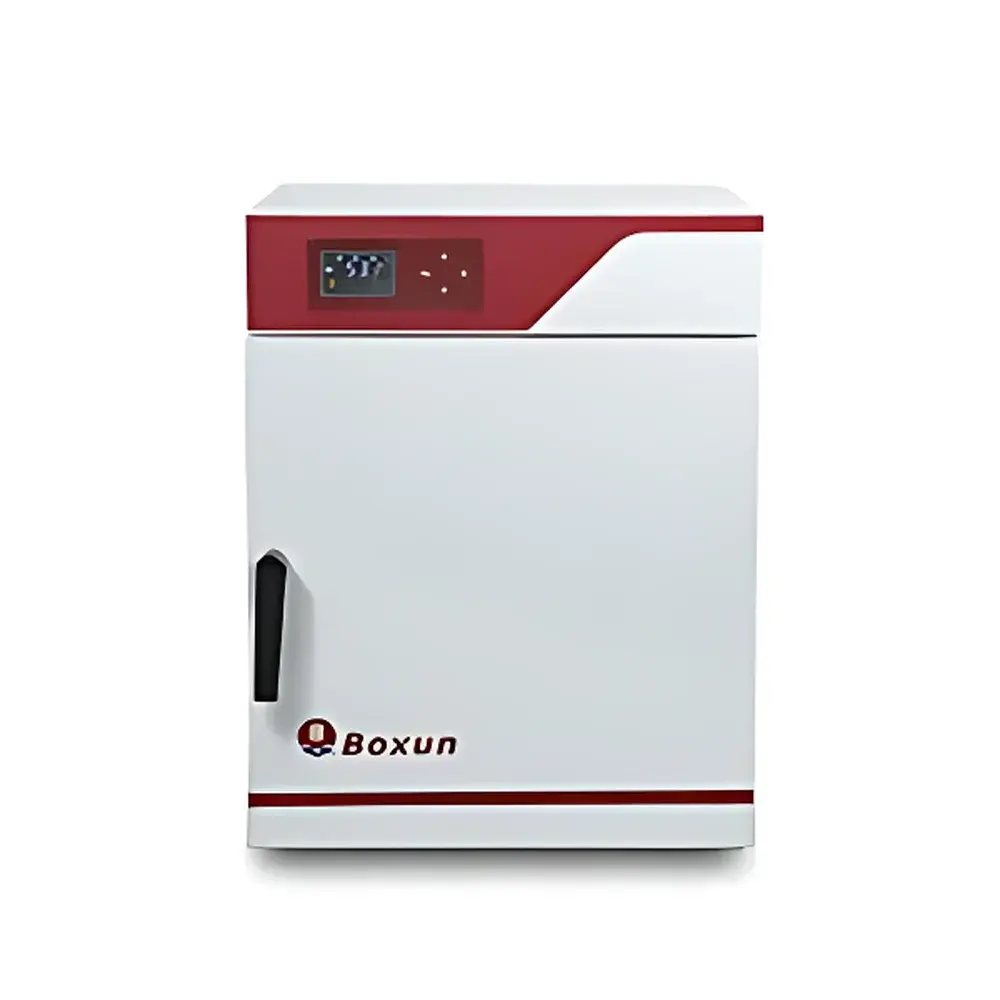
BOXUN BGZ-146 High-Temperature Forced-Air Drying Oven
| Brand | BOXUN |
|---|---|
| Origin | Shanghai, China |
| Manufacturer Type | Direct Manufacturer |
| Instrument Type | High-Temperature Drying Oven |
| Temperature Range | Ambient +5°C to 300°C |
| Temperature Uniformity | ±2% |
| External Dimensions (W×D×H) | 715 × 616 × 842 mm |
| Internal Chamber Dimensions (W×D×H) | 570 × 400 × 570 mm |
| Temperature Resolution | 0.1°C |
| Chamber Material | Mirror-Finish Stainless Steel (SUS304) |
| Heating Method | Forced-Air Circulation with Adjustable Fan Speed (6-step) |
| Control System | PMMA II Touchscreen Interface with Programmable Logic |
| Programming Capacity | 10 segments × 100 cycles |
| Timer Range | 0–9999 min/h |
| Delay Start Range | 0–999 min |
| Power Supply | AC 220 V ±10%, 50 Hz ±2% |
| Rated Power | 2150 W |
| Chamber Volume | 129 L |
| Standard Shelves | 2 pcs (max. 7 pcs), Load Capacity per Shelf: 15 kg |
| Communication Interface | RS-485 (standard) |
| Safety Features | Over-Temperature Alarm, Auto-Recovery after Power Interruption, Dual-Stage Door Locking Mechanism |
Overview
The BOXUN BGZ-146 High-Temperature Forced-Air Drying Oven is an engineered solution for precise thermal processing in laboratory and industrial quality control environments. Designed around the principle of convection-driven heat transfer, it employs a high-efficiency axial fan and optimized air duct geometry to ensure uniform temperature distribution across the entire working chamber. Unlike natural-convection ovens, the BGZ-146 utilizes forced-air circulation—air is drawn from the rear heating zone, pre-mixed in a dedicated preheating cavity, and reintroduced into the chamber via directional vents. This architecture minimizes thermal stratification and accelerates equilibration, particularly critical during ASTM D1654 (corrosion testing), ISO 17025-compliant drying protocols, or USP moisture content validation. With a maximum operating temperature of 300°C and a resolution of 0.1°C, the oven supports applications ranging from polymer curing and powder drying to glassware sterilization and accelerated aging studies.
Key Features
- PMMA II touchscreen control system with color LCD display, supporting real-time parameter monitoring and intuitive navigation
- Programmable temperature profile capability: up to 10 segments × 100 cycles, enabling complex ramp-hold-cool sequences for thermal stability testing
- 6-step adjustable fan speed control—optimizes airflow velocity to prevent sample disturbance (e.g., fine powders, lyophilized APIs) while maintaining thermal homogeneity
- Dual-stage rotary door locking mechanism with high-compression silicone gasket ensures >95% sealing efficiency and consistent chamber integrity under thermal stress
- Mirror-finish SUS304 stainless steel interior with radius-corner design facilitates residue-free cleaning and complies with GLP/GMP cleanroom maintenance requirements
- Preheating cavity design promotes rapid thermal response and reduces overshoot during setpoint transitions
- RS-485 serial interface enables integration with centralized lab management systems (LIMS) and supports Modbus RTU protocol for remote monitoring and data logging
- Auto-recovery function preserves program state and timer values following power interruption—critical for unattended overnight operation
Sample Compatibility & Compliance
The BGZ-146 accommodates standard laboratory ware including Petri dishes, weighing bottles, crucibles, and aluminum pans. Its 129 L chamber volume and modular shelf configuration (2 standard, up to 7 optional) support batch processing of heterogeneous samples without cross-contamination risk. The oven meets key international safety and performance benchmarks: IEC 61010-1 (electrical safety), EN 60529 (IP20 ingress protection), and conforms to temperature uniformity requirements specified in ISO 15504-2 for thermal validation. While not certified for Class I Div 1 hazardous locations, its construction avoids spark-generating components and includes redundant over-temperature cutoff (mechanical + electronic). For regulated environments, audit trails—including setpoint changes, alarm events, and door-open duration—are recordable via external data acquisition when paired with compliant software (e.g., LabArchives or custom SCADA).
Software & Data Management
The onboard PMMA II firmware logs operational metadata—including actual chamber temperature, fan speed, elapsed time, and alarm status—at user-defined intervals (default: 1 min). All logged data are exportable via USB flash drive in CSV format for post-processing in Excel or statistical analysis platforms (e.g., JMP, Minitab). The RS-485 interface supports bidirectional communication: read-only access to real-time parameters and write commands for setpoint modification or program initiation. When integrated with FDA 21 CFR Part 11-compliant enterprise systems, the BGZ-146 can be configured to generate electronic signatures, user-access logs, and change-history reports—fulfilling ALCOA+ data integrity principles (Attributable, Legible, Contemporaneous, Original, Accurate, Complete, Consistent, Enduring, Available).
Applications
- Moisture loss-on-drying (LOD) analysis per USP and Ph. Eur. 2.2.32
- Thermal desorption of residual solvents from pharmaceutical intermediates
- Curing of epoxy resins and silicone elastomers under controlled ramp rates
- Accelerated stability testing of medical device packaging per ISO 11607-1
- Drying of filter membranes prior to gravimetric particulate analysis (EPA Method 13A)
- Conditioning of reference standards before calibration (e.g., NIST SRM 1979)
- Pre-heating of metal substrates prior to coating adhesion testing (ASTM D3359)
FAQ
What is the maximum validated temperature uniformity across the chamber at 250°C?
At 250°C, temperature uniformity is maintained within ±2% of setpoint (±5.0°C), verified per ISO 15504-2 using 9-point sensor mapping.
Can the BGZ-146 be used for sterilization of surgical instruments?
No—it is not classified as a sterilizer per ISO 17665; it lacks vacuum capability, steam generation, and biological indicator validation pathways required for sterility assurance.
Is the RS-485 interface compatible with LabVIEW?
Yes, using standard Modbus RTU addressing; drivers and example VIs are available from BOXUN’s technical support portal.
How often does the temperature sensor require recalibration?
Annual calibration against a NIST-traceable reference thermometer is recommended for GLP compliance; internal self-diagnostic routines verify sensor continuity daily.
Does the oven support external humidity monitoring?
No—humidity sensing is outside its design scope; for combined temp/humidity studies, consider BOXUN’s BHG series environmental chambers.



