
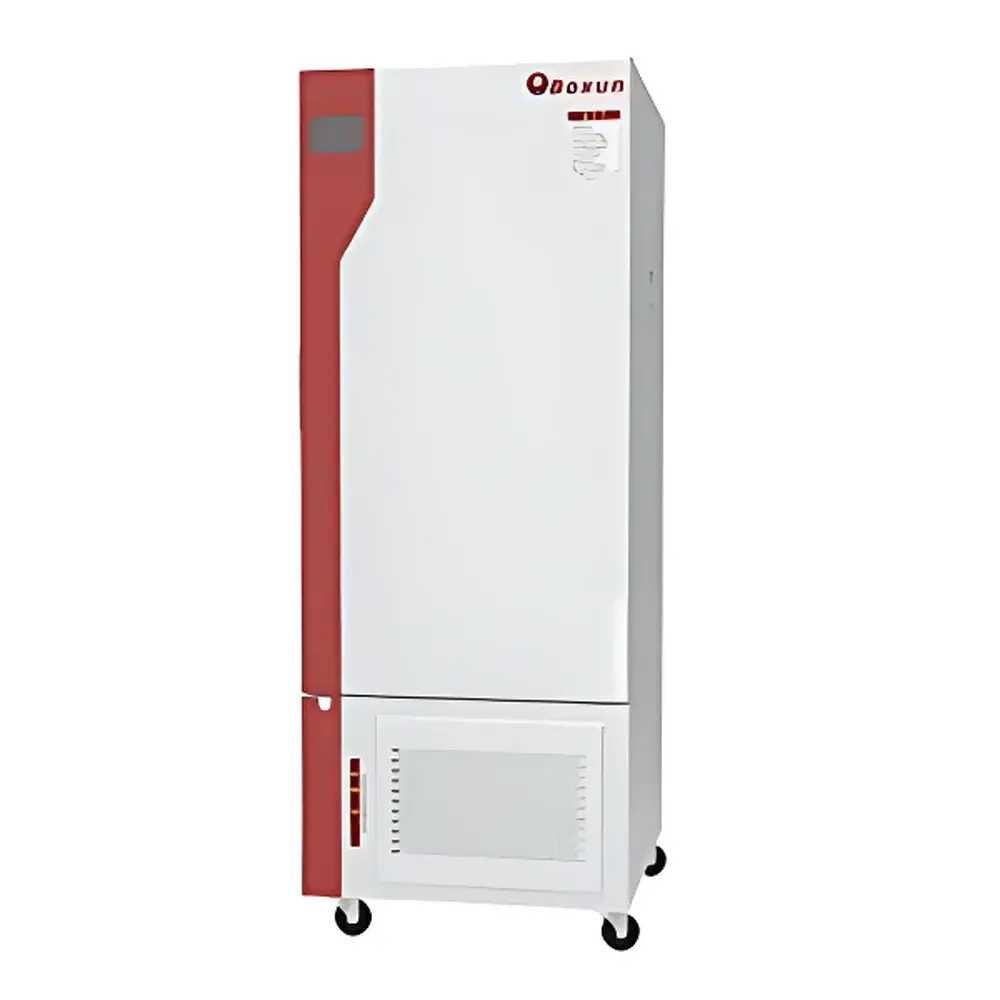
BOXUN BXG-150 Plant Growth Chamber with Programmable Illumination and Precision Temperature Control
| Brand | BOXUN |
|---|---|
| Model | BXG-150 |
| Origin | Shanghai, China |
| Manufacturer Type | Direct Manufacturer |
| Category | Domestic (China-Made) |
| Price Range | USD 2,800 – 7,000 (FOB Shanghai) |
| Temperature Range | 0–70°C (dark), 10–70°C (with illumination) |
| Temperature Resolution | 0.1°C |
| Temperature Uniformity (at 25°C) | ±1.0°C |
| Temperature Fluctuation (at 25°C) | ±0.5°C |
| Illuminance Range | 0–30,000 lux (10-step adjustable) |
| Internal Chamber Dimensions (L×W×H) | 510 × 390 × 760 mm |
| External Dimensions (L×W×H) | 650 × 680 × 1400 mm |
| Standard Shelves | 1 (max 4) |
| Standard Light Panels | 1 set (max 2 sets) |
| Input Power | 1250 W (standard) |
| Programmable Stages | 30 segments × 99 cycles |
| Data Logging Capacity | 250,000 records |
| Real-time Log View | Last 1600 entries |
| Interface | USB 2.0, RS485 |
| Cooling System | Inverter-driven, imported energy-efficient compressor |
| Air Circulation | C.H. thermal recycling system with high-efficiency imported fan |
| Compliance | Designed for GLP-compliant environments |
Overview
The BOXUN BXG-150 Plant Growth Chamber is an engineered environmental control system designed for reproducible, long-term cultivation of photobiological specimens under tightly regulated temperature and light conditions. It operates on the principle of forced-air convection combined with precision PID-based thermal regulation and digitally modulated LED or fluorescent illumination—enabling stable simulation of diurnal cycles, seasonal photoperiods, and controlled stress conditions. Unlike generic incubators, the BXG-150 integrates a dedicated illumination subsystem with ten-level intensity adjustment (0–30,000 lux), making it suitable for phytochrome-sensitive applications such as seed germination kinetics, photomorphogenesis studies, algal biomass optimization, and microbial phototroph culture. Its dual-range temperature capability—0–70°C in darkness and 10–70°C under active illumination—ensures compatibility with both mesophilic and thermotolerant strains, while its C.H. (Circulating Heat) thermal recovery architecture minimizes overshoot and accelerates stabilization after door openings.
Key Features
- 4.3-inch TFT 16-bit true-color LCD touchscreen interface running on Windows CE OS with high-frequency CPU and expanded onboard memory for robust multitasking
- Fuzzy logic PID temperature control with 30-segment, 99-cycle programmability—each segment configurable for duration (1–9999 hours), setpoint, and illumination level
- Inverter-driven refrigeration system using an imported high-efficiency compressor and low-noise centrifugal fan for precise cooling and rapid thermal recovery (≤5 min to re-stabilize after 30-sec door opening)
- Comprehensive data integrity suite: 250,000-point internal logging with timestamped event tracking (power-on/off, parameter changes, alarms); USB export of raw logs and audit trails including fault codes and operator actions
- Dual-layer security: screen lock with customizable password + mechanical door lock to prevent unauthorized access or accidental chamber disturbance
- C.H. thermal recycling system recaptures residual heat from condensation and compressor discharge, reducing heater duty cycle by up to 22% and improving energy efficiency across extended operation cycles
- Standard 1-piece adjustable illumination panel (LED or fluorescent, configurable at order); optional second panel for vertical light gradient studies or multi-tier canopy simulation
Sample Compatibility & Compliance
The BXG-150 supports a broad spectrum of biological materials requiring photoperiodic control—including Arabidopsis thaliana seedlings, rice callus cultures, cyanobacterial biofilms, fungal spore suspensions, and light-dependent recombinant protein expression systems (e.g., pET-based constructs with light-inducible promoters). Its interior chamber (510 × 390 × 760 mm) accommodates up to four stainless-steel shelves (standard: one), enabling scalable experimental replication. All electronic subsystems comply with IEC 61000-4 electromagnetic immunity standards. Optional GMP/FDA editions include validated firmware, electronic signature support, and full 21 CFR Part 11 audit trail functionality—including user role-based access control, immutable log archiving, and change history for all critical parameters. Humidity-enabled configurations (30–95% RH, ±3% fluctuation) meet ISO 17025 environmental monitoring requirements for stability testing per ICH Q1A(R2).
Software & Data Management
Data acquisition and remote supervision are facilitated via native RS485 Modbus RTU protocol and plug-and-play USB 2.0 connectivity. The included PC software (available in GLP, GMP, and FDA 21 CFR Part 11–certified versions) enables real-time graphing of temperature, illumination intensity, and event logs; automated report generation (PDF/CSV); and scheduled backup to network drives. All logged entries carry ISO 8601 timestamps and include contextual metadata (e.g., “Alarm: T-sensor failure at 2024-06-12T14:22:07Z, recovered after manual recalibration”). Optional GPRS module provides SMS alerts to up to three pre-registered mobile numbers upon threshold violation (e.g., temperature excursion >±2.0°C for >90 sec), supporting unattended overnight or weekend experiments in distributed lab networks.
Applications
- Controlled-environment phenotyping of crop mutants under defined photoperiods and thermal regimes
- Standardized seed germination assays per ISTA guidelines (International Seed Testing Association)
- Cultivation of phototrophic microorganisms (e.g., Synechocystis sp. PCC 6803) for metabolic flux analysis
- Light-dependent bioprocess development—including optogenetic circuit validation and photoregulated bioreactor inoculum preparation
- Stability studies of light-sensitive pharmaceutical intermediates per ICH Q1B (photostability testing)
- Long-term storage of light-responsive cell lines (e.g., melanopsin-expressing neurons) without cryopreservation
FAQ
What is the maximum illumination intensity, and how is uniformity ensured across the chamber volume?
The BXG-150 delivers up to 30,000 lux at shelf level, measured at center point under full output. Illumination uniformity is maintained within ±15% across the usable footprint (450 × 330 mm) via optimized reflector geometry and diffuser panels—validated per DIN 5035-3 photometric protocols.
Can the unit operate continuously for >30 days without maintenance?
Yes. The sealed refrigeration loop, brushless DC fan motors, and industrial-grade power supply support uninterrupted 24/7 operation. Preventive maintenance (condenser coil cleaning, sensor calibration) is recommended every 6 months per ISO/IEC 17025 Annex A.3.
Is humidity control available as a field-upgradeable option?
No—humidity modules must be factory-integrated due to structural modifications required for steam distribution ducting, condensate drainage, and RH sensor placement. Units ordered without humidity cannot be retrofitted.
Does the USB data export include metadata required for regulatory submissions?
Yes. Exported .csv files contain column headers compliant with ALCOA+ principles: Audit Trail ID, Timestamp (UTC), Parameter Name, Pre-change Value, Post-change Value, Operator ID, and Reason for Change (if entered).
What third-party validation documentation is supplied with the GMP version?
IQ/OQ protocols, traceable calibration certificates (NIST-traceable PT100 sensors and lux meter), and firmware version verification reports are included. Full CSV audit logs may be exported for FDA pre-submission review upon request.
Related Products



