
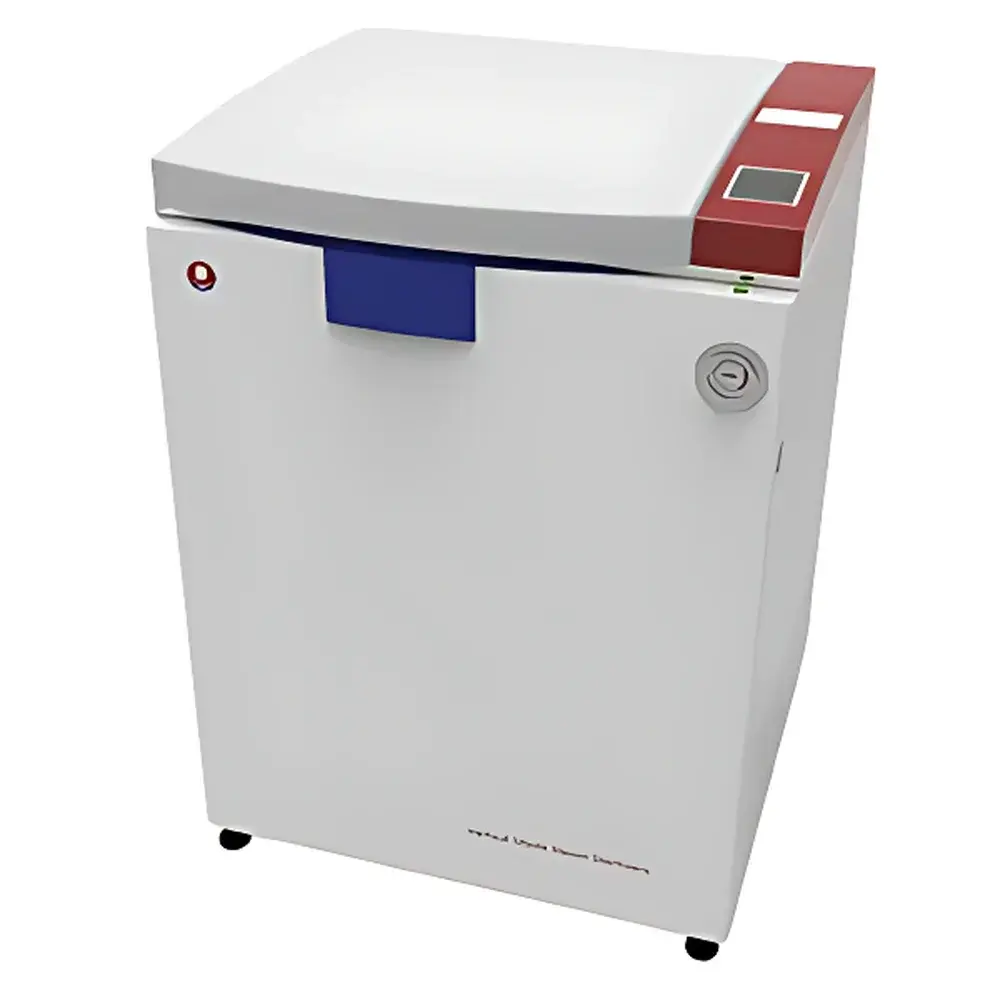
Boxun BXM-50M Vertical Steam Sterilizer
| Brand | Boxun |
|---|---|
| Origin | Shanghai, China |
| Manufacturer Type | Direct Manufacturer |
| Region of Origin | Domestic (China) |
| Model | BXM-50M |
| Instrument Type | Vertical |
| Max Temperature | 135 °C |
| Max Working Pressure | 0.22 MPa |
| Chamber Dimensions | Ø400 × 520 mm |
| External Dimensions | 750 × 800 × 950 mm |
| Chamber Volume | 50 L |
| Temperature Range (Sterilization) | 105–135 °C |
| Temperature Range (Drying) | 102 °C |
| Temperature Range (Melting) | 40–100 °C |
| Temperature Range (Heating/Insulation) | 25–85 °C |
| Time Range (Sterilization) | 4–120 min |
| Time Range (Drying/Melting/Insulation) | 0–999 min |
| Delay Start | Up to 99 h 60 min |
| Design Pressure | 0.25 MPa |
| Drying Residual Moisture | <1% |
| Heating Power | 5.1 kW |
| Power Supply | 220 V ± 22 V, 50 Hz ± 1 Hz |
| Ambient Operating Conditions | 5–40 °C, 20–80% RH |
Overview
The Boxun BXM-50M Vertical Steam Sterilizer is a fully integrated, microprocessor-controlled autoclave engineered for precision, safety, and regulatory compliance in academic laboratories, clinical diagnostics facilities, pharmaceutical QC labs, and biomedical research environments. It operates on the validated principle of saturated steam under pressure—leveraging the thermodynamic properties of moist heat to achieve microbial lethality across bacterial spores, viruses, fungi, and prions. With a chamber volume of 50 L and a maximum operating temperature of 135 °C at 0.22 MPa, the BXM-50M meets the fundamental requirements of ISO 17665-1 (Moist Heat Sterilization), EN 285 (Large Steam Sterilizers), and supports validation protocols aligned with FDA 21 CFR Part 11, EU Annex 1, and WHO TRS No. 961. Its vertical configuration optimizes floor space while maintaining ergonomic access to the sterilization chamber—critical for routine handling of glassware, media bottles, surgical instruments, and porous loads.
Key Features
- Double-locking door system combining mechanical self-locking and electronic interlock, preventing accidental opening during pressurized cycles
- High-resolution capacitive touchscreen interface with intuitive icon-based navigation and real-time status visualization
- 16 programmable user-defined cycles—including sterilization, drying, melting, and insulation—with persistent storage and recall capability
- SUS304 stainless steel chamber and dual sterilization baskets offering exceptional corrosion resistance to acidic, alkaline, and saline solutions
- Integrated cooling fan enabling rapid post-cycle air-cooling, reducing total cycle time by up to 40% compared to passive cooling
- Dual independent water supply channels (deionized and tap water) with automatic level detection and replenishment
- Onboard sample temperature probe (standard) for real-time monitoring of load core temperature—essential for thermal validation and cycle development
- C.W.S. Condensate Water Recycling System conserves deionized water by reusing condensate in subsequent cycles
- W.P.S. Waste & Purge System incorporating HEPA-grade filtration (≥99.97% @ 0.3 µm) and activated carbon adsorption for safe exhaust of non-condensable vapors and aerosols
- Comprehensive safety architecture: overtemperature cutoff, independent high-limit thermostat, overpressure relief valve, pressure sensor redundancy, and fault self-diagnosis with event logging
Sample Compatibility & Compliance
The BXM-50M accommodates a broad range of load types—including wrapped/unwrapped instruments, liquid media in sealed or vented containers, porous textiles, and microbiological waste bags—without compromising sterility assurance. Its chamber geometry (Ø400 × 520 mm) allows uniform steam penetration and efficient air removal via gravity displacement, supported by optional vacuum-assisted pulsation (configurable frequency: 2–99 cycles). All materials in contact with steam or condensate comply with USP Class VI biocompatibility standards. The sterilizer supports IQ/OQ/PQ documentation packages and is compatible with third-party validation tools, including wireless temperature sensors (rated to 130 °C) traceable to NIST standards (calibration points: 0 °C, 60 °C, 121 °C). It meets GLP/GMP operational prerequisites for record integrity, audit trail retention, and electronic signature readiness when paired with compliant software modules.
Software & Data Management
Built-in data logging records timestamped parameters—including chamber pressure, jacket temperature, load temperature, cycle phase, alarms, and door status—for every run. Data export is supported via USB 2.0 port in CSV format, enabling integration with LIMS or statistical process control platforms. Optional thermal printers (thermal or impact ribbon) provide immediate hard-copy output of cycle curves and summary reports, with embedded memory for offline storage. Remote operation is available via IR remote control (optional), while auxiliary lift mechanisms facilitate ergonomic loading/unloading of heavy or stacked items—reducing operator strain and improving workflow consistency. Firmware updates are delivered via secure USB import, ensuring ongoing alignment with evolving regulatory expectations.
Applications
- Terminal sterilization of culture media, buffers, and reagents in life science research labs
- Decontamination of biohazardous waste prior to disposal in BSL-2 and BSL-3 facilities
- Preparation of sterile surgical kits and reusable medical devices in hospital central sterile supply departments (CSSD)
- Validation support for pharmaceutical manufacturing processes requiring steam sterilization per USP & EP monographs
- Education and training in microbiology, biomedical engineering, and regulatory affairs curricula
FAQ
Does the BXM-50M support vacuum-assisted air removal?
Yes—the unit can be configured with programmable pulse vacuum cycles (2–99 pulses) to enhance air removal from porous or hollow loads, improving steam penetration and cycle reproducibility.
Is the sterilizer compliant with FDA 21 CFR Part 11 requirements?
Out-of-the-box functionality includes electronic audit trails, user authentication, and immutable data logging; full Part 11 compliance requires implementation of supplementary administrative controls and documented SOPs.
Can the built-in temperature probe be used for formal validation?
The standard wired probe provides real-time load monitoring and is suitable for routine qualification; however, formal validation (e.g., PQ) requires calibrated wireless sensors with accredited calibration certificates.
What maintenance intervals are recommended for the W.P.S. filtration system?
HEPA and activated carbon filters should be replaced every 6 months or after 500 cycles—whichever occurs first—to maintain exhaust integrity and odor control performance.
Is external water softening required for reliable operation?
While not mandatory, installation of the optional softener module is strongly advised when using municipal or hard well water to prevent scale buildup in the heating elements and steam generator.



