
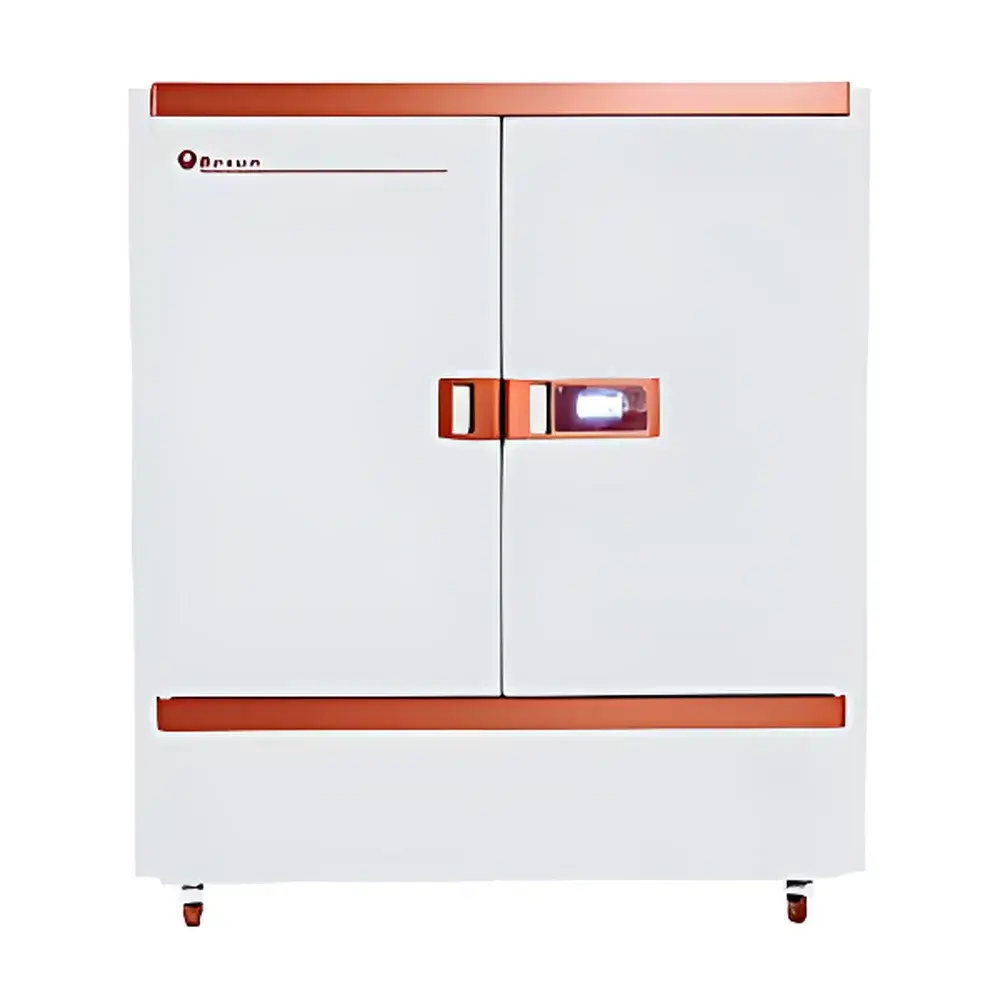
Boxun BXS-1600 Expandable Drug Stability Testing Chamber
| Brand | Boxun |
|---|---|
| Origin | Shanghai, China |
| Manufacturer Type | Direct Manufacturer |
| Product Category | Domestic |
| Model | BXS-1600 |
| Price Range | USD 7,000 – 11,200 (FOB Shanghai) |
| Temperature Control Range | 0–70°C |
| Temperature Resolution | 0.1°C |
| Temperature Uniformity (at 25°C) | ±2°C |
| Temperature Fluctuation (at 25°C) | ±0.5°C |
| Humidity Control Range (optional) | 30–95% RH |
| Humidity Fluctuation | ±5% RH |
| Illumination Range (optional) | 0–10,000 Lux (continuously adjustable) |
| Illumination Deviation | ±500 Lux |
| UV Irradiance Range (optional) | 0–2 W/m² |
| UV Spectral Range | 320–400 nm |
| Input Power (base) | 2150 W |
| Input Power (humidity + illumination configuration) | 3100 W |
| Chamber Internal Dimensions (L×W×H) | 1363 × 800 × 1500 mm |
| External Dimensions (L×W×H) | 1505 × 1136 × 2188 mm |
| Standard Shelves | 8 (max. 16) |
| Data Storage Capacity | 250,000 records |
| Real-time Log Access | Last 1600 temperature/humidity/illumination entries |
| Interface Options | USB, RS232, RS485 |
| Compliance Support | FDA 21 CFR Part 11 (via optional software), GMP/GLP audit trails, ICH Q1A(R2), Q5C, and WHO TRS 953 Annex 2 |
Overview
The Boxun BXS-1600 Expandable Drug Stability Testing Chamber is an engineered environmental simulation system designed to meet the stringent requirements of pharmaceutical stability testing per ICH Q1A(R2), Q5C, and WHO Technical Report Series No. 953 Annex 2. It provides precise, long-term control of temperature, relative humidity, visible light, and near-ultraviolet (UV-A) irradiation—critical parameters for assessing chemical and physical degradation pathways in active pharmaceutical ingredients (APIs) and finished dosage forms. Unlike generic climate chambers, the BXS-1600 integrates modular subsystems—humidity, illumination, and UV—each independently configurable and validated to deliver traceable, reproducible test conditions. Its chamber architecture employs a C.H. (Circulating Heat) thermal recovery system and variable-frequency refrigeration, enabling rapid stabilization after door opening (<15 min recovery to ±0.5°C at 40°C). The unit operates within a controlled ambient range of 10–30°C and is calibrated for continuous operation over extended cycles (up to 99 periods × 30 segments), supporting accelerated, intermediate, and long-term storage condition protocols.
Key Features
- Fully programmable 30-segment, 99-cycle controller with TFT 4.3-inch 16-bit color touchscreen interface running on Windows CE OS, supporting high-frequency data logging and local parameter management
- Fuzzy PID temperature control algorithm with ±0.5°C fluctuation (at 25°C) and ±2°C uniformity across full working volume
- Modular expansion architecture: field-upgradable humidity control (30–95% RH), illumination (0–10,000 Lux, ±500 Lux accuracy), and UV-A irradiation (0–2 W/m², 320–400 nm) modules—each with independent sensor feedback and dose-integrated shut-off logic
- Comprehensive data integrity framework: 250,000-point internal memory with time-stamped event logging (power cycles, setpoint changes, alarms); USB export of raw CSV logs including instrument status, fault codes, and operator actions
- GMP-compliant hardware safeguards: dual-limit temperature override, door-open detection with audible/visual alarm, humidity low-water cutoff, sensor failure diagnostics, and password-protected screen lock
- Integrated thermal efficiency systems: energy-efficient compressors (imported), high-static-pressure centrifugal fans, and C.H. heat recirculation to reduce heating power demand by up to 22% versus conventional designs
Sample Compatibility & Compliance
The BXS-1600 accommodates up to 16 adjustable stainless-steel shelves (standard: 8), supporting ICH-defined sample arrangements—including open trays, amber vials, blister packs, and secondary packaging configurations. Its internal volume (1.63 m³) ensures adequate air exchange and laminar airflow distribution for uniform exposure across heterogeneous sample loads. All optional modules are pre-validated against pharmacopeial benchmarks: illumination mode meets ICH Q1B’s requirement of ≥1.2 × 10⁶ Lux·hr total exposure; UV mode satisfies ≥200 W·hr/m² near-UV dose thresholds. The system supports IQ/OQ/PQ documentation packages—including 3Q validation files compliant with EU Annex 15 and ASTM E2500—and optional NIST-traceable calibration certificates (3-point temp: 0°C, 60°C, 121°C; 3-point RH/temp combo: 15°C/40% RH, 20°C/60% RH, 30°C/80% RH).
Software & Data Management
Data acquisition and reporting conform to regulatory expectations for electronic records. The embedded controller logs timestamped temperature, humidity, light intensity, and UV irradiance values at user-defined intervals (1 sec–24 hr). Optional FDA 21 CFR Part 11–compliant monitoring software provides role-based access control, electronic signatures, and immutable audit trails for all configuration changes and manual interventions. Exported datasets include metadata headers (instrument ID, operator ID, protocol ID, calibration dates) and support CSV, PDF, and XML formats compatible with LIMS and statistical process control (SPC) platforms. Wireless temperature and温湿度 recorders (optional) extend monitoring to shelf-level microenvironments and feed real-time validation data into automated trending reports.
Applications
This chamber serves as a primary tool in pharmaceutical R&D, QC release testing, and regulatory submission support. Typical use cases include: accelerated stability studies (40°C/75% RH, 30°C/65% RH); photostability assessment per ICH Q1B (optionally combined with thermal stress); long-term storage condition simulation (25°C/60% RH, 30°C/65% RH); forced degradation studies under controlled UV exposure; excipient compatibility screening; and biologics stability profiling under low-temperature/high-humidity regimes. Its modular design also supports non-pharma applications requiring multi-parameter environmental stress—such as polymer aging in medical device packaging, vaccine formulation development, and botanical extract shelf-life modeling.
FAQ
Does the BXS-1600 comply with ICH Q1A(R2) and Q1B guidelines?
Yes—the base configuration meets temperature/humidity control specifications outlined in ICH Q1A(R2), and optional illumination/UV modules are engineered to fulfill Q1B photostability testing requirements, including cumulative dose tracking and spectral fidelity verification.
Can humidity and UV be operated simultaneously with temperature control?
Yes. The humidity + illumination + UV expansion configuration enables concurrent, independent regulation of all three stress parameters while maintaining specified tolerances across the full operating envelope.
Is remote monitoring and alarm notification supported?
Optional GPRS-enabled firmware allows SMS alerts to designated mobile numbers upon critical events (e.g., temperature excursion, door left open, humidity failure), with full integration into enterprise SCADA or CMMS platforms via RS485 Modbus RTU.
What validation documentation is provided with the system?
Standard delivery includes Factory Acceptance Test (FAT) report, electrical safety certification (CE/GB), and operational manuals. Optional 3Q validation packages (IQ/OQ/PQ), GMP-compliant calibration certificates, and 21 CFR Part 11 software validation kits are available upon request.
How is data integrity ensured during power interruption?
Non-volatile flash memory retains all logged data and configuration settings during mains loss. Upon recovery, the system resumes operation from last valid state without data corruption or parameter reset.
Related Products







