
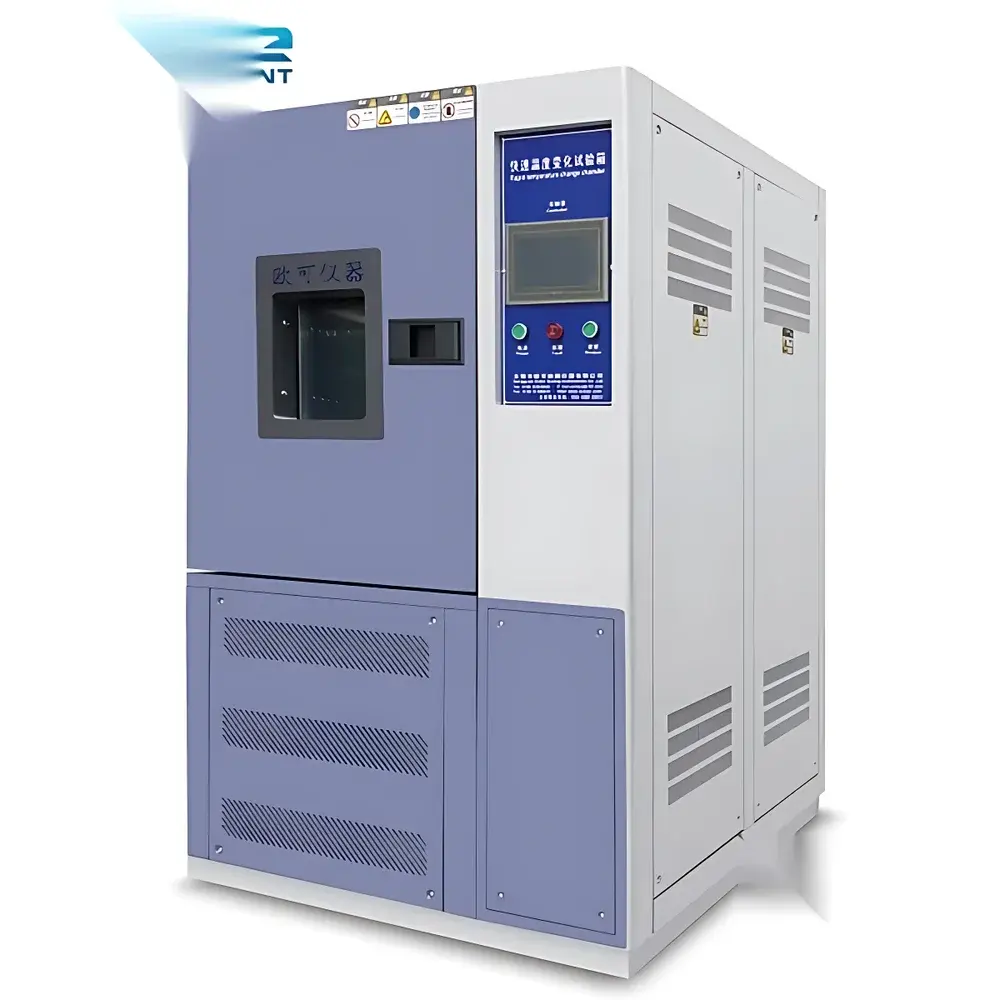
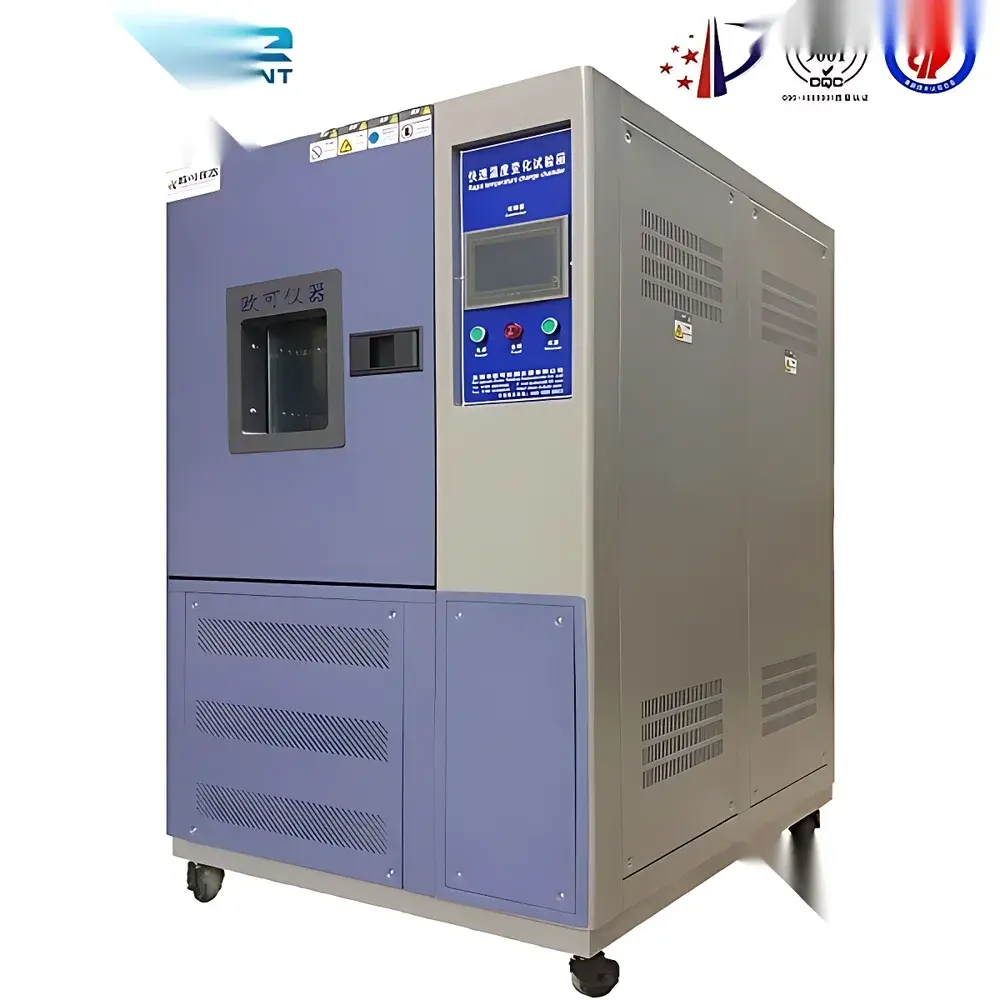
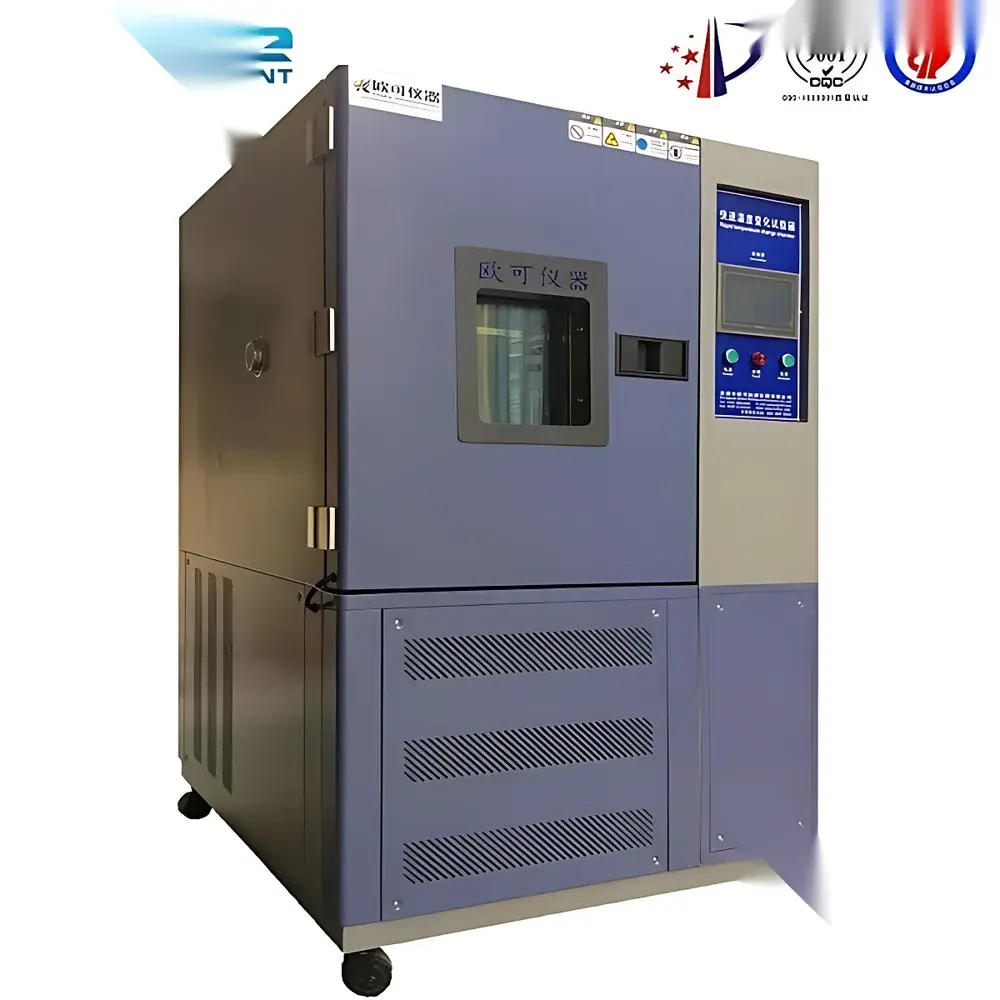
Other Brands KS-TH Series Rapid Temperature Change Chamber
| Brand | Other Brands |
|---|---|
| Origin | Imported |
| Manufacturer Type | Authorized Distributor |
| Temperature Range Options | -20°C to 130°C |
| Temperature Uniformity | ±2°C |
| Temperature Stability | ±0.5°C |
| Heating Rate | -20°C → 100°C in ~35 min |
| Cooling Rate | 25°C → -40°C in ~50 min |
| Control Resolution | ±0.1°C |
| Internal Chamber Material | SUS304 Stainless Steel (Mirror Finish) |
| External Cabinet Material | Cold-Rolled Steel with Phosphating & Electrostatic Powder Coating or Optional SUS304 Brushed Finish |
| Insulation | Rigid Polyurethane Foam + Ultra-Fine Glass Fiber |
| Refrigeration System | Hermetic Air-Cooled Single-Stage or Cascade Compressor (Original Tecumseh France) |
| Controller | Imported LED Digital PID Microcomputer Controller with Lock Function, Auto-Tuning, and Optional Printer Interface |
| Safety Protections | Overtemperature, Overcurrent, Leakage, Motor Overheat, Compressor High-Pressure & Overload Protection |
| Power Supply | AC 380V ±10%, 50 ±0.5 Hz, 3-Phase 5-Wire |
Overview
The Other Brands KS-TH Series Rapid Temperature Change Chamber is an engineered environmental test system designed for high-fidelity thermal stress evaluation of materials, components, and finished products under dynamically controlled temperature transitions. Based on forced-air convection and dual-stage (or single-stage) vapor-compression refrigeration architecture, the chamber delivers precise, repeatable, and accelerated thermal cycling—critical for reliability validation in aerospace, automotive electronics, semiconductor packaging, military-grade hardware, and industrial quality assurance laboratories. Its core operational principle relies on independent heating and cooling circuits, enabling simultaneous optimization of ramp rate, dwell stability, and thermal recovery time following door opening. The chamber complies with fundamental thermal test requirements defined in IEC 60068-2-14 (Test N: Change of Temperature), MIL-STD-810H Method 503.6, and supports protocol development aligned with JEDEC JESD22-A104 (Temperature Cycling) and A110 (Highly Accelerated Temperature and Humidity Stress Test, though humidity control is not included in this dry-thermal variant).
Key Features
- Modular chamber configurations: Six standard internal volumes (80 L to 1000 L), including KS-TH-80 (40×50×40 cm), KS-TH-150 (50×60×50 cm), KS-TH-225 (60×75×50 cm), KS-TH-408 (60×85×80 cm), TS-800 (100×100×80 cm), and KS-TH-1000 (100×100×100 cm), all constructed with CNC-machined structural integrity.
- Dual independent thermal systems: Separated nickel-chromium alloy heating elements and Tecumseh hermetic compressors ensure minimal cross-interference between heating and cooling functions—enhancing system longevity and reducing maintenance frequency.
- Uniform airflow design: Multi-blade centrifugal fan with low-noise AC motor and optimized duct geometry achieves ≤±2°C temperature uniformity across the working volume per IEC 60068-3-5.
- Advanced controller interface: LED digital PID microprocessor with auto-tuning capability, parameter lock function, and programmable ramp/soak profiles; optional thermal printer support for audit-ready hardcopy output.
- Robust thermal insulation: 100–150 mm thick rigid polyurethane foam combined with ultra-fine glass fiber layers minimizes heat leakage and improves energy efficiency during extended cycling tests.
- Human-centered access: Ergonomic no-backlash handle, double-layer high-temperature silicone gasket seal, and multi-layer heated observation window with interior lighting facilitate safe, contamination-free sample monitoring.
Sample Compatibility & Compliance
The KS-TH series accommodates a broad spectrum of test specimens—from printed circuit boards (PCBs) and MEMS sensors to automotive ECUs, battery modules, optical assemblies, and polymer-based enclosures. Standard test ports (25 mm, 50 mm, and 100 mm diameter) allow integration with external instrumentation (e.g., data loggers, power supplies, signal analyzers) without compromising chamber integrity. All models meet CE marking requirements for electromagnetic compatibility (EMC) and low-voltage directive (LVD) compliance. While not intrinsically rated for hazardous locations, the unit adheres to EN 61000-6-2/6-4 immunity and emission standards. For regulated environments (e.g., ISO 17025-accredited labs), the controller supports manual calibration traceability via PT100 Class A sensors (IEC 60751), and operation logs—including setpoints, actual values, alarms, and timestamps—can be exported for GLP/GMP documentation workflows.
Software & Data Management
Although the base configuration uses a standalone microcontroller, optional RS485/RS232 or Ethernet interfaces enable integration with centralized lab management systems (LIMS) or SCADA platforms. The controller records real-time temperature data at user-defined intervals (default: 1 sec), stores up to 100 programmable test profiles (each supporting up to 99 segments), and retains historical run logs for ≥30 days. When paired with compliant third-party software (e.g., LabVIEW, MATLAB, or custom Python-based DAQ tools), users can implement automated pass/fail evaluation against predefined thermal excursion limits, generate statistical process control (SPC) charts, and export CSV-formatted datasets compatible with JMP or Minitab. Audit trail functionality—including operator ID tagging, parameter modification timestamps, and firmware version logging—is available upon request for FDA 21 CFR Part 11–aligned deployments.
Applications
This rapid temperature change chamber serves critical roles across multiple verticals: thermal shock screening per IPC-9701 for solder joint reliability; preconditioning of lithium-ion cells prior to electrical performance testing; validation of conformal coating adhesion under extreme thermal gradients; qualification of avionics housings per RTCA DO-160 Section 4.2; and accelerated life testing of elastomeric seals used in oil & gas downhole tools. It is also widely deployed in university research labs conducting thermomechanical fatigue studies on shape-memory alloys and phase-change materials. The absence of humidity control makes it especially suitable for applications where condensation-induced failure modes must be excluded—such as evaluating oxide layer integrity on high-k dielectrics or assessing delamination thresholds in ceramic multilayer capacitors.
FAQ
What is the maximum achievable temperature ramp rate for the KS-TH-408 model?
Standard specifications indicate a heating rate of approximately 3.5°C/min (-20°C to 100°C in 35 minutes) and a cooling rate of ~1.2°C/min (25°C to -40°C in 50 minutes); actual performance may vary slightly depending on load mass, thermal mass distribution, and ambient conditions.
Can the chamber be integrated into an automated test cell with PLC control?
Yes—via optional digital I/O expansion modules or Modbus RTU/TCP communication protocols, enabling seamless synchronization with robotic handlers, safety interlocks, and MES-level production tracking systems.
Is calibration certification included with shipment?
A factory-as-built temperature uniformity report and PT100 sensor calibration certificate (traceable to NIST or equivalent national metrology institute) are provided; full ISO/IEC 17025 calibration services are available as a post-purchase option.
Does the system support thermal cycling with dwell periods?
Yes—the microcontroller supports multi-segment programs with independent ramp rates, soak durations (0.1 s to 999.9 h), and loop counts up to 999 cycles per program.
What maintenance intervals are recommended for the refrigeration system?
Compressor oil and filter-drier replacement is advised every 24 months under continuous operation; routine inspection of condenser coils, fan bearings, and door gasket integrity should occur quarterly.



