
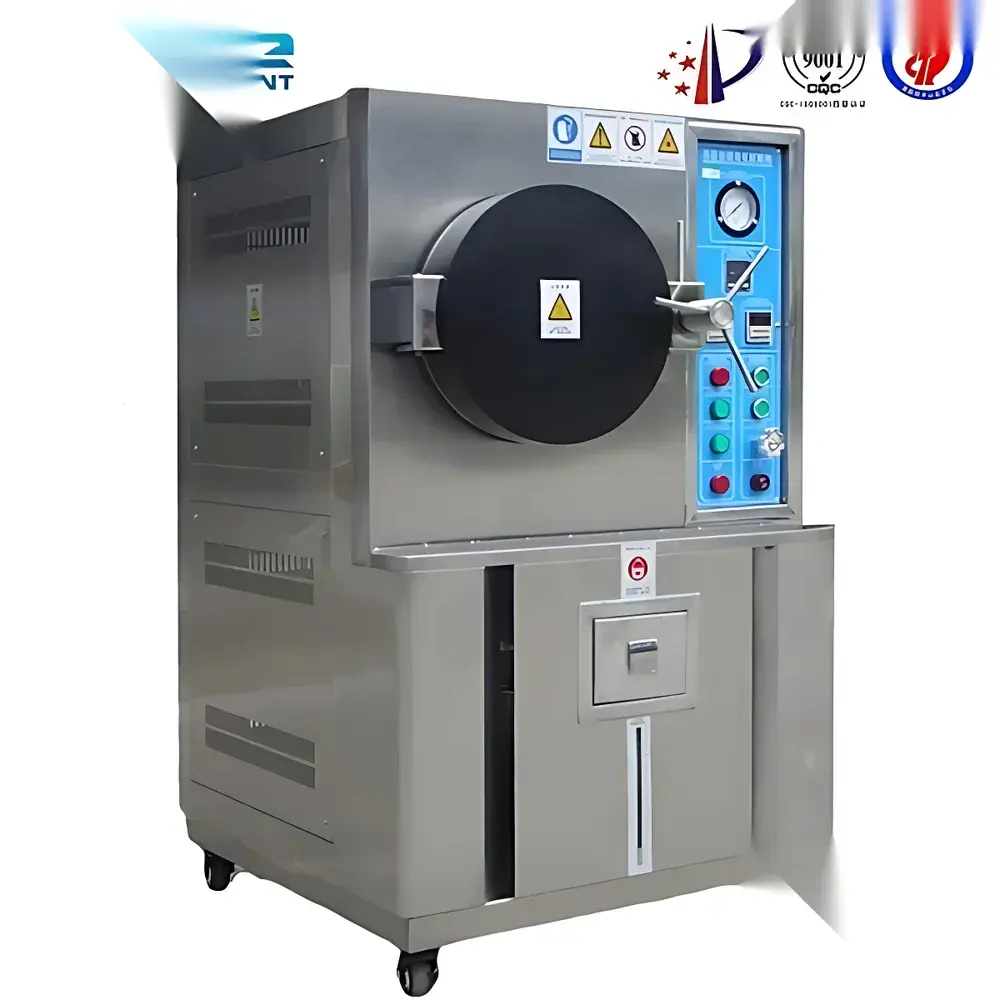
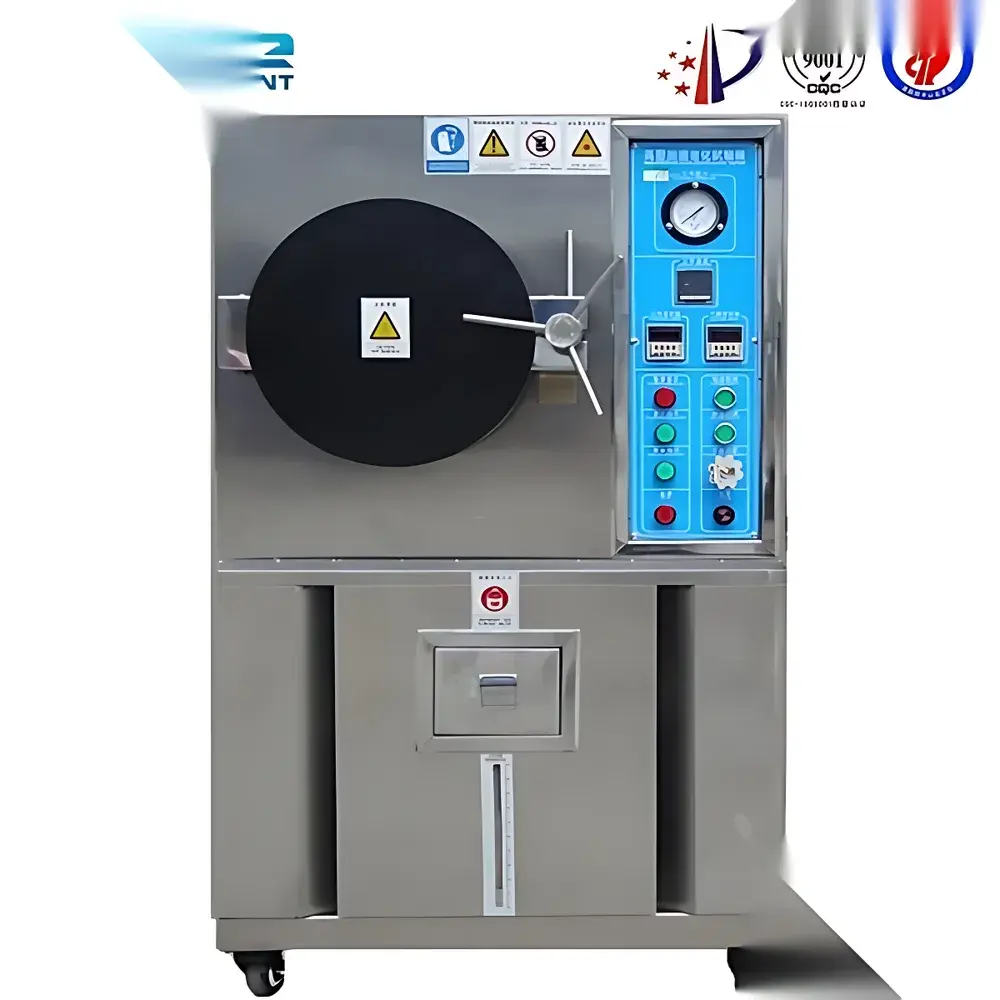
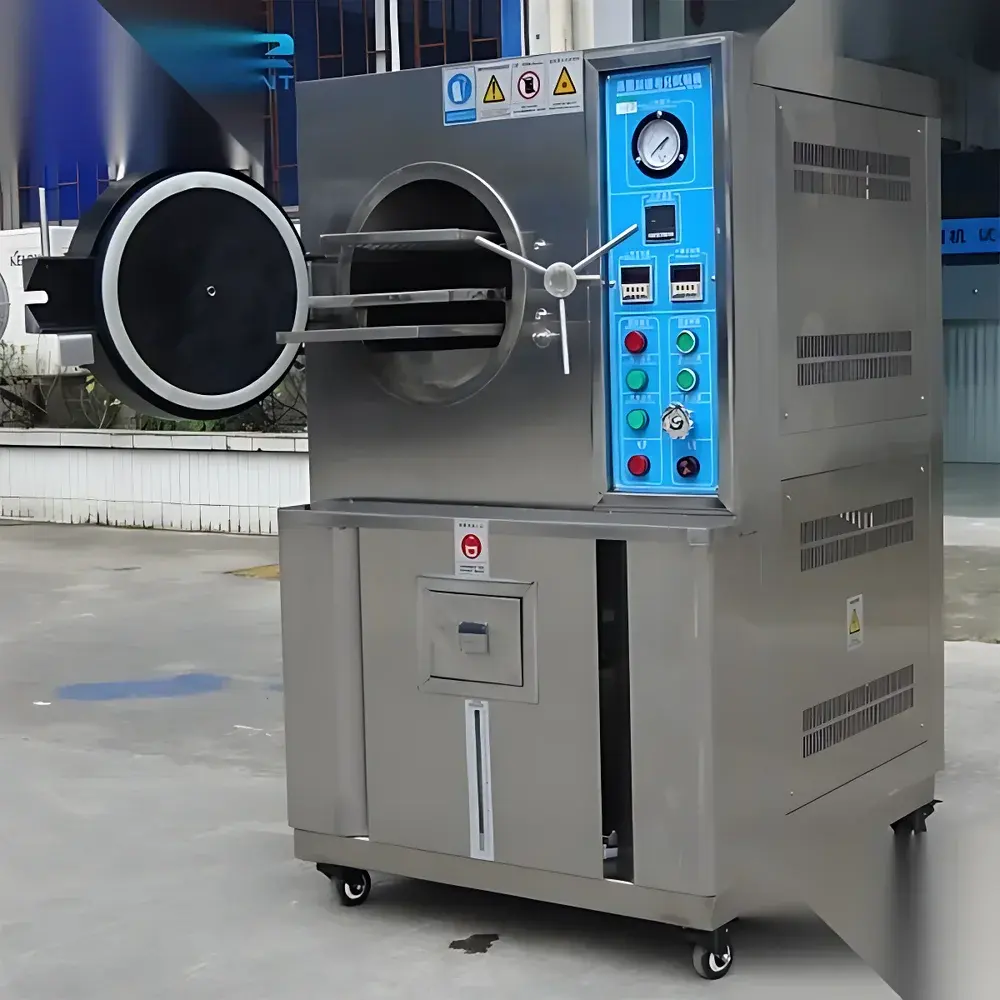
Other Brands OK-PTC-25 / OK-PTC-35 High-Pressure Accelerated Aging Test Chamber
| Brand | Other Brands |
|---|---|
| Model | OK-PTC-25 / OK-PTC-35 |
| Internal Chamber Dimensions | ∅250 × 450 mm (OK-PTC-25) or ∅350 × 500 mm (OK-PTC-35) |
| Temperature Range | RT+10°C to 132°C |
| Humidity Range | 100% RH |
| Pressure Range | 0.0–2.8 kg/cm² (gauge), max working pressure 3.0 kg/cm² (absolute), safety rating 4.0 kg/cm² |
| Temperature Uniformity | ±1.5°C |
| Temperature Control Accuracy | ±0.5°C |
| Temperature Resolution | 0.1°C |
| Pressurization Time (0 → 2.0 kg/cm²) | ~30 min |
| Chamber Material | SUS304 stainless steel |
| Exterior Material | SECC steel with electrostatic powder coating |
| Compliance | ASTM, DIN, BS, IEC, NACE, UL, CNS, ISO, JIS, MIL |
Overview
The OK-PTC-25 and OK-PTC-35 High-Pressure Accelerated Aging Test Chambers are engineered for controlled thermal-hygrometric-pressurized stress testing of materials and components under saturated steam environments. These chambers operate on the principle of accelerated aging via elevated temperature, full saturation humidity (100% RH), and regulated overpressure—mimicking long-term service conditions in compressed steam atmospheres typical of sterilization validation, polymer degradation studies, electronic encapsulant reliability assessment, and packaging integrity evaluation. Unlike ambient-pressure humidity chambers, the OK-PTC series introduces precise gauge pressure control (up to 2.8 kg/cm²) to increase the saturation temperature of water vapor beyond 100°C—enabling accelerated degradation kinetics without introducing non-condensable gases or compromising moisture saturation. The cylindrical horizontal chamber design ensures ergonomic sample loading while minimizing condensate pooling and operator exposure to transient steam bursts.
Key Features
- Cylindrical horizontal internal chamber constructed from high-purity SUS304 stainless steel—resistant to thermal cycling, corrosion, and steam erosion across repeated pressurization cycles.
- Dual-model configuration: OK-PTC-25 (∅250 × 450 mm) and OK-PTC-35 (∅350 × 500 mm) accommodate varying sample volumes and dimensional constraints in QC labs and R&D facilities.
- PID-controlled microprocessor system with SSR output drives precision saturated steam temperature regulation (RT+10°C to 132°C) at ±0.5°C control accuracy and 0.1°C display resolution.
- Integrated pressure regulation system with analog precision gauge and automated safety interlocks—maintaining stable gauge pressure between 0.0 and 2.8 kg/cm² with linear ramping profiles.
- Forced convection via magnetically coupled fan assembly and natural steam circulation architecture ensures uniform temperature distribution (±1.5°C) and consistent 100% RH saturation throughout the chamber volume.
- Multi-layer safety architecture including dual redundant pressure/temperature sensors, automatic emergency depressurization, vacuum-assisted air exchange pre-cycle, and mechanical door-locking mechanism activated by internal pressure differential.
Sample Compatibility & Compliance
The OK-PTC series supports a broad range of non-volatile, non-explosive samples—including medical device packaging (Tyvek®, pouches, trays), silicone elastomers, epoxy encapsulants, PCB conformal coatings, rubber gaskets, and thermoplastic housings. Its operational envelope aligns with standardized accelerated aging protocols referenced in ISO 11607-1 (packaging for terminally sterilized medical devices), ASTM F1980 (accelerated aging of sterile barrier systems), IEC 60068-2-66 (damp heat, steady state, high pressure), and MIL-STD-810H Method 507.5 (high temperature/humidity with pressure). All control logic and data logging functions support audit-ready operation under GLP and GMP frameworks when paired with optional 21 CFR Part 11-compliant software modules.
Software & Data Management
Standard LED-based controller provides real-time display of chamber temperature, relative humidity (inferred from saturation equilibrium), and absolute/gauge pressure. Optional PC-based data acquisition systems enable continuous timestamped logging of all process variables at user-defined intervals (1–60 sec), with CSV export and trend visualization. Event-driven alarms (e.g., pressure deviation >±0.2 kg/cm², temperature drift >±1.0°C for >60 sec) trigger automatic shutdown and digital event tagging. All logged data include operator ID, cycle ID, and calibration traceability metadata—facilitating compliance with FDA 21 CFR Part 11 requirements when configured with electronic signature and audit trail modules.
Applications
- Accelerated shelf-life prediction of sterile medical packaging per ISO 11607 and AAMI TIR17.
- Thermal-oxidative stability assessment of polymeric seals and O-rings used in high-pressure fluid systems.
- Validation of moisture barrier performance in flexible electronics encapsulation under combined thermal-mechanical-hygrometric stress.
- Reliability screening of solder mask adhesion and underfill delamination in automotive ECUs exposed to under-hood steam environments.
- Material compatibility testing for pharmaceutical primary packaging subjected to autoclave-like conditions.
- Corrosion resistance evaluation of coated metallic substrates per ASTM D2247 and ISO 9223 in saturated high-pressure steam.
FAQ
What is the maximum allowable working pressure, and how is overpressure protection implemented?
The chamber is rated for a maximum working pressure of 3.0 kg/cm² (absolute) and certified to a safety capacity of 4.0 kg/cm². Overpressure protection includes dual independent pressure transducers, hardware-based pressure cutoff relays, and a fail-safe mechanical burst disc calibrated to 4.0 kg/cm².
Can the chamber maintain true 100% RH across the full temperature range?
Yes—by operating exclusively with saturated steam and maintaining strict pressure-temperature equilibrium per the IAPWS-IF97 formulation, the chamber guarantees 100% RH at all setpoints from 100°C to 132°C.
Is vacuum pre-conditioning mandatory before each test cycle?
Vacuum evacuation is optional but recommended for applications requiring oxygen-free environments or elimination of air pockets in porous samples; it is fully programmable and integrated into the start-up sequence.
How does the door interlock system ensure operator safety during pressurized operation?
The circular door employs a pressure-actuated cam-lock mechanism: increasing internal pressure enhances the sealing force between the door gasket and chamber flange. The door cannot be manually opened until internal pressure drops below 0.05 kg/cm², verified by redundant pressure sensors.
Are custom chamber sizes or automation integrations available?
Yes—custom diameters, lengths, and fully automated water replenishment systems (including conductivity-monitored deionized water tanks and level-sensing feed pumps) are available upon request and subject to engineering review.



