
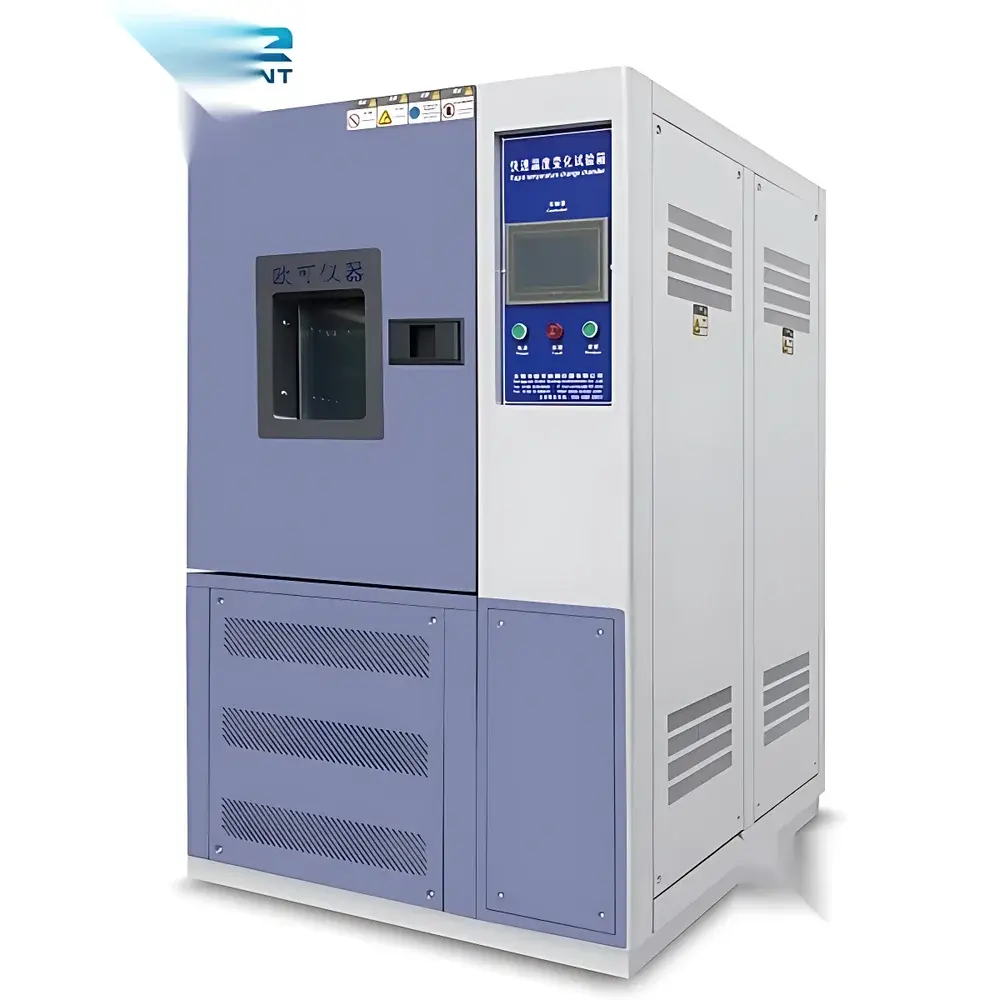
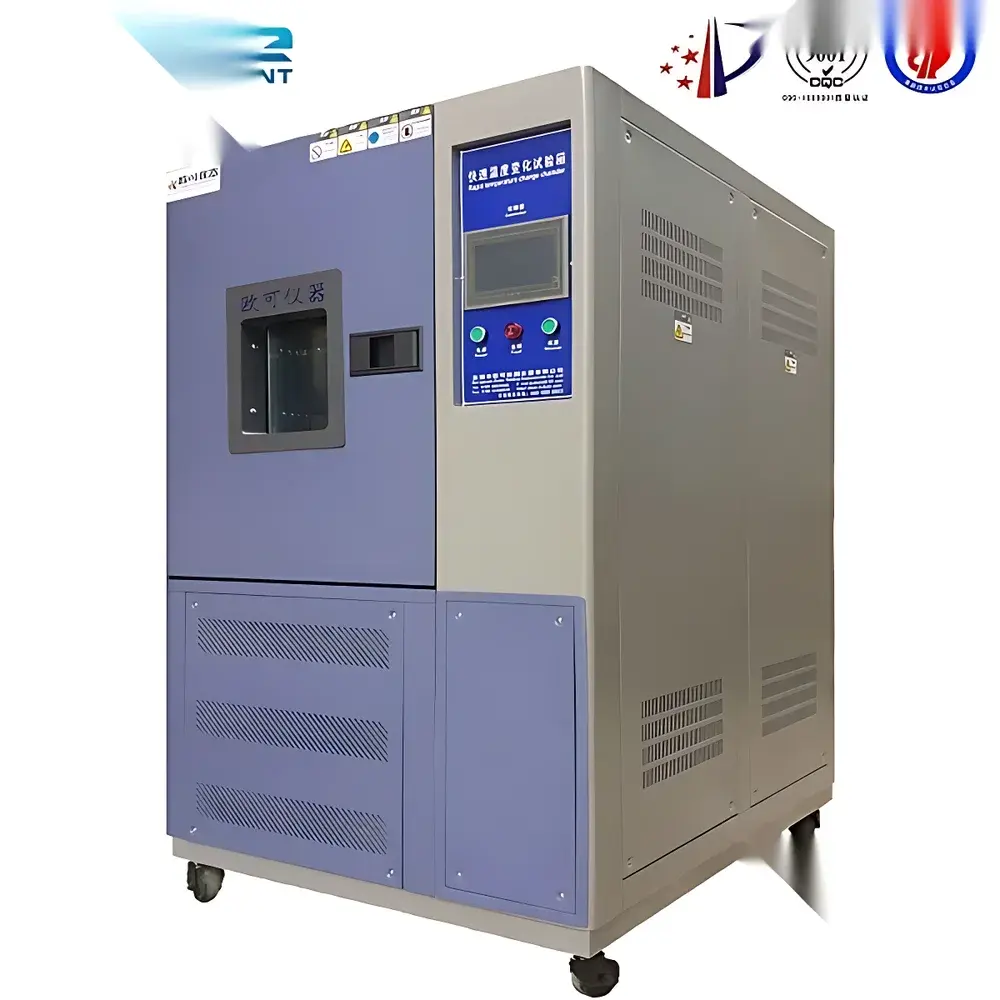
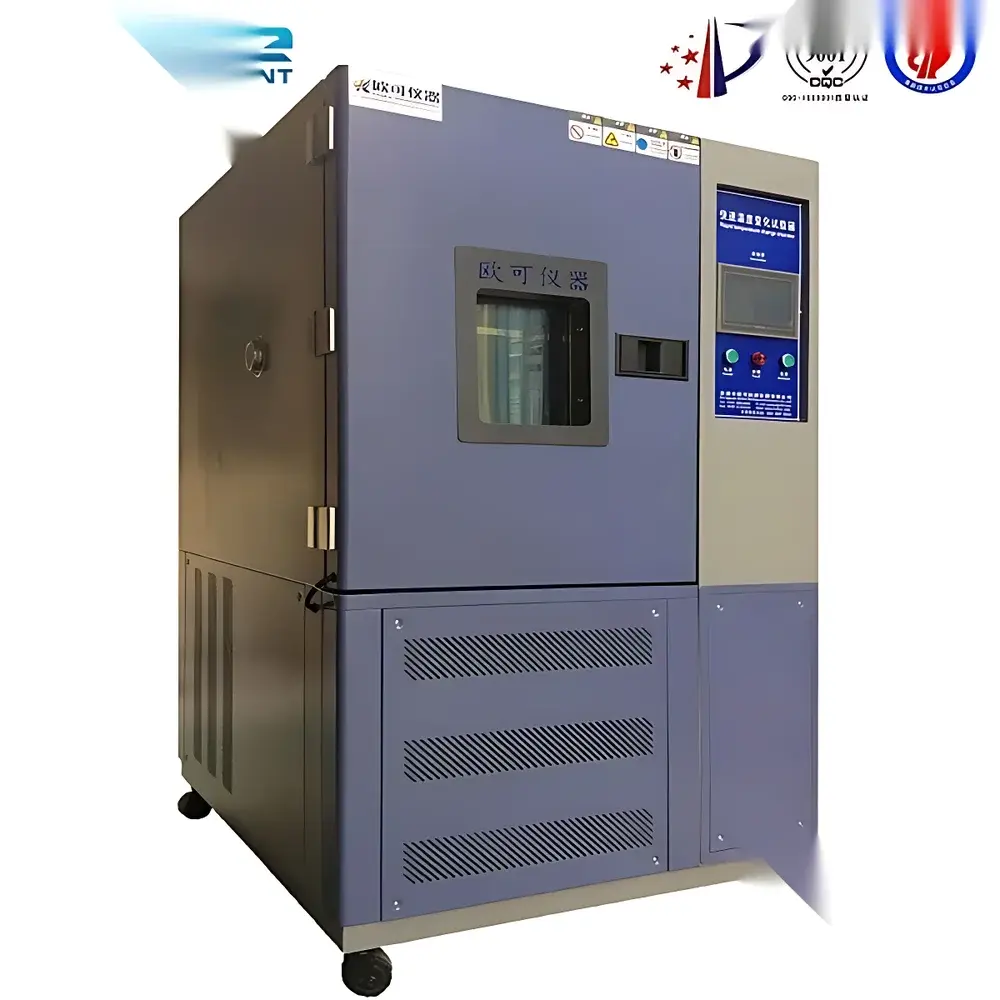
Other Brands Rapid Temperature Change Chamber (RTC Chamber)
| Brand | Other brands |
|---|---|
| Origin | Imported |
| Manufacturer Type | General distributor |
| Price | USD 14,000 (approx.) |
| Temperature Range | −70 °C to +170 °C |
| Temperature Uniformity | ±2 °C |
| Temperature Stability | ±0.5 °C |
| Temperature Recovery Time | ≤5 min |
| High-Temp Soak | ≥30 min at +150 °C |
| Low-Temp Soak | ≥30 min at −40 °C |
| Specimen Transfer Method | Pneumatic |
| Max Specimen Weight | 3 kg |
| Heating Rate | +25 °C → +170 °C in 30 min |
| Cooling Rate | +25 °C → −55 °C in 65 min |
| Noise Level | ≤65 dB(A) |
| Power Supply | AC 380 V ±10%, 50/60 Hz with protective earth |
Overview
The Rapid Temperature Change (RTC) Chamber is a three-zone thermal shock test system engineered for evaluating material and component resilience under extreme, accelerated thermal transitions. Operating on the principle of pneumatic specimen transfer between isolated high-temperature and low-temperature chambers—combined with a dedicated test chamber—it enables precise, repeatable thermal shock profiling per ASTM D5229, IEC 60068-2-14, MIL-STD-810H Method 503.7, and JESD22-A104. Unlike single-chamber cyclic systems, this design eliminates thermal inertia delays by maintaining stable soak conditions in dedicated reservoir zones, ensuring true step-change exposure with minimal dwell-time deviation. The chamber supports both two-point (high/low) and three-point (high/ambient/low) shock protocols, making it suitable for qualification testing of aerospace avionics, automotive ECUs, BGA solder joints, PCB laminates, and medical-grade polymer enclosures subject to field-deployed thermal transients.
Key Features
- Triple-chamber architecture with independent high-temperature (+170 °C max), low-temperature (−70 °C min), and test-zone compartments, thermally isolated via vacuum-insulated stainless-steel walls and silicone-sealed gaskets.
- Pneumatically actuated specimen carrier with position feedback sensors and fail-safe mechanical interlocks, enabling repeatable transfer within ≤5 seconds and minimizing thermal lag during transition.
- Large-format 7-inch color LCD touchscreen controller with real-time graphical display of temperature curves, alarm logs, and multi-segment programmable profiles—including up to 96 user-defined test specifications.
- Full PID-based temperature regulation with auto-tuning capability; dual-stage refrigeration circuit with cascade cooling for sub-zero stability; electric heating elements with over-temperature cut-off protection.
- Dual-mode operation: supports standalone high-/low-temperature cycling, as well as synchronized thermal shock sequences with configurable dwell times (1–999 minutes), cycle counts (1–999), and ramp rate constraints.
- Standard 50 mm diameter access port on left chamber wall, fitted with silicone gasket and clamping flange, enabling live electrical feedthrough for powered-in-situ testing of active devices.
Sample Compatibility & Compliance
The RTC Chamber accommodates specimens up to 3 kg and dimensions compatible with standard ISO 16750-4 mounting fixtures. It meets structural and operational requirements for GLP-compliant environmental testing laboratories, including traceable calibration paths per ISO/IEC 17025, audit-ready event logging, and hardware-enforced safety interlocks (door switches, overheat sensors, pressure relief valves). Test reports generated via controller export support compliance documentation for automotive AEC-Q200, aerospace AS9100, and medical device ISO 13485 submissions. All electrical components conform to IEC 61000-4 EMC standards and UL 61010-1 safety certification.
Software & Data Management
The embedded controller firmware supports CSV-formatted data export (time-stamped temperature readings at 1-second intervals), USB mass storage backup, and optional RS-485/Ethernet connectivity for integration into centralized LabVIEW or Python-based test orchestration platforms. Audit trails record operator login, parameter changes, alarm triggers, and system faults with timestamp and user ID—meeting FDA 21 CFR Part 11 electronic record requirements when paired with validated network authentication. Firmware updates are performed via secure signed package installation with rollback capability.
Applications
This chamber is routinely deployed in R&D labs and QA departments for: accelerated life testing of lead-free solder interconnects; validation of thermal expansion coefficient mismatches in MEMS packaging; screening of adhesive bond integrity in battery module assemblies; qualification of optical sensor housings under desert-to-ice thermal cycling; and verification of conformal coating performance on high-density flex circuits. Its rapid recovery and tight uniformity make it especially effective for failure mode analysis where microcrack propagation correlates strongly with thermal gradient magnitude and transition frequency.
FAQ
What is the maximum allowable specimen volume for thermal shock testing in this chamber?
The chamber supports specimens up to 3 kg in mass. Physical envelope limitations depend on internal basket configuration; typical usable test space measures 300 × 300 × 300 mm (W×D×H). Custom baskets are available upon request.
Does the system include calibration certificates traceable to NIST or equivalent national metrology institutes?
Yes—each unit ships with a factory calibration report covering temperature uniformity, stability, and recovery time, traceable to ISO/IEC 17025-accredited reference standards. On-site recalibration services are available globally.
Can the controller be configured to comply with FDA 21 CFR Part 11 requirements for electronic records?
When deployed with network authentication, role-based access control, and electronic signature modules (optional add-on), the system satisfies Part 11 technical controls for audit trail integrity, record retention, and operator accountability.
Is remote monitoring and control supported out-of-the-box?
Basic Ethernet connectivity is standard; full remote supervision—including real-time curve streaming, alarm push notifications, and script-triggered test initiation—requires optional software license and TLS-secured gateway configuration.
Related Products



