
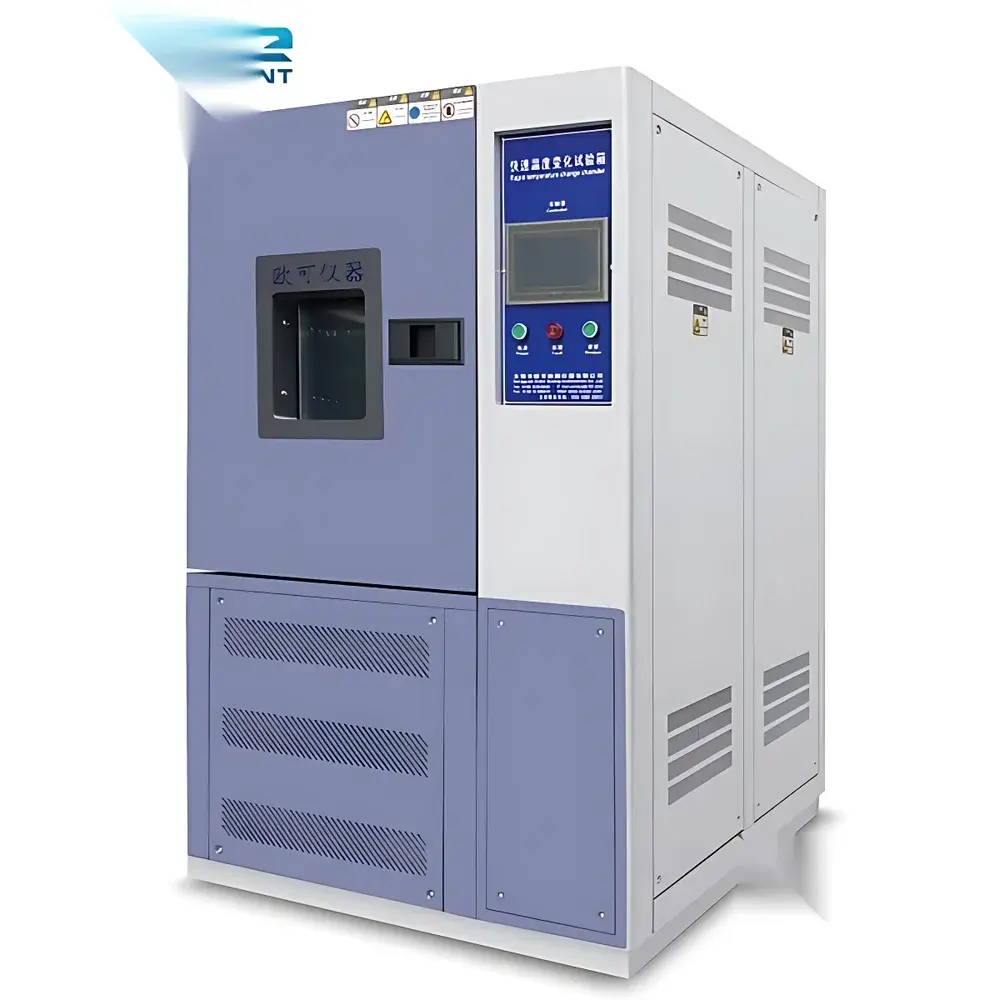
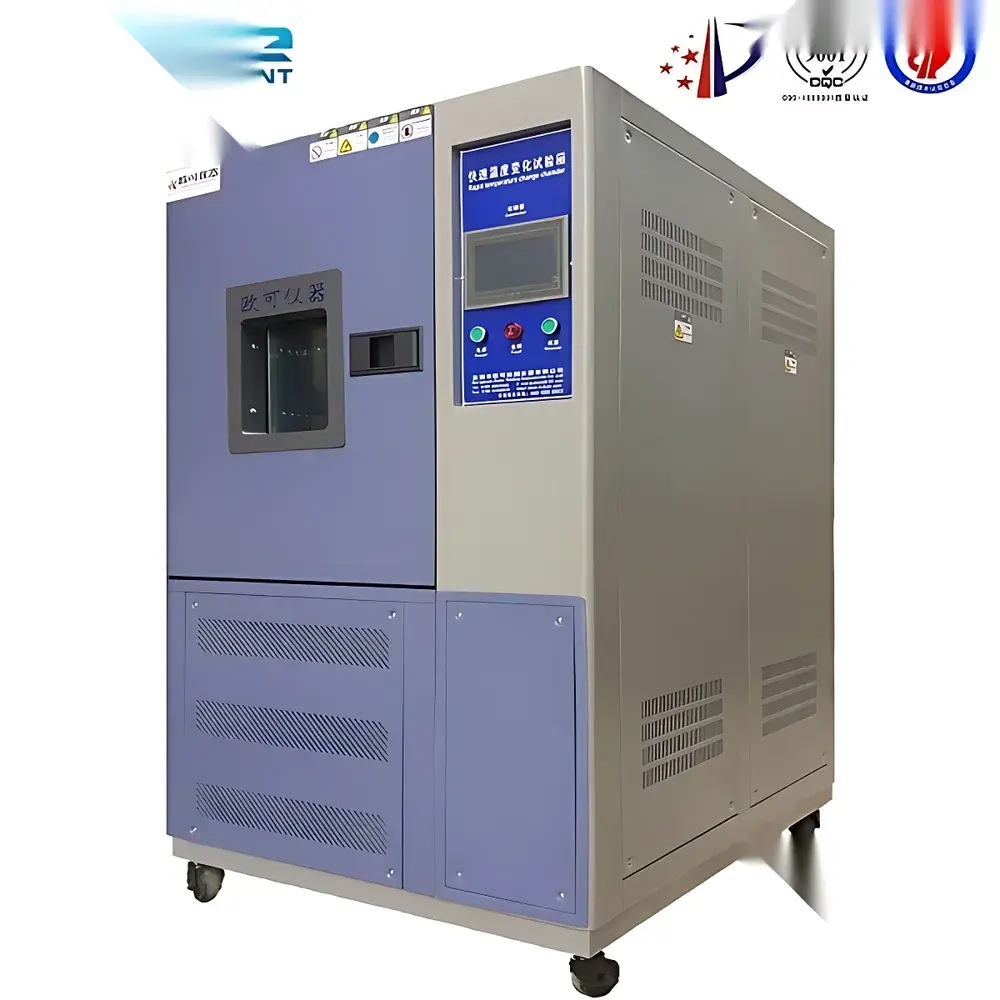
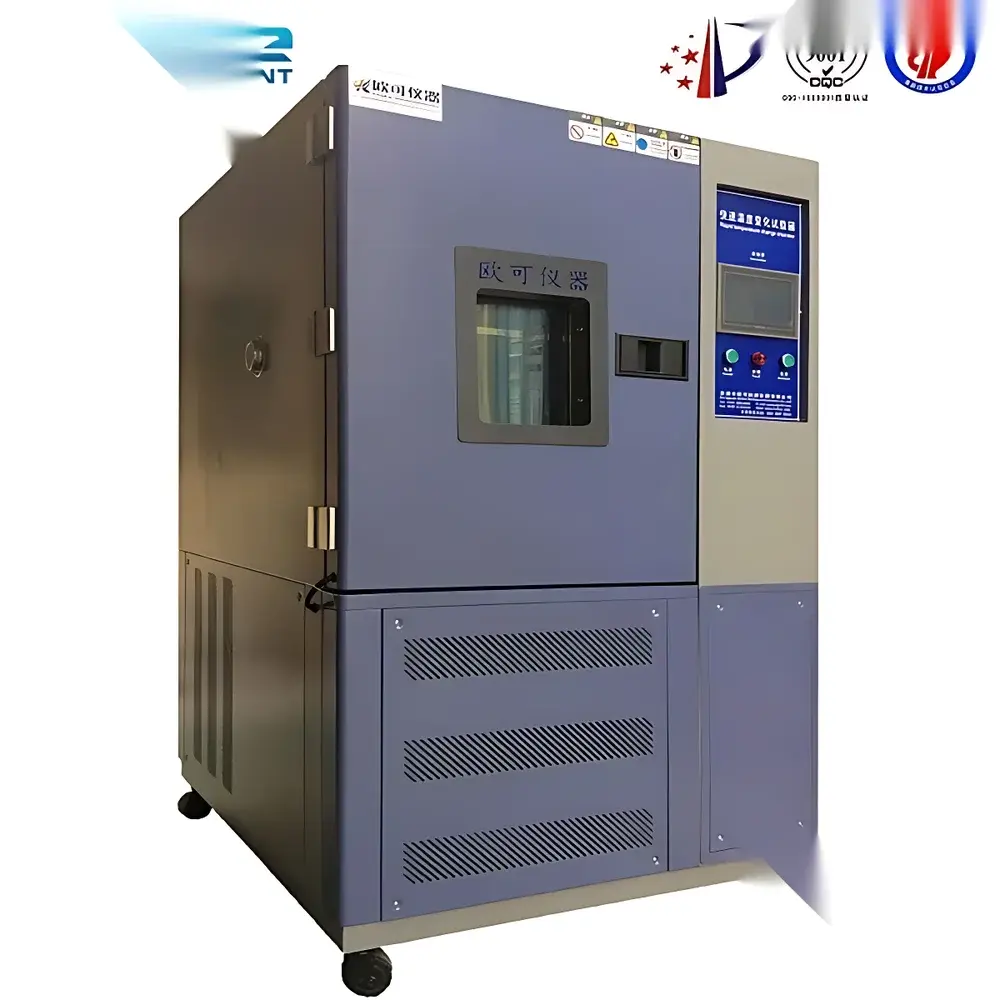
Other Brands OK-TH Series Rapid Temperature Change Environmental Test Chamber
| Brand | Other Brands |
|---|---|
| Origin | Imported |
| Manufacturer Type | General Distributor |
| Price | USD 14,000 (approx.) |
| Temperature Range | −70 °C to +150 °C |
| Humidity Range | 20–98% RH (optional: 5–98% RH) |
| Rapid TC Range | −45 °C to +85 °C or −20 °C to +85 °C |
| Ramp Rates | 5–25 °C/min (configurable) |
| Temp. Uniformity | ±2 °C |
| Humidity Uniformity | ±3.0% RH (≥75% RH) |
| Temp. Stability | ±0.5 °C |
| Humidity Stability | ±2.5% RH |
| Interior Material | SUS#304 Stainless Steel |
| Refrigeration | Hermetic Dual-Stage Compressor System with R404A/R23 Eco-Friendly Refrigerants |
| Controller | LCD Touchscreen with English/Chinese UI |
| Power Supply | AC 380 V ±5%, 50 Hz ±0.5 Hz, 3-Phase 5-Wire |
Overview
The OK-TH Series Rapid Temperature Change Environmental Test Chamber is an engineered solution for accelerated thermal stress screening of electronic components, automotive modules, aerospace subsystems, and industrial materials. It operates on the principle of controlled, high-rate thermal cycling—inducing repeatable thermal expansion and contraction within test specimens to expose latent defects including interfacial delamination, solder joint fatigue, polymer microcracking, and coefficient-of-thermal-expansion (CTE) mismatch failures. Unlike standard temperature-humidity chambers, this system delivers programmable ramp rates up to 25 °C/min across a wide operational envelope (−70 °C to +150 °C; 20–98% RH), enabling compliance-driven qualification per MIL-STD-810H Method 503.5 (Temperature Shock), IEC 60068-2-14 (Change of Temperature), and JEDEC JESD22-A106B (Thermal Shock). Its dual-stage refrigeration architecture ensures stable low-temperature hold capability and precise humidity control without condensation-induced drift.
Key Features
- Programmable rapid temperature transition profiles: selectable ramp rates of 5, 10, 15, 20, or 25 °C/min between user-defined upper and lower limits (e.g., −45 °C ↔ +85 °C)
- High-fidelity environmental control: ±0.5 °C temperature stability and ±2.5% RH humidity stability (measured at sensor location, 1-hour averaging)
- SUS#304 stainless steel interior chamber with seamless welded construction, corrosion-resistant finish, and non-outgassing surface treatment
- Dual-refrigerant cascade system using R404A (high-stage) and R23 (low-stage) compliant with current EU F-Gas Regulation (EU No. 517/2014) and EPA SNAP requirements
- Intuitive 7-inch TFT LCD touchscreen controller with real-time graphing, multi-segment program editing, and password-protected parameter locking
- Integrated over-temperature, over-humidity, compressor high-pressure, and phase-failure safety interlocks meeting IEC 61000-6-2/6-4 immunity and emission standards
Sample Compatibility & Compliance
The OK-TH series accommodates test specimens up to 1000 L internal volume (OK-TH-1000 model: 100 × 100 × 100 cm W×H×D), with customizable access ports, cable feedthroughs, and internal mounting rails. It supports standardized test configurations for PCB assemblies, battery packs, sensors, and sealed enclosures. The chamber meets critical regulatory and industry-standard requirements including GB/T 2423.1–2023 (Cold Testing), GB/T 2423.2–2023 (Dry Heat), GB/T 2423.22–2012 (Temperature Change), GJB 150.3A–2009 (High Temperature), GJB 150.4A–2009 (Low Temperature), and GJB 150.5A–2009 (Temperature Shock). Optional validation packages include IQ/OQ documentation aligned with ISO/IEC 17025 and GLP-compliant audit trails.
Software & Data Management
Embedded controller firmware supports CSV export of time-stamped temperature/humidity logs (1-second resolution), alarm history with timestamped event codes, and remote monitoring via Ethernet (Modbus TCP) or optional RS-485 interface. For laboratory integration, optional PC-based software provides automated report generation (PDF/Excel), statistical process control (SPC) charts (X-bar R, Cpk), and 21 CFR Part 11-compliant electronic signatures, audit trail logging, and user role-based access control. All data files are stored in UTC timestamp format and support traceability to NIST-traceable reference sensors calibrated annually per ISO/IEC 17025-accredited procedures.
Applications
- Reliability qualification of automotive ECUs under ISO 16750-4 thermal shock conditions
- Qualification of lithium-ion battery modules per UN 38.3 Thermal Cycling (T1–T4) protocols
- Screening of aerospace avionics for cold-start performance and thermal hysteresis effects
- Process validation of conformal coating adhesion and reflow solder joint integrity
- Material compatibility testing of elastomers, adhesives, and encapsulants across extreme thermal gradients
- Accelerated life testing (ALT) of medical device housings and sterilization packaging systems
FAQ
What is the difference between temperature cycling and temperature shock testing?
Temperature cycling involves controlled ramping between defined extremes with dwell periods; temperature shock uses near-instantaneous transfer between chambers. The OK-TH chamber performs cycling—not mechanical shock—but achieves high ramp rates sufficient for most JEDEC and MIL-STD thermal stress applications.
Can the chamber operate continuously at −70 °C with 98% RH?
No. At ultra-low temperatures, maximum achievable humidity is physically constrained by dew point limitations. The specified 20–98% RH range applies above 0 °C; below 0 °C, humidity control is limited to ≥10% RH (optional configuration) and requires extended stabilization time.
Is third-party calibration certification included with shipment?
Standard delivery includes factory calibration certificates for temperature and humidity sensors (traceable to NIM, China). ISO/IEC 17025-accredited on-site calibration and validation services are available as add-on options.
Does the system support custom test profiles with variable ramp rates per segment?
Yes. The controller supports up to 99 programmable segments per test cycle, each with independent ramp rate, dwell time, and setpoint values—including dynamic transitions between temperature and humidity steps.
What maintenance intervals are recommended for the refrigeration system?
Compressor oil analysis and refrigerant purity verification are recommended every 24 months; filter-drier replacement every 36 months; full system leak check and pressure test every 60 months—per ASHRAE Guideline 3-2021 and manufacturer service bulletins.



