
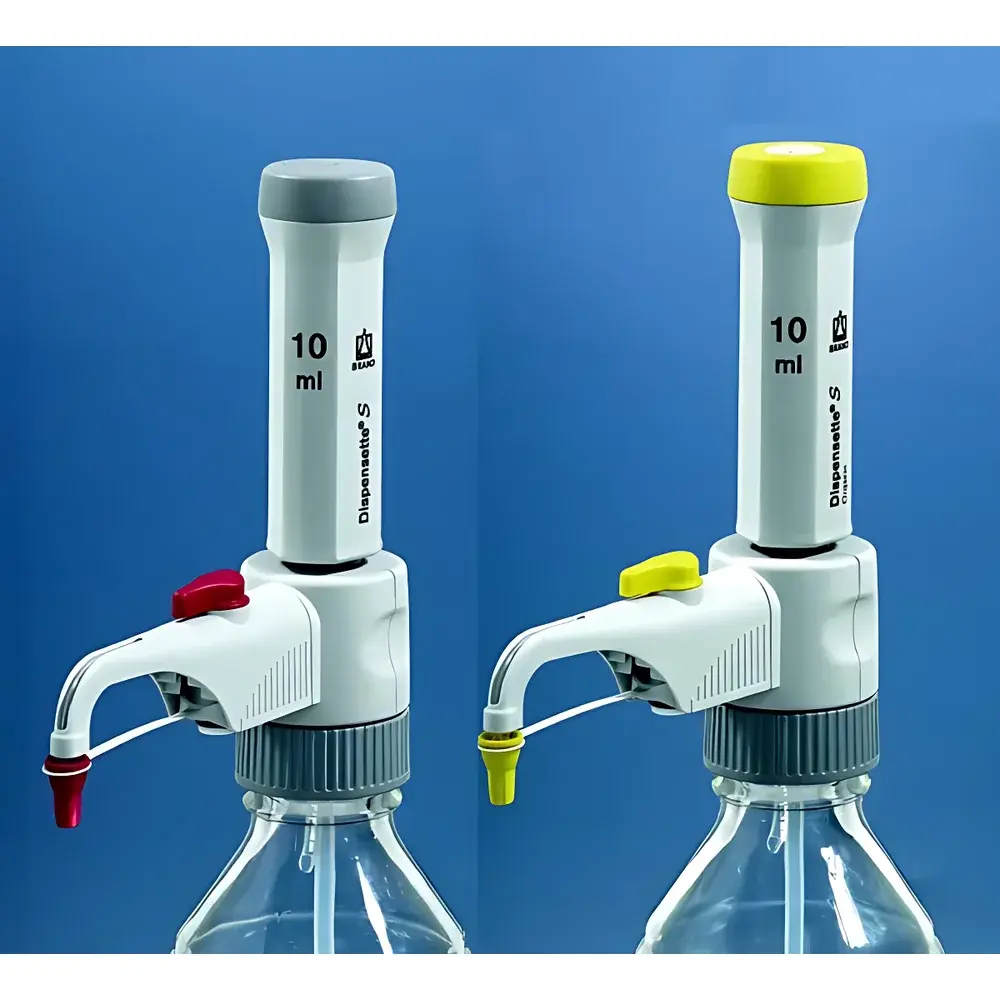
Brandtech Dispensette® S Fixed-Volume Bottle Top Dispenser
| Brand | BRAND® |
|---|---|
| Origin | Germany |
| Model | Standard / Organic |
| Type | Manual Bottle Top Dispenser |
| Compatibility | Corrosive Acids (e.g., H₂SO₄, H₃PO₄), Strong Bases (e.g., NaOH, KOH), Halogenated & Fluorinated Hydrocarbons (e.g., CCl₃CF₃, CH₂Cl₂), TFA, THF, Peroxides |
| Materials in Contact | Borosilicate Glass, Ceramic, Platinum-Iridium Alloy, ETFE, FEP, PFA, PP |
| Max. Vapor Pressure | 500 mbar |
| Max. Viscosity | 500 mm²/s |
| Max. Temperature | 40 °C |
| Max. Density | 2.2 g/cm³ |
| Sterilization | Autoclavable at 121 °C (wet heat) |
| Calibration | Tool-assisted, factory-set with red calibration indicator |
Overview
The Brandtech Dispensette® S Fixed-Volume Bottle Top Dispenser is an engineered precision liquid handling instrument designed for repeatable, contamination-free dispensing of aggressive and sensitive reagents directly from laboratory reagent bottles. Based on positive displacement piston technology, the Dispensette® S operates without reliance on air displacement or syringe-based mechanisms—eliminating vapor lock, bubble formation, and cross-contamination risks commonly associated with air-cushioned systems. Its robust architecture ensures consistent volumetric delivery across a wide chemical spectrum, including concentrated mineral acids, caustic alkalis, halogenated solvents, peroxides, and fluorinated compounds. The device is purpose-built for routine analytical, quality control, and synthetic chemistry workflows where operator safety, reagent integrity, and traceability are critical.
Key Features
- Fixed-volume dispensing mechanism ensures high reproducibility (CV < 0.5% under ISO 8655-3 conditions) without manual volume adjustment between operations.
- Chemically inert fluid path constructed from borosilicate glass, ceramic, platinum-iridium alloy, ETFE, FEP, PFA, and autoclavable polypropylene—validated for compatibility with Class I–III corrosives per ASTM D1250 and IEC 60529 IP54 environmental rating.
- Two chemically segregated variants: Red-labeled Standard model for strong acids/bases and aqueous salt solutions; Yellow-labeled Organic model optimized for chlorinated/fluorinated hydrocarbons, TFA, THF, and peroxide-containing solvents.
- Integrated red calibration indicator provides immediate visual feedback when factory-set volume has been altered—supporting GLP-compliant documentation and audit readiness.
- Full disassembly without tools enables thorough cleaning and validation; all wetted parts withstand sterilization at 121 °C for 20 minutes under saturated steam (EN 285 compliant).
- Operating limits rigorously defined per manufacturer validation: max. vapor pressure 500 mbar, max. kinematic viscosity 500 mm²/s, max. ambient temperature 40 °C, and max. liquid density 2.2 g/cm³—ensuring predictable performance within certified operational envelopes.
Sample Compatibility & Compliance
The Dispensette® S meets stringent regulatory expectations for use in GMP and GLP environments. All materials in contact with liquids comply with USP Class VI biocompatibility testing and EU Regulation (EC) No. 1935/2004 for food contact materials. Device design supports compliance with FDA 21 CFR Part 11 when integrated into validated electronic lab notebook (ELN) or LIMS workflows via documented calibration logs and change-control records. It is routinely deployed in laboratories adhering to ISO/IEC 17025:2017 for testing and calibration laboratories, particularly in applications requiring traceable volumetric transfer of hazardous substances under OSHA Hazard Communication Standard (29 CFR 1910.1200) and CLP Regulation (EC) No. 1272/2008.
Software & Data Management
While the Dispensette® S is a manually operated mechanical instrument with no embedded electronics or firmware, its calibration and usage history are fully documentable within laboratory quality management systems. Each unit ships with a Certificate of Conformance and individual calibration report traceable to DKD/DAkkS-accredited standards. Users maintain calibration records—including date, technician ID, reference standard used, and post-calibration verification data—in accordance with ISO/IEC 17025 clause 7.7. The red calibration indicator serves as a physical, tamper-evident marker supporting integrity checks during internal audits and regulatory inspections.
Applications
- Precise dispensing of concentrated HCl, HNO₃, H₂SO₄, and H₃PO₄ in titration standardization and acid digestion protocols.
- Safe handling of NaOH/KOH solutions in buffer preparation and pH adjustment without risk of crystallization-induced valve seizure.
- Accurate transfer of halogenated solvents (e.g., CH₂Cl₂, CCl₃CF₃) and peroxide-forming ethers (e.g., THF, diethyl ether) in organic synthesis and extraction workflows.
- Reagent addition in ICP-MS, HPLC, and GC sample preparation where particulate-free, bubble-free delivery is essential for instrument protection and data fidelity.
- Use in pharmaceutical QC labs for dissolution media preparation and stability-indicating assay dilutions under USP <1058> guidance.
FAQ
Is the Dispensette® S suitable for dispensing hydrogen peroxide solutions?
Yes—the Organic variant is specifically validated for stabilized peroxide solutions up to 30% w/w, provided storage and dispensing temperatures remain ≤40 °C and exposure to catalytic metals is avoided.
Can the device be sterilized in an autoclave?
All wetted components are rated for repeated autoclaving at 121 °C, 103 kPa (15 psi) for 20 minutes in saturated steam per EN 285 Annex A. Disassembly and drying post-sterilization are mandatory before reuse.
What is the expected service life under daily use in a QC lab?
With proper maintenance—including quarterly cleaning, annual recalibration, and avoidance of exceeding stated operating limits—the dispenser maintains metrological integrity for ≥5 years based on Brandtech’s field reliability data (MTBF > 25,000 cycles).
Does it comply with ISO 8655 for piston-operated dispensers?
Yes—each model is type-tested and certified to ISO 8655-3:2022 for fixed-volume dispensers, with accuracy and precision verified across the full specified density and viscosity range.
How is calibration traceability established?
Each unit includes a DKD/DAkkS-traceable calibration certificate referencing national standards (e.g., PTB, NIST SRM 2191c), with uncertainty budgets reported per ISO/IEC 17025 Annex A.3.



