
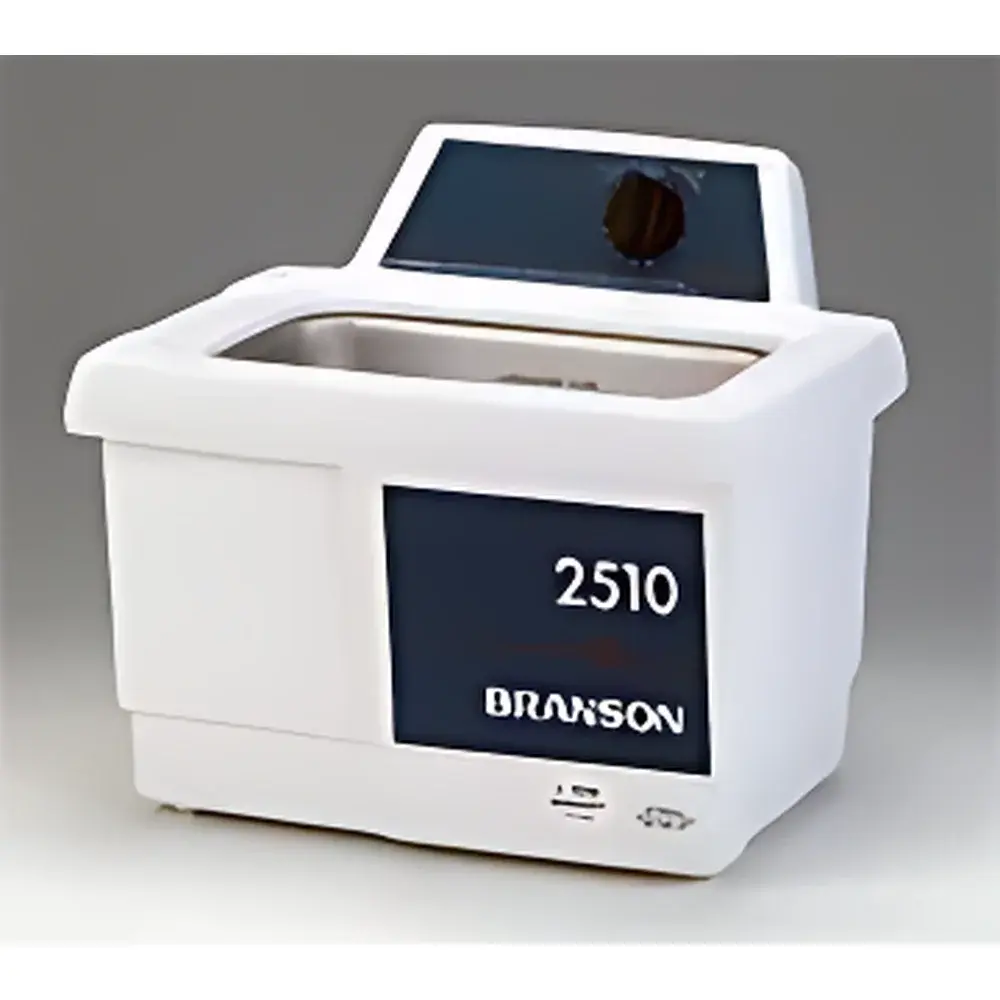
Branson B2510E-MT Ultrasonic Cleaner
| Brand | Branson |
|---|---|
| Origin | USA |
| Model | B2510E-MT |
| Tank Capacity | 2.8 L |
| Internal Dimensions | 241 × 139 × 101 mm |
| Ultrasonic Frequency | 40 kHz |
| Timer Range | 0–99 min (digital, programmable) |
| Ultrasonic Power Output | 130 W |
| Input Voltage | 220 V, 50/60 Hz |
| Heating Function | Yes (temperature display and control) |
| Construction Material | Polypropylene (PP) tank and housing |
| Transducer Type | Langevin-type piezoelectric transducer (metal/ceramic composite) |
| Sweep Frequency Function | Yes |
| Water Level Indicator | Fixed optimal fill line |
| Lid Design | Hinged noise-reduction lid with integrated drip tray and drain valve |
| Safety Features | Sealed vertical PCB layout, moisture-resistant control panel, rubber-coated power switch |
Overview
The Branson B2510E-MT Ultrasonic Cleaner is a precision-engineered benchtop cleaning system designed for reproducible, non-destructive removal of particulate, organic, and ionic contaminants from delicate laboratory components, analytical instrumentation parts, surgical tools, optical elements, and electronic assemblies. It operates on the principle of high-frequency acoustic cavitation—where controlled 40 kHz ultrasonic energy induces rapid formation and collapse of microscopic vapor bubbles in the cleaning solution. This transient cavitation generates localized high-pressure micro-jets and shear forces that dislodge contaminants from surfaces without mechanical abrasion or thermal degradation. Engineered for consistent energy distribution across the entire tank volume, the B2510E-MT employs Branson’s proprietary spherical wave propagation design to minimize standing wave interference and ensure uniform cleaning efficacy—even in complex geometries such as narrow lumens, threaded fittings, and microfluidic channels.
Key Features
- Langevin-type piezoelectric transducers (metal/ceramic composite) mounted via advanced adhesive bonding for long-term structural integrity and minimal acoustic decoupling.
- Programmable digital timer with extended range (1–99 minutes), enabling precise process validation and repeatable cycle execution per SOP requirements.
- Polypropylene (PP) construction for both tank and outer housing—resistant to common aqueous alkaline, acidic, and solvent-based cleaning chemistries including IPA, acetone, and enzymatic formulations.
- Integrated heating system with real-time digital temperature display and closed-loop thermal regulation—supports temperature-assisted cleaning protocols up to 80 °C (user-configurable).
- Vertically oriented printed circuit board assembly with conformal coating—designed to mitigate condensation ingress and enhance operational reliability in humid environments.
- Ergonomic top-mounted control interface with tactile rubber-coated power switch and intuitive LED indicators—minimizes risk of liquid intrusion during routine operation.
- Hinged acoustic lid featuring dual functionality: noise attenuation (reducing ambient sound pressure by ≥15 dB(A)) and secondary use as a spill-containment drip tray with integrated drain valve for efficient solution disposal.
- Fixed optimal fill line ensures consistent acoustic coupling and maximum energy transfer efficiency—critical for maintaining GMP-aligned process consistency across batches.
Sample Compatibility & Compliance
The B2510E-MT accommodates a broad spectrum of sample types—including glassware (vials, cuvettes, pipette tips), stainless-steel instruments (forceps, scalpel handles), ceramic substrates, silicon wafers, and polymer-based microplates—without compromising dimensional stability or surface finish. Its PP tank complies with USP Class VI biocompatibility standards for short-term contact with medical devices. While not certified as a sterilizer, the unit supports validated cleaning steps aligned with ISO 15883-1 (washer-disinfectors) and ASTM F3127 (ultrasonic cleaning performance testing). The absence of moving parts and sealed electronics facilitates routine cleaning validation per FDA 21 CFR Part 11-compliant documentation workflows when paired with Branson’s optional data-logging software.
Software & Data Management
The B2510E-MT operates as a standalone instrument with embedded firmware; no external PC connection is required for basic operation. For laboratories requiring audit-ready traceability, Branson offers optional USB-enabled data loggers compatible with the B2510E-MT platform. These modules record timestamped parameters—including start/stop time, set temperature, actual bath temperature, and elapsed ultrasonic duration—with export capability to CSV for integration into LIMS or ELN systems. All firmware updates are delivered via secure Branson Field Service Portal, ensuring continued alignment with evolving GLP/GMP documentation expectations.
Applications
- Pre-analytical sample preparation: cleaning HPLC autosampler vials, GC injection ports, and ICP-MS nebulizers to eliminate carryover and baseline drift.
- Quality control labs: decontamination of metal calibration standards, reference material holders, and particle-counting filters prior to gravimetric analysis.
- Medical device manufacturing: removal of machining oils and polishing residues from orthopedic implants and endoscopic components prior to passivation.
- Research settings: gentle cleaning of AFM cantilevers, TEM grids, and microelectrode arrays without altering surface morphology or electrochemical properties.
- Electronics R&D: residue-free degreasing of PCBs, solder stencils, and MEMS sensors before conformal coating or packaging.
FAQ
Is the B2510E-MT suitable for use with flammable solvents?
No. This unit is designed exclusively for aqueous or water-miscible solutions. Flammable solvents require explosion-proof ultrasonic systems with intrinsically safe transducers and purge ventilation—consult Branson’s Ex-rated product line for such applications.
Can the heating function be disabled independently of ultrasonic operation?
Yes. The heater and ultrasonics operate as fully independent subsystems—enabling cold ultrasonic cleaning or static heating without cavitation.
What maintenance is required to sustain optimal cavitation performance?
Routine descaling every 3–6 months (depending on water hardness) using Branson’s recommended citric acid solution; transducer inspection is advised annually by authorized service personnel.
Does the unit include a degas mode?
No. Degassing must be performed manually prior to loading samples—typically by running the unit empty for 5–10 minutes at elevated temperature (50–60 °C) to remove dissolved air that impedes cavitation onset.
Is calibration certification available for the temperature sensor?
Yes. NIST-traceable temperature calibration reports are available upon request through Branson’s Technical Services group, supporting ISO/IEC 17025-compliant laboratory accreditation requirements.



