
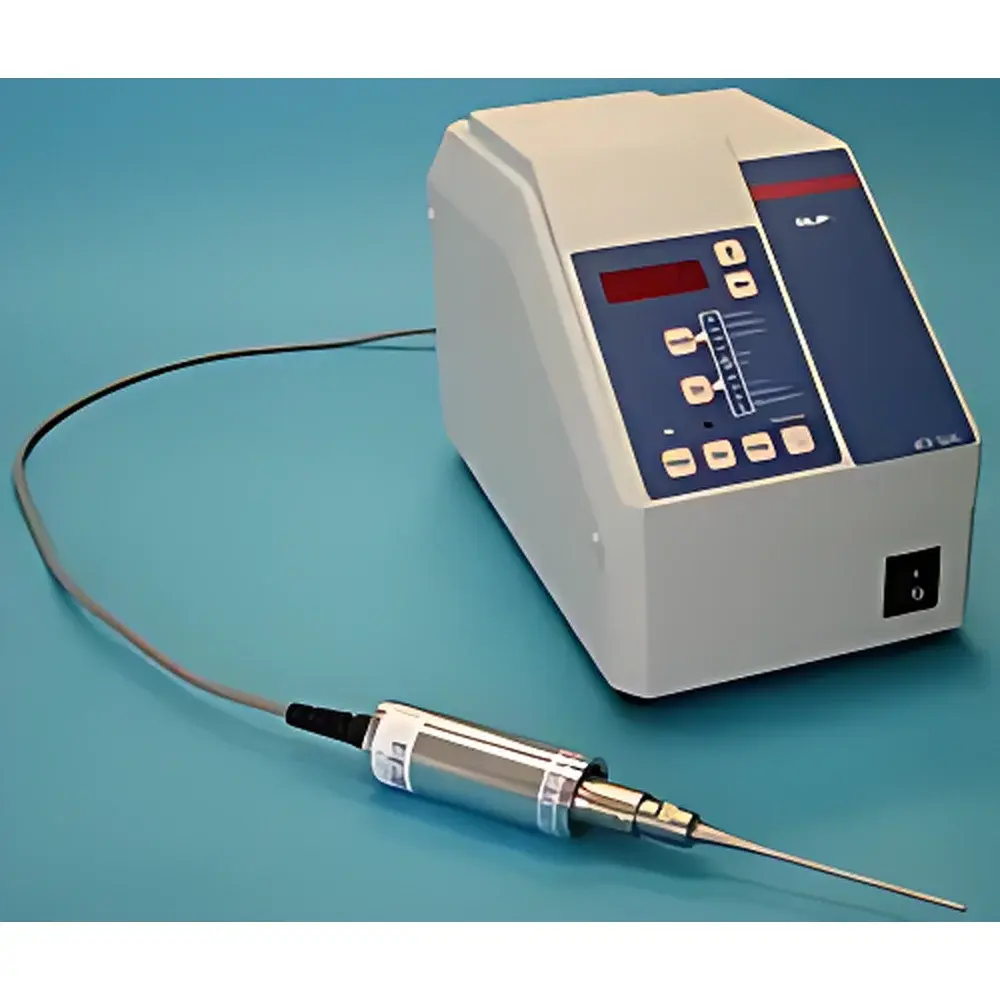
Brookfield Sonifier® SLPe Ultrasonic Cell Disruptor
| Origin | USA |
|---|---|
| Manufacturer Type | Distributor |
| Origin Category | Imported |
| Model | SLPe |
| Instrument Type | Ultrasonic Cell Disruptor |
| Operating Frequency | 40 kHz |
| Output Power | 150 W (continuously adjustable) |
| Voltage Rating | 230 V AC, 50/60 Hz |
| Max Current | 4 A |
| Standard Probe | 1/8" (3 mm) microtip |
| Sample Volume Range | 0.25–10 mL |
| Amplitude Control | 10–100% in 1% increments |
| Time Setting Range | 1 s – 99 h |
| Energy Setting Range | 1–10,000 J |
| Pulse Duration | 0.1–9.9 s |
| Auto-Tuning & Memory (AT/M) | Yes |
| Diagnostic Self-Test | On power-up |
| Weight | 7.71 kg |
Overview
The Brookfield Sonifier® SLPe Ultrasonic Cell Disruptor is an engineered laboratory instrument designed for precise, reproducible mechanical lysis of biological samples via high-frequency ultrasonic energy. Operating at a stable 40 kHz frequency, the system generates controlled acoustic cavitation in liquid media—inducing transient microbubble formation, growth, and violent collapse. This physical phenomenon delivers localized shear forces, microstreaming, and shockwaves sufficient to disrupt cell membranes, viral envelopes, bacterial walls, spores, and subcellular organelles without introducing chemical or thermal artifacts. Unlike thermal or enzymatic lysis methods, ultrasonic disruption preserves native protein conformation and nucleic acid integrity when optimized, making the SLPe particularly suitable for downstream applications including Western blotting, ELISA, qPCR, RNA-seq library preparation, and recombinant protein extraction. Its compact footprint, integrated generator-transducer architecture, and microtip probe design enable consistent processing of small-volume samples (0.25–10 mL), aligning with modern high-throughput and low-input workflows in molecular biology, immunology, and virology laboratories.
Key Features
- Digital amplitude control: Precise 10–100% adjustment in 1% increments ensures repeatable energy delivery across replicates and experimental conditions.
- Two operational modes: Continuous output for rapid homogenization or pulsed mode (0.1–9.9 s pulse/on duration) to minimize sample heating and preserve thermolabile biomolecules.
- Programmable energy and time parameters: Independent setting of total energy (1–10,000 J) and total duration (1 s–99 h) enables method standardization compliant with internal SOPs and external regulatory expectations.
- Auto-tuning & memory (AT/M) function: Automatically optimizes resonant frequency at the start of each cycle and stores the last-used parameters—even after power loss—reducing setup variability between users and shifts.
- Real-time LED interface: Displays setpoints and real-time operational status (e.g., amplitude %, elapsed time, remaining energy), supporting visual verification during critical steps.
- Integrated diagnostics: Built-in self-test on power-up verifies transducer coupling, generator stability, and probe integrity prior to operation—supporting GLP-aligned equipment qualification protocols.
- Low-heat microtip probe (1/8″ / 3 mm): Delivers up to 70% peak amplitude (vs. ~40% in conventional probes), enabling efficient lysis of resilient targets—including Gram-positive bacteria and enveloped viruses—while minimizing localized temperature rise.
Sample Compatibility & Compliance
The SLPe is validated for use with aqueous suspensions of mammalian cells, plant protoplasts, yeast, bacteria (including E. coli, B. subtilis), viral particles (e.g., influenza, lentivirus), and tissue homogenates. Its non-contact probe configuration minimizes cross-contamination risk; optional non-contact horn accessories further isolate aerosolized biohazards during viral lysis. The instrument meets IEC 61010-1 safety requirements for laboratory electrical equipment and complies with electromagnetic compatibility (EMC) standards EN 61326-1. While not FDA-cleared as a medical device, its operational parameters support adherence to USP <1043> (Cell Culture Performance Qualification), ISO 13485-aligned process validation, and internal QC documentation required under GLP and GMP environments. Data integrity is reinforced by parameter logging capability and audit-ready operation records when paired with compliant LIMS or ELN systems.
Software & Data Management
The SLPe operates as a standalone hardware platform with no proprietary software dependency—ensuring long-term usability and cybersecurity resilience. All user-defined parameters (amplitude, time, energy, pulse settings) are retained in non-volatile memory and accessible via front-panel controls. For traceability, laboratories may integrate the device into electronic lab notebooks (ELNs) or quality management systems (QMS) using manual entry or barcode-scanned method IDs. When used with optional external data loggers or industrial PLC interfaces (via I/O ports), analog or digital signals can be captured for automated record generation—facilitating compliance with FDA 21 CFR Part 11 requirements where electronic signatures and audit trails are mandated. Calibration certificates and performance verification reports (e.g., amplitude linearity, energy accuracy per ASTM E2877-22) are available upon request for IQ/OQ documentation.
Applications
- Preparation of soluble antigen extracts from splenocytes or dendritic cells for immunogenicity assays
- Chromatin shearing in ChIP-seq workflows requiring narrow fragment size distribution (200–500 bp)
- Lysis of Mycobacterium tuberculosis cultures for proteomic analysis under BSL-3 containment
- Exosome isolation from conditioned media via sequential ultrasonication and differential centrifugation
- Disruption of fungal hyphae for genomic DNA extraction in phytopathology studies
- Emulsification of lipid nanoparticles (LNPs) during mRNA vaccine development R&D
- Cleaning and functionalization of microfluidic channels and AFM cantilevers
FAQ
What is the recommended maintenance schedule for the SLPe transducer and probe?
Routine inspection of probe threads and tip erosion should occur before each use; full calibration and impedance verification are recommended every 6 months or after 500 operating hours.
Can the SLPe be used for inactivation of infectious agents?
Ultrasonic treatment alone does not constitute validated sterilization or viral inactivation per ISO 15223 or WHO guidelines; it must be combined with chemical or thermal validation steps for biosafety compliance.
Is the 1/8″ probe autoclavable?
Yes—the titanium alloy probe is autoclavable at 121°C for 20 minutes; however, the transducer housing and generator must never be exposed to steam or immersion.
How does the SLPe compare to high-pressure homogenizers for bacterial lysis?
The SLPe offers superior control over small volumes and heat-sensitive samples but is less scalable than pressure-based systems; it excels in R&D and pre-clinical batch sizes (<50 mL), whereas homogenizers dominate manufacturing-scale processing.
Does the SLPe support remote operation or network connectivity?
No native Ethernet or Wi-Fi interface is provided; however, digital I/O ports allow integration with programmable logic controllers (PLCs) or custom LabVIEW-based automation frameworks.




