
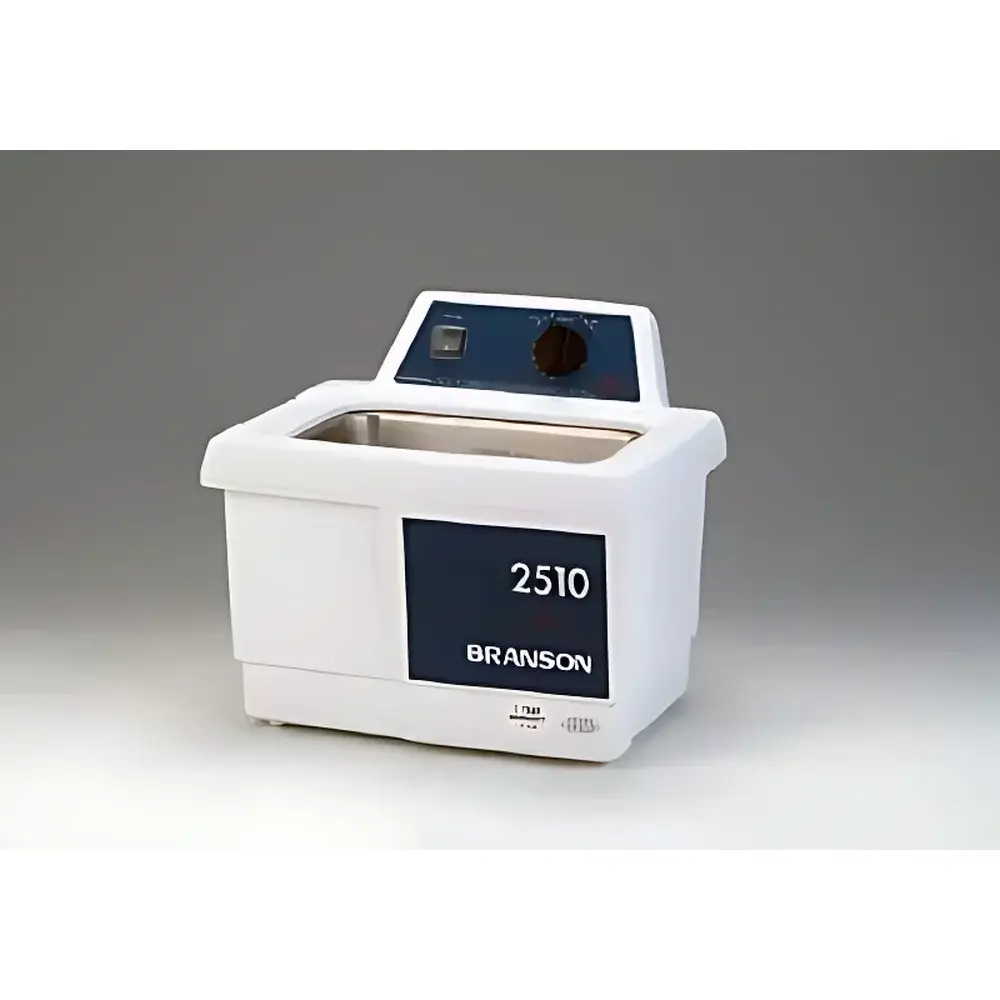
Branson B2510E-MTH Ultrasonic Cleaner
| Brand | Branson |
|---|---|
| Origin | USA |
| Model | B2510E-MTH |
| Tank Capacity | 2.8 L |
| Internal Dimensions | 241 × 139 × 101 mm |
| Ultrasonic Frequency | 40 kHz |
| Heating Range | 0–70 °C |
| Timer Range | 0–99 min (digital) |
| Heater Power | 109 W |
| Total Power | 239 W |
| Input Voltage | 220 V, 50/60 Hz |
| Tank Material | Polypropylene (PP) |
| Transducer Type | Langevin-type metal/ceramic |
| Sweep Frequency Function | Yes |
| Display | Digital temperature readout (actual & setpoint) |
| Lid | Hinged noise-reduction cover with integrated drip tray and drain valve |
Overview
The Branson B2510E-MTH Ultrasonic Cleaner is an entry-level yet rigorously engineered benchtop cleaning system designed for routine laboratory decontamination, parts degreasing, and preparatory sample handling in analytical, pharmaceutical, and materials science workflows. It operates on the principle of ultrasonic cavitation—where high-frequency mechanical vibrations (40 kHz) generate controlled micro-bubbles in a liquid medium; their implosive collapse delivers localized energy sufficient to dislodge particulate matter, organic residues, and loosely adhered contaminants from submerged surfaces. Unlike immersion-only or manual scrubbing methods, this process achieves consistent, non-abrasive cleaning across complex geometries—including lumens, crevices, and porous substrates—without compromising sample integrity or operator safety. The unit is built to meet the functional expectations of ISO/IEC 17025-accredited laboratories and aligns with general Good Laboratory Practice (GLP) requirements for equipment traceability, reproducibility, and operational stability.
Key Features
- Chemically resistant polypropylene (PP) tank construction ensures long-term compatibility with mild alkaline, acidic, and aqueous cleaning solutions—eliminating corrosion risks associated with stainless-steel alternatives in low-pH applications.
- Langevin-type transducers—metal-ceramic hybrid elements—deliver superior electromechanical coupling efficiency and thermal stability over conventional piezoelectric designs, extending service life under continuous operation.
- Integrated frequency sweep function continuously modulates the 40 kHz output within a narrow bandwidth, preventing standing-wave formation and ensuring uniform energy distribution throughout the tank volume.
- Digital dual-display interface shows real-time bath temperature and user-defined setpoint, enabling precise thermal control during temperature-sensitive cleaning protocols (e.g., enzyme removal or polymer residue dissolution).
- Hinged acoustic lid doubles as a drip tray and incorporates a quick-release drain valve—facilitating rapid solution exchange and minimizing cross-contamination between cleaning cycles.
- Vertical PCB orientation and elevated control panel placement provide inherent protection against moisture ingress, enhancing reliability in humid environments and supporting extended mean time between failures (MTBF).
- Adjustable timer supports programmable durations from 1 to 99 minutes—exceeding standard industry ranges—and includes automatic shutdown with audible alert for unattended operation compliance.
Sample Compatibility & Compliance
The B2510E-MTH accommodates a broad range of sample types including glassware (vials, pipettes, cuvettes), metal components (surgical instruments, calibration standards), ceramic substrates, and plastic labware—provided material compatibility with ultrasonic energy and selected cleaning chemistries is verified. It conforms to IEC 61000-6-3 (EMC emissions) and IEC 61000-6-2 (immunity) standards. While not certified to UL or CE for medical device reprocessing, its design supports adherence to ASTM D2603 (standard test method for ultrasonic cleaning performance) and complements institutional SOPs aligned with USP (Cleaning and Sanitization of Laboratory Equipment). Routine maintenance—including transducer inspection and tank integrity verification—is recommended per Branson’s Technical Bulletin TB-ULS-002.
Software & Data Management
This model operates as a standalone instrument without embedded firmware-based data logging or network connectivity. All operational parameters—including timer setting, target temperature, and activation status—are manually configured via front-panel controls. For laboratories requiring audit-ready records, integration with external environmental monitoring systems (e.g., Vaisala viewLinc or DeltaTrak BlueView) is feasible using optional analog voltage outputs (available via third-party signal conditioning modules). Temperature calibration may be performed using NIST-traceable thermistors per manufacturer-recommended procedures, supporting GLP documentation requirements.
Applications
- Routine cleaning of HPLC vials, GC autosampler trays, and spectrophotometer cells prior to analysis.
- Removal of polishing compounds and metal fines from precision machined components in quality control labs.
- Preparation of electron microscopy grids and TEM specimen holders requiring particle-free surfaces.
- Decontamination of reusable pipette tips and electrophoresis combs in molecular biology workflows.
- Supporting ASTM E165 and ISO 3452-2 penetrant testing procedures through pre- and post-inspection cleaning stages.
FAQ
Is the B2510E-MTH suitable for cleaning delicate optical components?
Yes—when operated at reduced power (via duty-cycle adjustment using external timers) and paired with low-surface-tension, non-ionic surfactants, it has been validated for cleaning fused silica lenses and laser mirrors without inducing micro-scratches.
Can this unit be used with flammable solvents?
No. The B2510E-MTH lacks explosion-proof certification and is rated exclusively for aqueous or water-miscible solutions. Use only in well-ventilated areas and never with acetone, ethanol, or chlorinated hydrocarbons.
What is the recommended cleaning solution concentration for general labware?
A 1–2% w/v concentration of Branson EC, Alconox, or equivalent low-foaming alkaline detergent is optimal for most glass and metal substrates at 40–55 °C.
Does the unit include a degassing cycle?
No. Degassing must be performed manually by activating ultrasonics for 5–10 minutes before sample immersion to remove dissolved air that attenuates cavitation efficiency.
How often should the transducer bonding integrity be inspected?
Branson recommends visual and acoustic inspection every 6 months—or after 500 operational hours—using a calibrated sound pressure level meter per TB-ULS-004 guidelines.



