
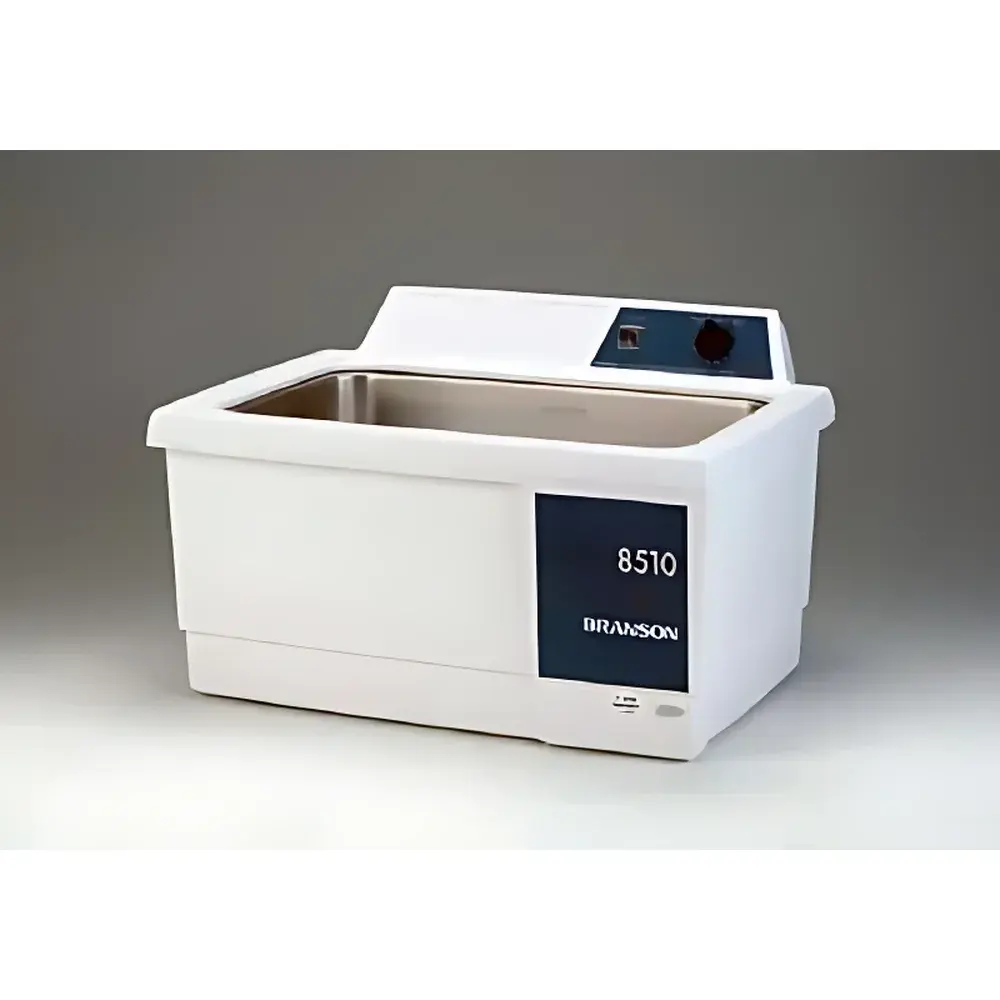
Branson B8510E-MTH Ultrasonic Cleaner
| Brand | Branson |
|---|---|
| Origin | USA |
| Model | B8510E-MTH |
| Tank Volume | 20.81 L |
| Internal Dimensions | 492 × 292 × 152 mm |
| Ultrasonic Frequency | 40 kHz |
| Heating Range | 0–69 °C |
| Timer Range | 1–60 min (ambient or heated mode) |
| Ultrasonic Power Output | 320 W |
| Input Voltage | 220 V, 50/60 Hz |
| Construction Material | Polypropylene (PP) tank and housing |
| Transducer Type | Langevin-type metal/ceramic stack |
| Mounting Method | Adhesive-bonded transducers |
| Control Interface | Digital temperature display with setpoint control |
| Lid Function | Hinged noise-reduction lid with integrated drip tray and drain valve |
Overview
The Branson B8510E-MTH Ultrasonic Cleaner is a precision-engineered laboratory-grade cleaning system designed for reproducible, residue-free decontamination of delicate instruments, glassware, surgical tools, electronic components, and analytical sample preparation vessels. It operates on the principle of high-frequency acoustic cavitation—where controlled 40 kHz ultrasonic energy induces microscopic bubble formation and implosion within the cleaning fluid, generating localized shear forces that dislodge particulate matter, organic films, and biofilm without mechanical abrasion. Engineered for stability in regulated environments, this unit integrates thermostatically controlled heating (0–69 °C), digital timing (1–60 min), and optimized energy distribution via Branson’s proprietary spherical wave propagation design—ensuring uniform cavitation intensity across the entire 20.81 L tank volume.
Key Features
- Chemically resistant polypropylene (PP) construction—including tank, housing, and lid—provides long-term compatibility with aqueous alkaline, acidic, and mild solvent-based cleaning solutions commonly used in ISO 13485-certified medical device reprocessing and GLP-compliant lab workflows.
- Langevin-type piezoelectric transducers (metal/ceramic composite stacks) mounted via high-strength adhesive bonding to the tank bottom ensure consistent power transfer, minimal harmonic distortion, and extended operational life under continuous duty cycles.
- Advanced frequency sweeping circuitry eliminates standing wave nodes and hot spots by dynamically modulating the drive signal across a narrow band around 40 kHz—maintaining stable cavitation density regardless of load geometry or fluid level.
- Vertically oriented internal PCB layout with conformal coating minimizes condensation-related corrosion and enhances reliability in high-humidity laboratory settings.
- Ergonomic top-mounted control panel features dual digital displays: real-time bath temperature and user-defined setpoint—enabling precise thermal management critical for enzymatic cleaning protocols or low-temperature-sensitive samples.
- Hinged acoustic lid doubles as a spill-containment drip tray and incorporates a quick-release drain valve for rapid, tool-free fluid evacuation—reducing turnaround time between cleaning cycles and supporting water conservation initiatives.
- Factory-calibrated ultrasonic output delivers 320 W nominal power at rated load, meeting ASTM D2603-20 requirements for ultrasonic cleaner performance verification.
Sample Compatibility & Compliance
The B8510E-MTH accommodates a wide range of sample types—including stainless steel forceps, quartz cuvettes, HPLC vials, microfluidic chips, printed circuit boards, and ceramic substrates—without risk of surface pitting or etching when operated within recommended parameters. Its PP tank complies with USP Class VI biocompatibility standards for indirect contact with pharmaceutical manufacturing equipment. The unit supports validation protocols aligned with ISO 15883-1 (washer-disinfectors), AAMI ST33 (ultrasonic cleaner testing), and FDA 21 CFR Part 11-ready data logging when interfaced with Branson’s optional Insight™ software suite. All electrical components meet IEC 61010-1 safety certification for laboratory use.
Software & Data Management
While the B8510E-MTH operates as a standalone analog/digital hybrid controller, it is fully compatible with Branson’s Insight™ PC-based software (sold separately) for automated method storage, cycle documentation, audit trail generation, and export of timestamped temperature/timer logs in CSV or PDF format. This integration enables full traceability for quality assurance departments requiring compliance with GMP Annex 11, ISO/IEC 17025, or CAP-accredited laboratory standards. Firmware updates are delivered via USB interface, ensuring continued alignment with evolving regulatory expectations for instrument calibration and maintenance records.
Applications
- Pre-analytical sample preparation: removal of residual proteins, lipids, and nucleic acid carryover from pipette tips, centrifuge tubes, and electrophoresis trays.
- Medical device reprocessing: cleaning of endoscopic accessories, orthopedic implants, and dental handpieces prior to sterilization per AAMI TIR30 guidelines.
- Materials science: deburring of MEMS components, degassing of polymer precursor solutions, and surface activation of substrates before thin-film deposition.
- Electronics manufacturing: flux residue removal from SMT assemblies and solder paste inspection wafers without thermal or mechanical stress.
- Pharmaceutical QC labs: cleaning of dissolution apparatus baskets, tablet friability testers, and Karl Fischer titration cells to prevent cross-contamination.
FAQ
What is the recommended cleaning solution for optimal cavitation efficiency?
Aqueous solutions with low surface tension and moderate viscosity—such as 1–2% Branson EC, Alconox®, or similar non-ionic surfactants—are validated for use. Avoid chlorinated solvents or highly volatile organics unless explicitly approved in the Safety Data Sheet.
Can the unit be operated without heating?
Yes—the timer and ultrasonic generator function independently of the heater; ambient-temperature cleaning is supported across the full 1–60 minute range.
Is the tank depth sufficient for submerging tall glassware?
With a liquid depth of 152 mm, standard 100 mm test tubes, 50 mL centrifuge tubes, and most volumetric flasks up to 1 L can be fully immersed when placed vertically.
How often should the transducers be inspected for adhesion integrity?
Under normal use, no routine inspection is required; however, visual checks every 6 months are advised if operating >8 hrs/day in aggressive chemical environments.
Does the unit support external temperature probe input?
No—the built-in NTC thermistor provides closed-loop bath temperature control; external probe integration requires third-party DAQ hardware and custom scripting.



