
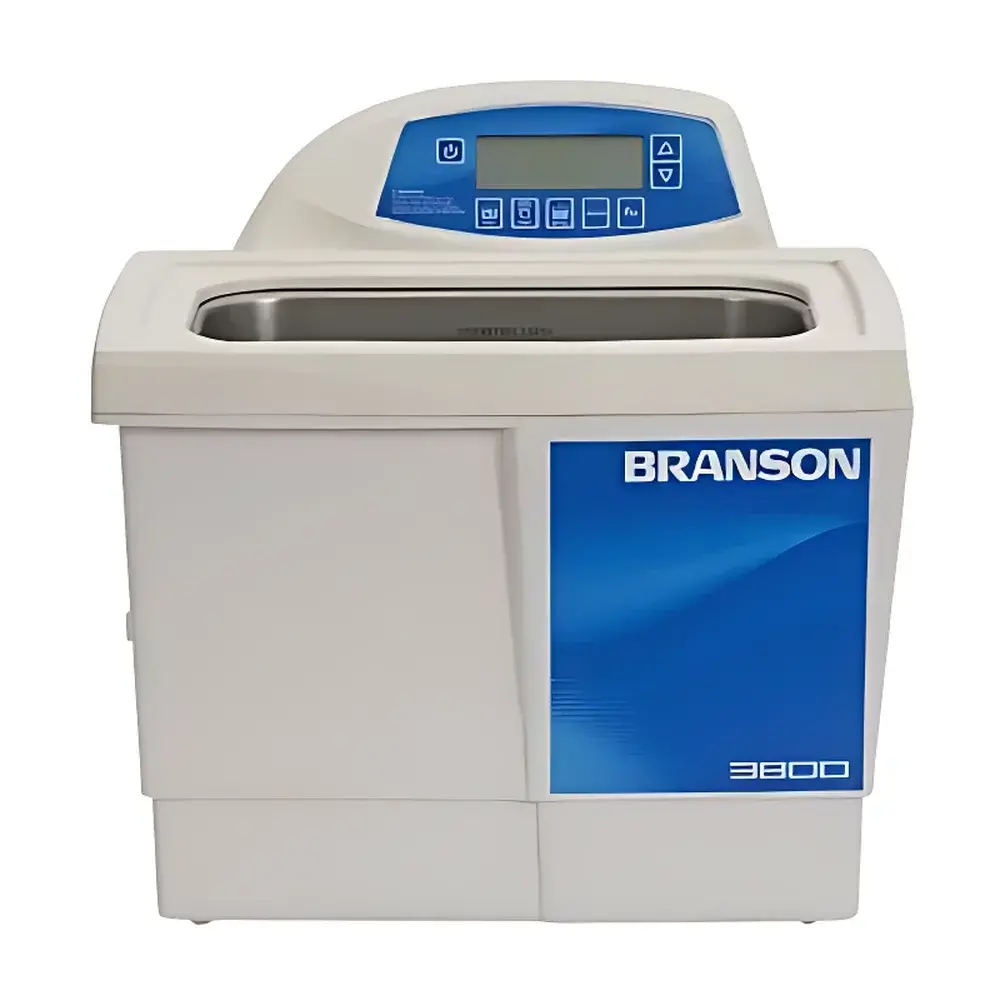
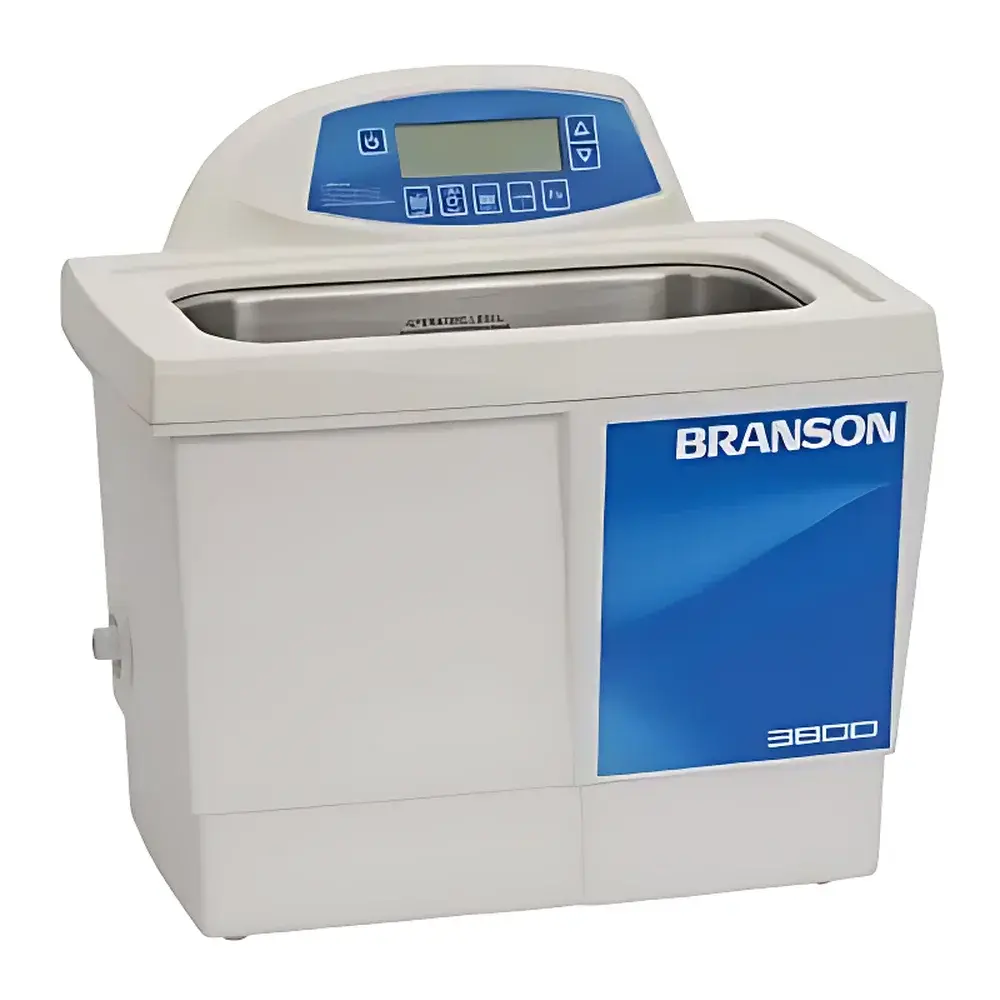
Branson CPX3800H-C Benchtop Ultrasonic Cleaner
| Brand | Branson |
|---|---|
| Origin | Mexico |
| Model | CPX3800H-C |
| Capacity | 5.7 L |
| Ultrasonic Frequency | 40 kHz |
| Ultrasonic Power | 130 W |
| Adjustable Power | Yes |
| Heating Range | Ambient to 69 °C |
| Timer Range | 1–99 min |
| Sound-Dampening Lid | Yes |
| Manual Fill/Drain | Yes |
Overview
The Branson CPX3800H-C is a precision-engineered benchtop ultrasonic cleaner designed for demanding laboratory and quality control environments where reproducible, residue-free cleaning of delicate components—such as optical lenses, microfluidic devices, surgical instruments, and analytical sample holders—is critical. It operates on the principle of high-frequency acoustic cavitation: at 40 kHz, piezoelectric transducers generate controlled pressure waves in the cleaning bath, inducing transient microbubbles that collapse with localized energy sufficient to dislodge particulate, organic, and thin-film contaminants without mechanical abrasion. This non-destructive mechanism ensures compatibility with fragile substrates while maintaining high cleaning efficacy across heterogeneous sample geometries. The CPX3800H-C integrates advanced digital control architecture with real-time power tracking, enabling consistent energy delivery regardless of load variation, bath temperature, or liquid level—key requirements for GLP-compliant sample preparation workflows.
Key Features
- Digital microprocessor control with intuitive front-panel interface supporting programmable multi-step cycles (time, temperature, power level)
- Automatic power tracking system maintains stable ultrasonic output across changing impedance conditions (e.g., varying load mass, temperature, or degassing state)
- Dual-power mode selection (high/low) allows optimization for sensitive vs. robust substrates—e.g., low power for MEMS devices, high power for metal tooling
- Integrated degassing function with up to 99-minute programmable duration supports solvent conditioning prior to cleaning or sonication-based sample homogenization
- Precision temperature control (±0.5 °C accuracy) with external calibration capability ensures thermal stability for temperature-sensitive applications such as enzyme deactivation or polymer dissolution
- Robust construction: 304 stainless steel tank, polypropylene (PP) corrosion-resistant housing, and Langevin-type ceramic/metal transducers bonded via aerospace-grade adhesive for long-term mechanical integrity
- Vertical PCB orientation and elevated control panel minimize moisture ingress; conformal-coated electronics enhance resistance to condensation and splash exposure
- Sound-dampening lid doubles as a drip tray and incorporates a quick-release drain valve for efficient bath exchange
- Optimized tank geometry (290 × 150 × 150 mm internal dimensions) and standardized fill line ensure uniform acoustic field distribution per ASTM E1416 and ISO 13002 guidelines
Sample Compatibility & Compliance
The CPX3800H-C accommodates a wide range of sample formats—including Petri dishes, cuvettes, syringe filters, chromatography vials, endoscopic components, and printed circuit boards—when used with optional accessories (e.g., perforated baskets, test tube racks, beaker stands). Its PP/304 SS construction resists common aqueous and mild organic solvents (e.g., isopropanol, ethanol, alkaline detergents), though aggressive acids or halogenated solvents require validation per material compatibility charts. The unit complies with international safety and electromagnetic standards: UL 61010-1, CSA C22.2 No. 61010-1, CE (EMC Directive 2014/30/EU, LVD Directive 2014/35/EU), and TÜV-certified functional safety per IEC 61000-6-3. While not inherently 21 CFR Part 11 compliant, audit-ready operation is supported through manual logbook documentation and external calibration records traceable to NIST standards.
Software & Data Management
The CPX3800H-C operates via embedded firmware without proprietary software dependency. All operational parameters—including time, temperature setpoint, power level, and cycle count—are stored in non-volatile memory with timestamped event logging (e.g., overtemperature alert, lid-open detection, timer completion). Users may export calibration logs and maintenance history manually via USB-connected printers or digital photography. For laboratories requiring electronic record integrity, integration with LIMS or ELN systems is achievable through RS-232 or optional analog output modules (0–5 V signal for temperature/power status), enabling traceability in GMP/GLP audits. Firmware updates are performed locally via secure USB key, with version verification and rollback capability.
Applications
- Pre-analytical sample preparation: removal of residual proteins, lipids, or salts from HPLC autosampler vials and GC inlet liners
- Microelectronics: cleaning photomasks, wafer carriers, and bonding fixtures prior to lithography or deposition
- Medical device reprocessing: adjunctive cleaning of reusable laparoscopic instruments before sterilization validation
- Materials science: debubbling epoxy resins, dispersing nanomaterials in suspension, or activating surface oxides prior to coating
- Pharmaceutical QC: cleaning tablet punches, capsule fillers, and dissolution apparatus parts per USP recommendations
- Academic research: standardizing substrate cleanliness in surface chemistry, AFM probe preparation, and cell culture ware decontamination
FAQ
Is the CPX3800H-C suitable for use with flammable solvents?
No. This model is rated for aqueous and low-volatility solutions only. Flammable solvent use requires explosion-proof certification (e.g., Class I, Division 1) and is not supported.
What is the recommended maintenance interval for transducer performance verification?
Branson recommends quarterly acoustic output verification using a calibrated hydrophone or calorimetric method per ISO 13002 Annex B, especially after >500 operating hours or following prolonged high-power usage.
Can the unit operate continuously beyond 99 minutes?
Yes—selecting “continuous” mode disables the timer and sustains ultrasonic output until manually terminated or interrupted by safety interlocks.
Does the heating function activate automatically during ultrasonic operation?
Heating is independent and user-activated; it may run concurrently with or separately from sonication, allowing precise thermal management for applications like wax removal or viscosity reduction.
How is temperature calibration performed?
Using an external NIST-traceable thermometer immersed at the tank center, users access the calibration menu to adjust the displayed reading within ±2.0 °C offset range—documented per ISO/IEC 17025 clause 6.5.2.



