
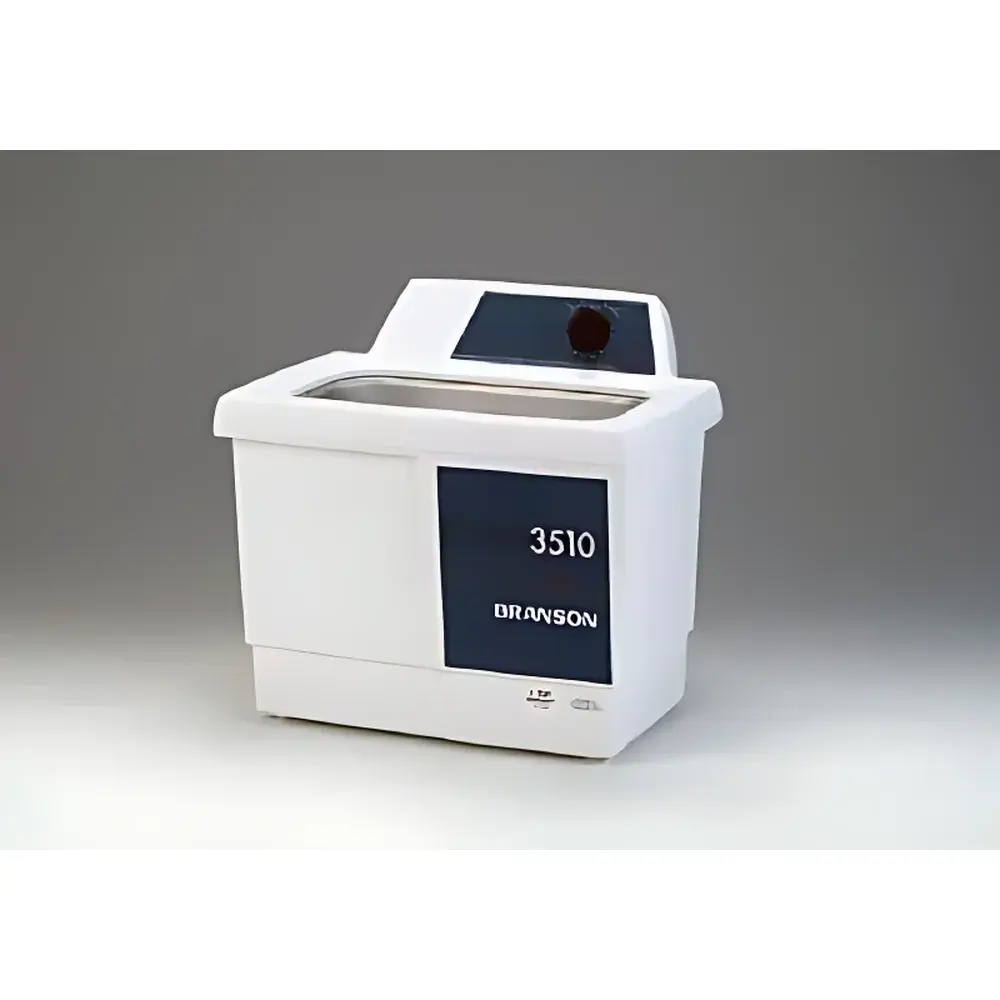
Brookfield B3510E-MT Ultrasonic Cleaner
| Origin | USA |
|---|---|
| Manufacturer Type | Authorized Distributor |
| Origin Category | Imported |
| Model | B3510E-MT |
| Price | Upon Request |
| Tank Volume | 5.7 L |
| Chamber Dimensions | 292 × 152 × 152 mm |
| Ultrasonic Frequency | 40 kHz |
| Heating Range | 0–70 °C |
| Timer Range | 1–99 min |
| Ultrasonic Power Output | 130 W |
| Total Power Consumption | 335 W |
| Input Voltage | 220 V, 50/60 Hz |
| Construction Material | Polypropylene (PP) Body |
| Transducer Type | Langevin-type Metal/Ceramic Stack |
| Mounting Method | Adhesive-Bonded Transducers |
| Control Interface | Digital Display with Dual-Temperature Readout (Current Bath Temp & Setpoint) |
| Lid Function | Hinged Noise-Reduction Cover with Integrated Drip Tray and Drain Valve |
Overview
The Brookfield B3510E-MT Ultrasonic Cleaner is a precision-engineered laboratory-grade cleaning system designed for reproducible, non-destructive removal of particulate, organic, and ionic contaminants from delicate instruments, glassware, surgical tools, electronic components, and analytical sample holders. It operates on the principle of high-frequency acoustic cavitation—generating controlled microbubbles in liquid media that collapse asymmetrically near solid surfaces, producing localized shockwaves and microstreaming forces sufficient to dislodge sub-micron residues without mechanical abrasion. With a fixed 40 kHz transduction frequency optimized for general-purpose cleaning efficacy and material compatibility, the B3510E-MT delivers consistent energy distribution across its 5.7 L polypropylene tank—engineered to withstand routine exposure to aqueous solutions, mild acids, and alkaline detergents commonly used in QC, R&D, and clinical lab workflows.
Key Features
- Polypropylene (PP) tank and housing—chemically resistant to common laboratory solvents, dilute acids (e.g., HCl, HNO₃), and alkaline cleaning agents; eliminates galvanic corrosion risks associated with stainless-steel tanks in aggressive chemistries.
- Langevin-type metal/ceramic transducer stack—designed for thermal stability and long-term power output consistency; bonded directly to the tank bottom using aerospace-grade epoxy for minimal energy loss and zero mechanical detachment over extended duty cycles.
- Dual-mode digital control interface—displays real-time bath temperature and user-set heating setpoint simultaneously; supports precise thermal regulation within ±1.5 °C accuracy across the 0–70 °C range.
- Extended timer functionality—programmable from 1 to 99 minutes in 1-minute increments, enabling method-specific dwell time alignment with ASTM D4812 (ultrasonic cleaning validation) or ISO 13408-1 (aseptic processing equipment cleaning).
- Hinged acoustic lid with integrated drip tray and quick-release drain valve—reduces ambient noise by ≥15 dB(A); facilitates rapid fluid evacuation without tilting or manual siphoning, supporting GLP-compliant workflow continuity.
- Vertical PCB orientation and elevated control panel—minimizes condensation ingress and electrolyte tracking; conforms to IEC 61010-1 safety requirements for laboratory electrical equipment in humid environments.
- Optimized water-level indicator—standardized fill line ensures uniform cavitation field intensity and prevents transducer overheating during low-volume operation.
Sample Compatibility & Compliance
The B3510E-MT accommodates a broad range of load geometries—including beakers, vials, pipette tips, chromatography columns, microscope slides, and reusable surgical instruments—within its 292 × 152 × 152 mm chamber. Its 40 kHz frequency provides balanced penetration depth and surface shear force, making it suitable for both fine particulate removal (e.g., SiO₂ residues from semiconductor wafers) and biofilm disruption (e.g., dried protein films on stainless-steel forceps). The unit complies with UL 61010-1 and CE marking directives for laboratory instrumentation. While not certified as a medical device sterilizer, it supports cleaning steps aligned with AAMI ST79:2017 Annex E and FDA Guidance for Industry: Reprocessing Medical Devices in Health Care Settings when integrated into validated cleaning protocols.
Software & Data Management
This model operates via embedded firmware with no external software dependency. All operational parameters—including elapsed time, active temperature, and power-on status—are retained in non-volatile memory and displayed in real time. The digital interface logs no audit trail or timestamped event history; therefore, users requiring 21 CFR Part 11 compliance must integrate external data loggers or connect the unit to a networked environmental monitoring system (EMS) via optional analog output modules (sold separately). Calibration verification is performed manually using NIST-traceable thermistors and calibrated stopwatch measurements per ISO/IEC 17025-accredited procedures.
Applications
- Pre-analytical sample preparation: Cleaning HPLC vials, GC autosampler trays, and ICP-MS nebulizers to prevent cross-contamination and signal drift.
- Pharmaceutical manufacturing: Removing lubricants and polishing compounds from stainless-steel tablet punches prior to visual inspection per USP and .
- Materials science labs: Deburring MEMS devices and ultrasonic-assisted dispersion of nanomaterials in suspension media.
- Electronics manufacturing: Stripping flux residues from printed circuit boards before solderability testing (IPC-J-STD-001).
- Clinical microbiology: Decontaminating reusable culture loops, spreaders, and inoculating needles between use cycles under CLSI M22-A3 guidelines.
FAQ
Is the B3510E-MT suitable for cleaning aluminum or soft metals?
Yes—when operated with deionized water or neutral pH detergents and limited to ≤50 °C, the unit avoids pitting or etching of aluminum, magnesium, and zinc alloys. Avoid acidic or chloride-containing solutions unless validated for specific alloy grades.
Can this unit be used with flammable solvents?
No. The B3510E-MT lacks explosion-proof certification and is rated only for aqueous and water-miscible cleaning solutions. Flammable solvent use violates UL 61010-1 Section 10.3.2 and voids warranty.
What maintenance is required to sustain optimal cavitation performance?
Monthly descaling with 5% citric acid solution (at 40 °C for 20 min), followed by thorough rinsing, preserves transducer coupling efficiency. Inspect adhesive bond integrity annually using ultrasonic impedance spectroscopy per ASTM E1158.
Does the unit support external temperature probe input?
Not natively. Temperature feedback is internal only. For external bath monitoring, users must deploy a separate calibrated PT100 probe connected to a standalone data logger.
Is the drain valve compatible with standard laboratory tubing?
Yes—the 8 mm OD barbed outlet accepts standard silicone or Tygon® tubing (ID 6–8 mm), enabling direct connection to floor drains or waste collection vessels.



