
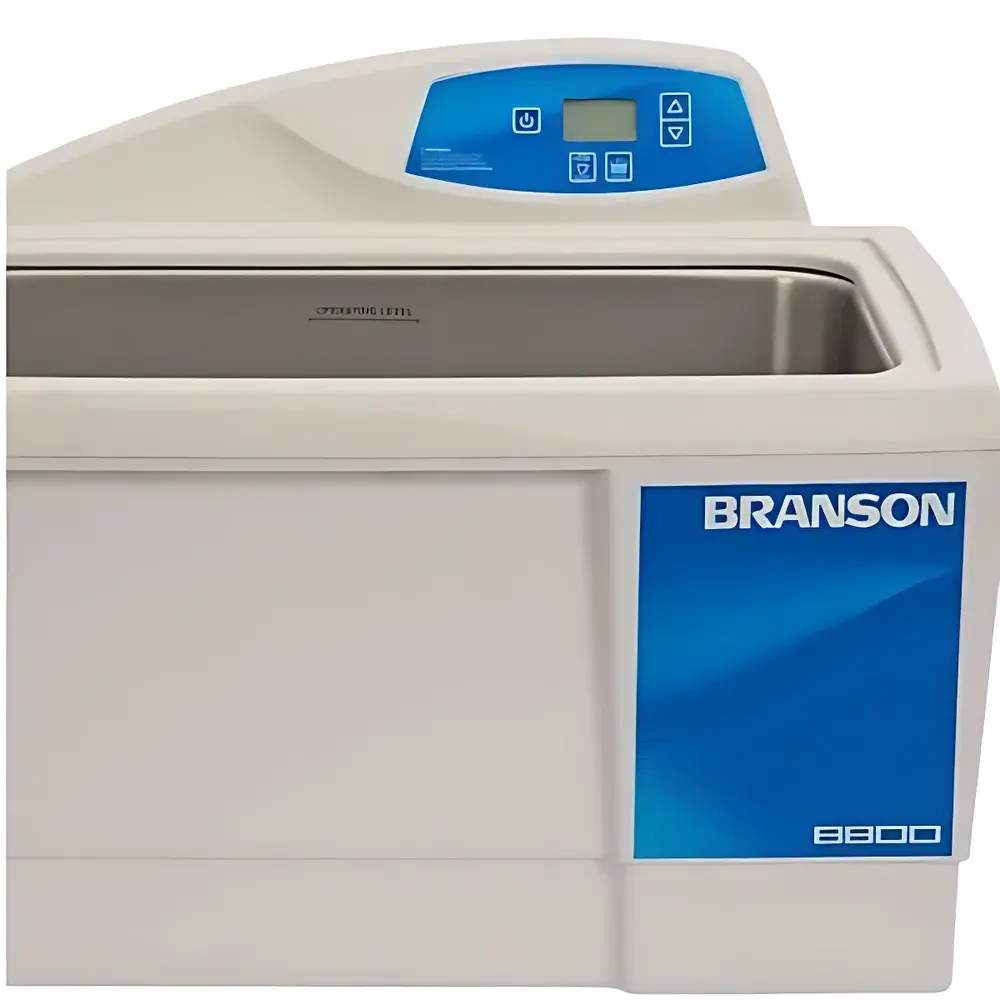
Branson CPX8800-C Ultrasonic Cleaner
| Brand | Branson |
|---|---|
| Origin | USA |
| Model | CPX8800-C |
| Tank Capacity | 20.81 L |
| Ultrasonic Frequency | 40 kHz |
| Ultrasonic Power Output | 380 W |
| Heating Power | 500 W |
| Total Power Consumption | 880 W |
| Temperature Range | 0–69 °C |
| Timer Range | 1–59 min |
| Adjustable Power | Yes |
| Adjustable Temperature | Yes |
| Adjustable Timer | Yes |
| Sound-Dampening Lid | Included |
| Drain Valve | Manual |
| Tank Dimensions (L×W×H) | 492 × 292 × 152 mm |
| Construction Material | Polypropylene (PP) |
| Transducer Type | Langevin-type metal-ceramic |
| Mounting | Adhesive-bonded transducers |
| Control Interface | Digital display with front-mounted controls |
| Electrical Input | 220 V, 50/60 Hz |
Overview
The Branson CPX8800-C is a high-reliability, general-purpose ultrasonic cleaner engineered for precision cleaning in regulated laboratory, dental, optical, and electronics maintenance environments. It operates on the principle of acoustic cavitation—generating controlled microbubbles in liquid media via high-frequency mechanical vibrations at 40 kHz. When these bubbles collapse near solid surfaces, they produce localized shockwaves and microstreaming that effectively dislodge particulate contaminants, biofilms, and organic residues without mechanical abrasion. Designed for reproducible cleaning performance across diverse sample geometries, the CPX8800-C integrates robust thermal and temporal control to support standardized cleaning protocols compliant with ASTM D2603, ISO 13485 (for medical device reprocessing), and internal GLP/GMP documentation requirements.
Key Features
- Digital microprocessor-controlled interface with real-time display of bath temperature and setpoint; supports precise thermal regulation from ambient up to 69 °C.
- Langevin-type piezoelectric transducers bonded directly to the stainless-steel tank base—ensuring uniform energy distribution and long-term mechanical stability under continuous operation.
- Spherical wave propagation design optimizes cavitation field homogeneity across the full 20.81 L tank volume (492 × 292 × 152 mm), minimizing dead zones and enhancing cleaning consistency.
- Adhesive-mounted transducer array eliminates mechanical fasteners, reducing potential points of failure and preventing delamination under thermal cycling.
- Vertical PCB orientation and elevated control panel placement mitigate moisture ingress risks—critical for extended use in humid or splash-prone lab settings.
- Integrated sound-dampening lid functions both as acoustic barrier and auxiliary drip tray; features integrated manual drain valve for rapid, spill-free fluid removal.
- Polypropylene (PP) tank housing resists corrosion from common aqueous cleaning solutions, including mild alkaline detergents and low-concentration acidic rinses.
- Programmable timer (1–59 minutes) enables repeatable exposure durations essential for validation-driven workflows such as instrument reprocessing or QC sample preparation.
Sample Compatibility & Compliance
The CPX8800-C accommodates a broad range of delicate and complex components—including dental handpieces, endoscopic accessories, precision optics, semiconductor wafers, surgical instruments, and jewelry—without compromising structural integrity. Its 40 kHz frequency balances penetration depth and surface resolution, making it suitable for both macro-particulate removal and fine contaminant dispersion. The unit meets UL 61010-1 safety standards for laboratory equipment and supports traceable operation when used with validated cleaning chemistries. While not certified for sterilization, it serves as a critical pre-sterilization step aligned with AAMI ST79 and CDC guidelines for reprocessed medical devices.
Software & Data Management
This model operates via embedded firmware with no external software dependency. All operational parameters—including time, temperature, and power level—are stored in non-volatile memory and retain settings after power cycling. Though it lacks network connectivity or electronic audit trail functionality, its digital display logs current operating state continuously, facilitating manual recordkeeping required under FDA 21 CFR Part 11–aligned SOPs when paired with procedural documentation. Optional accessories—including baskets, beaker holders, and degassing modules—extend adaptability while maintaining compatibility with standard lab documentation practices.
Applications
- Pre-analytical sample preparation: removal of residual solvents, oils, or polishing compounds from glassware, cuvettes, and HPLC components.
- Dental and veterinary clinics: cleaning of scaler tips, impression trays, and orthodontic tools prior to autoclaving.
- Optical laboratories: gentle decontamination of lenses, prisms, and coated mirrors without scratching.
- Electronics R&D: post-solder flux residue removal from PCBs and microelectromechanical systems (MEMS).
- Jewelry manufacturing and repair: restoration of fine filigree, gemstone settings, and engraved surfaces.
- Academic research labs: routine maintenance of centrifuge rotors, pipette tips, and filtration housings.
FAQ
What is the maximum recommended operating temperature for aqueous cleaning solutions?
The system is rated for continuous operation up to 69 °C—ideal for accelerated cleaning kinetics while preserving solution stability and transducer longevity.
Can the ultrasonic power output be reduced for sensitive substrates?
Yes—the unit provides variable intensity control, allowing operators to lower effective cavitation energy without altering frequency or duty cycle.
Is the tank compatible with organic solvents?
No. The polypropylene construction and transducer bonding chemistry are optimized for aqueous media only; solvent exposure may compromise material integrity and void warranty.
Does the CPX8800-C include a degassing function?
It does not feature automated degassing; however, the sweep-mode ultrasonic drive minimizes air entrapment during initial fill, supporting efficient bubble nucleation upon activation.
How is calibration verified for temperature and timing accuracy?
Temperature calibration is performed using NIST-traceable RTD probes during factory acceptance testing; users may verify accuracy with secondary calibrated thermometers per internal QA procedures.



