
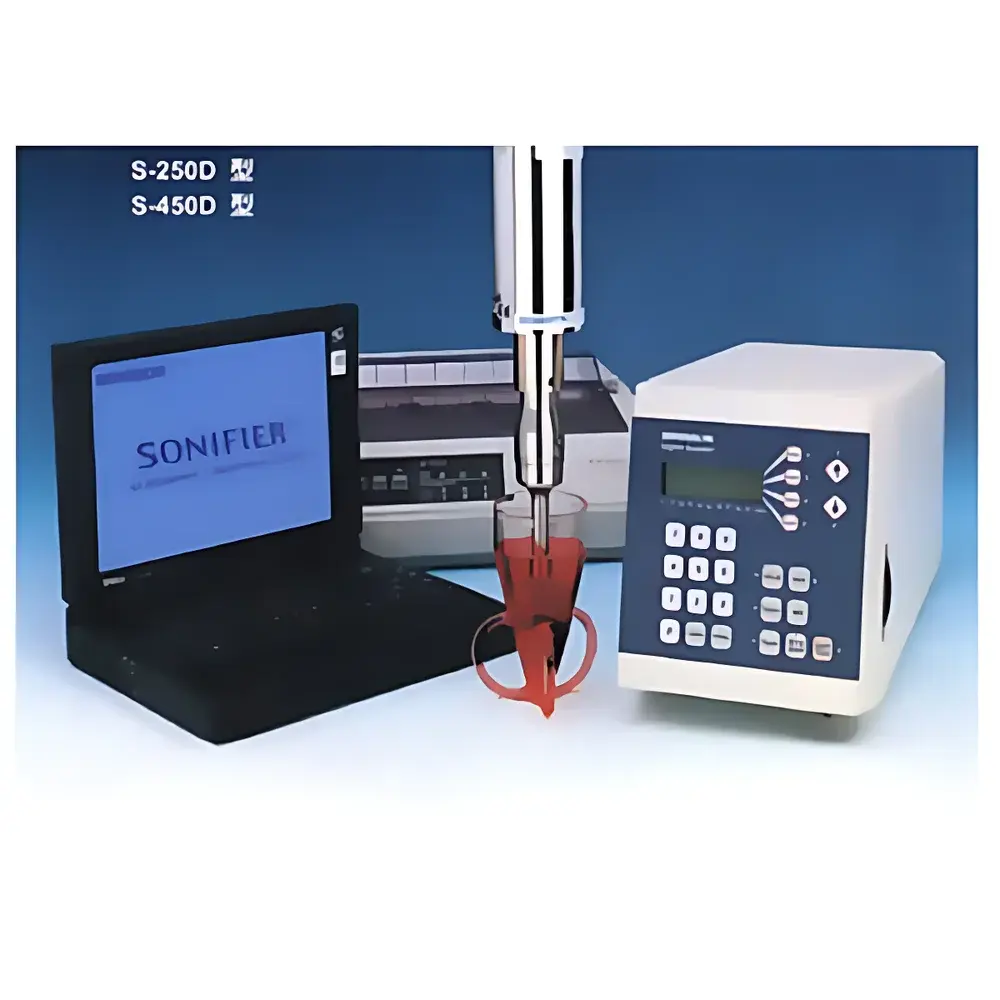
Branson SLPe Ultrasonic Sonifier Cell Disruptor
| Brand | Branson |
|---|---|
| Origin | USA |
| Model | SLPe |
| Instrument Type | Ultrasonic Cell Disruptor |
| Operating Frequency | 40 kHz |
| Ultrasonic Power Output | 200 W |
| Temperature Control Range | 5°C to 50°C |
| Sample Volume Capacity | 200 µL – 1000 mL |
| Number of Samples Processed Simultaneously | 1 |
Overview
The Branson SLPe Ultrasonic Sonifier Cell Disruptor is an engineered solution for controlled, reproducible cell lysis and sample homogenization in life science laboratories. It operates on the principle of ultrasonic cavitation: high-frequency mechanical vibrations (40 kHz) are transmitted via a titanium alloy probe into liquid media, generating transient microbubbles that rapidly nucleate and collapse. This implosive collapse produces localized shockwaves exceeding 1000 atm, intense shear forces, and microstreaming—mechanisms collectively responsible for disrupting cellular membranes, organelles, bacterial walls, viral envelopes, and subcellular structures without significant thermal denaturation when operated under pulsed conditions. Designed for precision and consistency, the SLPe integrates real-time amplitude regulation, programmable duty cycles, and integrated temperature monitoring—enabling reliable extraction of nucleic acids, proteins, inclusion bodies, and intracellular metabolites across diverse biological matrices.
Key Features
- Stable 40 kHz ultrasonic frequency with digitally regulated 200 W power output for consistent energy delivery across variable load conditions
- Intelligent amplitude control: maintains set vibrational amplitude (10–100%) regardless of sample viscosity, volume, or electrical supply fluctuations
- Programmable operation modes: continuous, timed, and pulse-modulated (pulse width adjustable in 0.1 s increments; duty cycle configurable for thermally sensitive samples)
- Integrated temperature management: Peltier-cooled probe option supports precise thermal control between 5°C and 50°C during sonication
- Digital interface with backlit LCD display: stores up to 20 user-defined protocols, logs operational history including date/time stamps, and supports parameter recall
- RS-232 serial port for instrument control and data export to LIMS or laboratory information systems; optional printer interface for audit-ready session reports
- Modular probe compatibility: accepts standard Branson disruptor horns (e.g., 1/2″ threaded probes) for scalable processing from microliter-scale lysates to 1 L bulk suspensions
Sample Compatibility & Compliance
The SLPe accommodates a broad range of biological and biochemical samples—including mammalian and insect cell cultures, yeast, bacteria (Gram-positive and Gram-negative), spores, plant tissues, and subcellular fractions—without requiring chemical lysis reagents. Its design adheres to internationally recognized laboratory safety and performance standards, including IEC 61010-1 (electrical safety), ISO 13485 (for medical device-related applications), and USP guidelines for analytical instrument qualification. When configured with temperature-controlled accessories and time-stamped protocol logging, the system supports GLP/GMP-aligned workflows and satisfies FDA 21 CFR Part 11 requirements for electronic records and signatures when deployed with validated software environments.
Software & Data Management
While the SLPe operates as a standalone benchtop unit with embedded firmware, its RS-232 interface enables integration with third-party laboratory automation platforms or custom scripting environments (e.g., Python-based control via PySerial). All operational parameters—including amplitude setting, pulse duration, total runtime, temperature setpoint, and session timestamp—are recorded internally and exportable in CSV format. Audit trails generated by connected printers or external data acquisition systems meet traceability requirements for method validation, regulatory submissions, and internal quality assurance reviews. No proprietary cloud platform or vendor-hosted software is required; data ownership remains fully under institutional control.
Applications
- Cell lysis for genomic DNA, plasmid, and RNA isolation with minimized shearing and nuclease activation
- Preparation of soluble protein extracts and inclusion body solubilization in recombinant expression workflows
- Disruption of biofilms and microbial aggregates for antimicrobial susceptibility testing
- Homogenization of tissue biopsies prior to proteomic or metabolomic profiling
- Emulsification of lipid nanoparticles (LNPs) and nanoemulsions for drug delivery formulation
- Accelerated solvent extraction of phytochemicals, alkaloids, and polyphenols from botanical matrices
- Cleaning and decontamination of microfluidic channels and capillary electrophoresis components
FAQ
What is the maximum recommended sample volume for the SLPe model?
The SLPe supports volumes from 200 µL to 1000 mL, contingent upon appropriate horn selection (e.g., microtip for low-volume lysates; large-diameter probes for bulk processing). Optimal efficiency is achieved within 10–500 mL using standard 1/2″ threaded horns.
Does the SLPe comply with FDA 21 CFR Part 11 requirements?
Yes—when used with validated procedural controls, time-stamped protocol logging, and secure electronic record retention (e.g., via RS-232–connected LIMS), the SLPe meets technical prerequisites for electronic signature and audit trail integrity per Part 11.
Can the SLPe be operated in cold rooms or refrigerated enclosures?
The unit itself is rated for ambient operation between 15°C and 30°C; however, the optional Peltier-cooled probe allows internal sample temperature maintenance down to 5°C—even during extended sonication—eliminating the need for external ice baths or cryogenic setups.
Is amplitude calibration traceable to NIST standards?
Branson provides factory calibration certificates with uncertainty statements traceable to NIST-accredited metrology labs. Users may perform routine verification using calibrated laser vibrometers or impedance analyzers per ASTM E1779.
How does the SLPe differ from legacy S-series models like the S-250D?
The SLPe features enhanced digital signal processing, improved thermal management architecture, expanded memory for protocol storage, and native RS-232 connectivity—addressing evolving needs for data integrity, remote monitoring, and integration into automated lab ecosystems.
Related Products




