
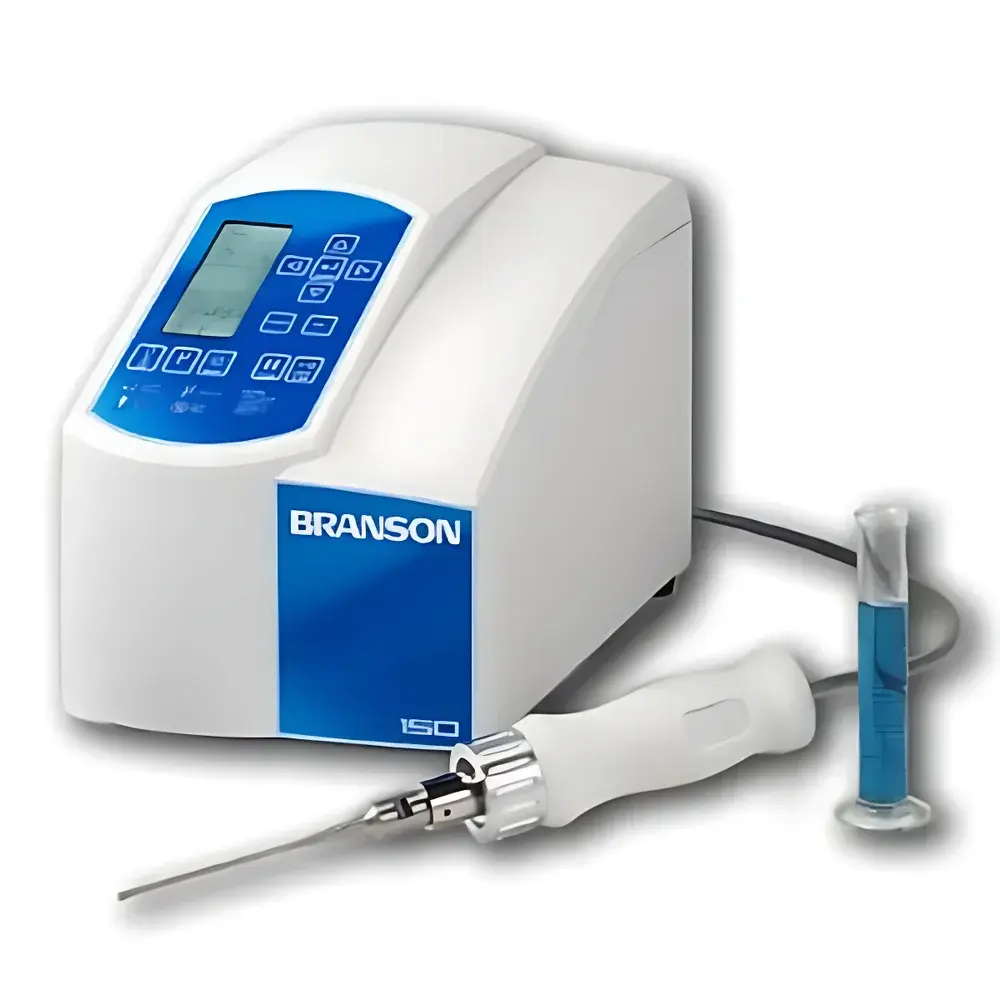
Branson Sonifier® SFX150 Ultrasonic Cell Disruptor
| Brand | Branson |
|---|---|
| Origin | USA |
| Model | SFX150 |
| Ultrasonic Frequency | 40 kHz |
| Maximum Output Power | 150 W |
| Sample Volume Range | 0.1–150 mL |
| Temperature Control Range | 0–99 °C |
| Probe Diameter | 3 mm (1/8″) |
| Data Storage Capacity | 20 protocols |
| Input Voltage | AC 200–240 V, 50/60 Hz |
| Dimensions (L×W×H) | 348 × 203 × 242 mm |
| Weight | 6.35 kg |
Overview
The Branson Sonifier® SFX150 Ultrasonic Cell Disruptor is a benchtop ultrasonic processor engineered for reproducible, high-efficiency lysis of biological samples in volumes ranging from 0.1 mL to 150 mL. It operates on the principle of piezoelectric transduction: an electrical signal at 40 kHz drives a titanium horn (probe) to generate high-intensity acoustic cavitation in liquid media. This localized energy transfer induces rapid pressure fluctuations, resulting in microstreaming, shear forces, and transient cavitation bubble collapse—mechanisms that effectively disrupt cell membranes, solubilize inclusion bodies, fragment chromatin, and disperse nanoparticles. Designed for routine use in molecular biology, protein purification, and microbiology laboratories, the SFX150 delivers consistent energy delivery without requiring water-bath coupling or external cooling systems—making it suitable for both ambient and temperature-controlled applications.
Key Features
- Digital Touchscreen Interface: A responsive 4.3-inch capacitive touchscreen enables intuitive navigation through time-, energy-, and temperature-based operating modes. Users directly configure amplitude (0–100%), pulse duty cycle (1–100%), total treatment duration (0.1–999 s), and real-time temperature setpoint (0–99 °C).
- Intelligent Frequency Tracking: Automatic frequency tuning compensates for load-dependent impedance shifts during sonication, maintaining optimal resonance across varying sample viscosities and probe wear—ensuring stable power delivery and minimizing transducer stress.
- Programmable Protocol Management: Stores up to 20 user-defined methods with full parameter recall—including amplitude, pulse profile, temperature limit, and safety lockout settings—supporting standardized workflows compliant with GLP documentation requirements.
- Multi-Mode Energy Delivery: Supports continuous-wave operation for rapid homogenization and pulsed-mode (burst mode) for thermal management in heat-sensitive samples such as enzymes, antibodies, or primary cell lysates.
- Integrated Thermal Monitoring & Protection: Built-in thermistor feedback loop actively regulates sample temperature via optional external chiller integration (via standard 3/8″ barbed fittings). Overtemperature cutoff (≥99 °C) and overcurrent protection prevent hardware damage during extended runs.
- Modular Titanium Probe System: Ships with a 3 mm (1/8″) solid-tip titanium alloy probe (Model 7-4), optimized for small-volume processing. Additional probe geometries (microtip, cup-horn, flow-through cells) are available as accessories for specialized applications.
Sample Compatibility & Compliance
The SFX150 is validated for use with diverse biological matrices including bacterial cultures (E. coli, Bacillus spp.), yeast (S. cerevisiae), mammalian cell lines (HEK293, CHO), plant tissues, and soft animal tissues. It accommodates aqueous buffers, detergent-containing lysis reagents (e.g., RIPA, NP-40), and viscous solutions up to 10,000 cP. The system conforms to IEC 61000-6-3 (EMC emissions) and IEC 61000-6-2 (immunity) standards. Its programmable audit trail capability supports alignment with FDA 21 CFR Part 11 when paired with Branson’s optional PC-based data logging software (Sonifier Connect™), enabling electronic signature capture and secure protocol archiving for regulated environments.
Software & Data Management
While standalone operation requires no external software, the SFX150 features an RS-232 serial port and USB host interface for connectivity to Branson’s Sonifier Connect™ application (Windows-compatible). This platform enables remote control, real-time parameter logging (time-stamped amplitude, temperature, and power output), automated report generation (PDF/CSV), and version-controlled protocol deployment across multiple instruments. All stored methods include metadata fields for operator ID, sample ID, and instrument serial number—facilitating traceability in QA/QC and clinical research settings.
Applications
- Preparation of soluble protein extracts from recombinant E. coli cultures
- Chromatin shearing for ChIP-seq and ATAC-seq library construction
- Nanoparticle dispersion in drug delivery formulation development
- Disruption of Gram-positive bacteria for peptidoglycan analysis
- Homogenization of frozen tissue sections prior to RNA extraction
- Emulsification of lipid-based nanocarriers under controlled thermal conditions
FAQ
What is the recommended maintenance schedule for the SFX150 transducer and probe?
Routine inspection of probe tip erosion and thread integrity is advised after every 10 hours of cumulative operation. Replace the probe when tip diameter reduction exceeds 10% or visible pitting occurs. Transducer servicing is recommended annually by an authorized Branson service center.
Can the SFX150 be used with cryogenic cooling jackets?
Yes—the unit accepts standard laboratory cooling jackets (e.g., Neslab RTE-7) connected via inlet/outlet ports on the rear panel. Temperature feedback remains active only when the internal thermistor is immersed in the sample.
Is the 3 mm probe autoclavable?
No. The titanium probe is not designed for autoclaving. Sterilization should be performed using 70% ethanol immersion or UV irradiation; avoid prolonged exposure to strong oxidizers (e.g., bleach, peracetic acid).
Does the SFX150 support external trigger input for synchronization with other lab equipment?
Yes—a TTL-compatible trigger input (BNC connector) allows external initiation of sonication cycles, enabling integration into automated liquid handling or imaging platforms.
How does amplitude calibration relate to actual power output?
Amplitude (%) is a normalized setting referencing the maximum mechanical displacement achievable at full gain. Actual delivered power (W) varies with load impedance and probe geometry; Branson provides factory calibration certificates traceable to NIST standards for each instrument shipment.




