
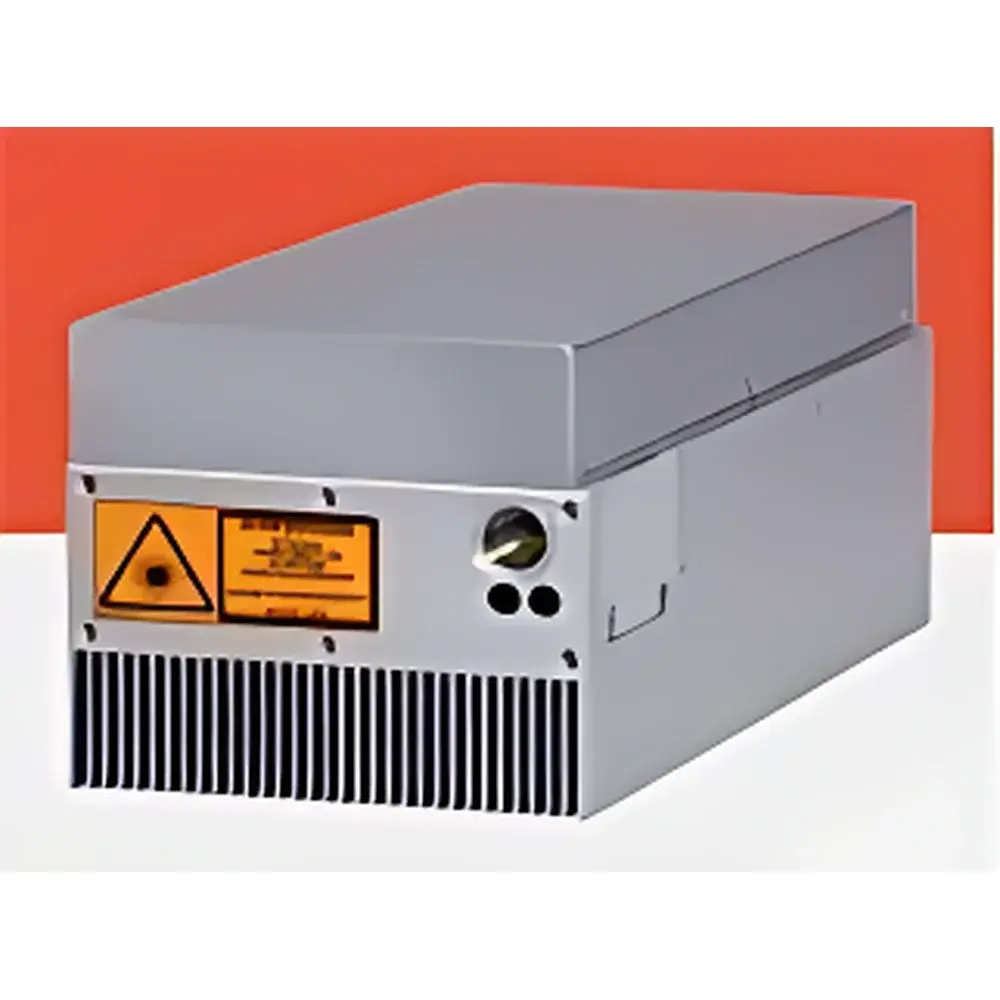
Bright Solutions Nanosecond Pulsed Solid-State Laser System
| Brand | RPMC Lasers |
|---|---|
| Origin | Italy |
| Manufacturer Type | Authorized Distributor |
| Import Status | Imported |
| Core Technology | Diode-Pumped Solid-State (DPSS) Q-Switched Laser |
| Wavelength Options | 266 nm, 355 nm, 473 nm, 532 nm, 946 nm, 1064 nm, 1570 nm, 1572 nm, 3300 nm |
| Pulse Energy Range | 0.2 µJ – 200 mJ |
| Pulse Width | 0.7 ns – 80 ns |
| Repetition Rate | Single-shot to 150 kHz |
| Beam Quality (M²) | <1.3 to <2.5 (model-dependent) |
| Cooling | Air- or Water-Cooled (model-specific) |
Overview
The Bright Solutions Nanosecond Pulsed Solid-State Laser System is a family of diode-pumped, Q-switched lasers engineered for high temporal precision, spectral stability, and industrial-grade reliability. Based on robust DPSS architecture, these lasers generate nanosecond-duration pulses via active or passive Q-switching in Nd:YAG, Nd:YVO₄, or specialized crystal gain media (e.g., LBO, BBO, KTP), enabling wavelength conversion through harmonic generation (2nd–4th harmonics) or optical parametric processes. The system operates across ultraviolet (266 nm), visible (473 nm, 532 nm), near-infrared (946 nm, 1064 nm), short-wave infrared (1570–1572 nm), and mid-infrared (3300 nm) spectral bands—each optimized for specific photon–matter interaction cross-sections. Designed for integration into OEM platforms and laboratory setups, the series complies with IEC 60825-1:2014 (laser safety) and meets RoHS/CE directives. Its pulse-to-pulse energy stability (<±1.5% RMS over 8 hours) and pointing stability (<5 µrad/°C) support applications demanding metrological traceability and long-term repeatability.
Key Features
- Multi-wavelength platform supporting discrete emission lines from 266 nm to 3300 nm, with narrow spectral bandwidth (<0.1 nm FWHM for fundamental lines)
- Adjustable pulse width from sub-nanosecond (0.7 ns) to 80 ns, selectable via cavity design and Q-switch type (acousto-optic, electro-optic, or microchip)
- Repetition rate flexibility: single-shot triggering, low-frequency burst mode (≤1 kHz), and high-repetition-rate continuous operation up to 150 kHz
- High beam quality with M² < 1.3 (standard models) to < 2.5 (high-energy variants), enabling efficient coupling into fibers, scanning optics, and nonlinear crystals
- Industrial-grade thermal management: air-cooled configurations for ≤5 W average power; water-cooled options for ≥6 W systems with ΔT stability < ±0.1 °C
- Integrated digital control interface (RS-232, USB, or optional Ethernet) supporting TTL/CMOS synchronization, external trigger input (5 V logic), and analog modulation of repetition rate
Sample Compatibility & Compliance
The Bright Solutions nanosecond laser series is compatible with standard optical tables, motorized translation stages, and vacuum-compatible beam delivery paths. All models meet ISO 11146-1/-2 for beam propagation analysis and are calibrated per ISO/IEC 17025-accredited procedures at the manufacturer’s facility in Italy. For regulated environments, the systems support audit-ready operation under GLP and GMP frameworks: firmware logs include timestamped operational parameters (pulse energy, rep rate, temperature), with optional password-protected configuration locking. While not FDA-cleared as medical devices, selected 532 nm and 1064 nm variants comply with ANSI Z136.1-2022 for Class 4 laser use in dermatology and ophthalmology research settings. No radioactive components or hazardous materials are employed in construction.
Software & Data Management
Each laser includes BrightControl™ Lite—a Windows-based GUI enabling real-time monitoring of diode current, crystal temperature, pulse energy (via integrated photodiode feedback), and interlock status. For automated workflows, the SDK provides C/C++, Python, and LabVIEW drivers compliant with NI-VISA and IVI-C standards. Data export supports CSV and HDF5 formats, preserving metadata (wavelength, pulse width, M², ambient temperature). Firmware updates are performed via signed binary packages with SHA-256 verification. Audit trail functionality—required for 21 CFR Part 11 compliance—can be enabled through optional BrightControl Pro, which logs user actions, parameter changes, and calibration events with electronic signatures and immutable timestamps.
Applications
- LIDAR & Remote Sensing: High peak power (up to 200 mJ @ 1064 nm) enables atmospheric backscatter profiling and differential absorption LIDAR (DIAL) at 1572 nm for methane detection
- Materials Processing: Nanosecond ablation of thin-film solar cells (e.g., selective removal of CIGS layers at 532 nm), semiconductor scribing (355 nm UV), and precision marking of polymers and ceramics
- Scientific Instrumentation: Pump source for ultrafast amplifiers (e.g., Ti:sapphire regenerative systems), time-resolved fluorescence lifetime imaging (FLIM), and laser-induced breakdown spectroscopy (LIBS)
- Biomedical Research: Photodisruption in ex vivo ocular tissue studies (266 nm, 355 nm), optoacoustic imaging excitation (1064 nm), and mid-IR tissue ablation feasibility testing (3300 nm)
- Defense & Security: Eye-safe rangefinding (1570 nm), counter-drone directed energy testing, and IR scene projection using short-wave infrared (SWIR) variants
FAQ
What cooling method is required for continuous operation at 100 kHz?
Air cooling suffices for models rated ≤2.5 W average power (e.g., Luce 355-2.5W). Systems exceeding 3 W (e.g., Sol 1064-20W) require closed-loop water cooling with 18–22 °C inlet temperature and ≥0.5 L/min flow rate.
Can pulse energy be monitored in real time without external equipment?
Yes—integrated photodiode sensors provide calibrated pulse energy readout via BrightControl software, with ±3% accuracy traceable to NIST standards.
Is wavelength tuning possible within a single model?
No—each unit is factory-configured for a fixed output wavelength. Multi-wavelength operation requires separate modules or an OPO-based extension system (sold separately).
Are these lasers suitable for cleanroom integration?
All units feature sealed, particle-free enclosures meeting ISO Class 5 requirements when installed with HEPA-filtered airflow; optional stainless-steel housing upgrades available upon request.
Does the system support synchronization with external cameras or delay generators?
Yes—TTL-compatible sync outputs (rise time < 2 ns) and programmable delay channels (0–10 ms, 10 ps resolution) enable precise timing alignment with streak cameras, ICCDs, or motion controllers.



