
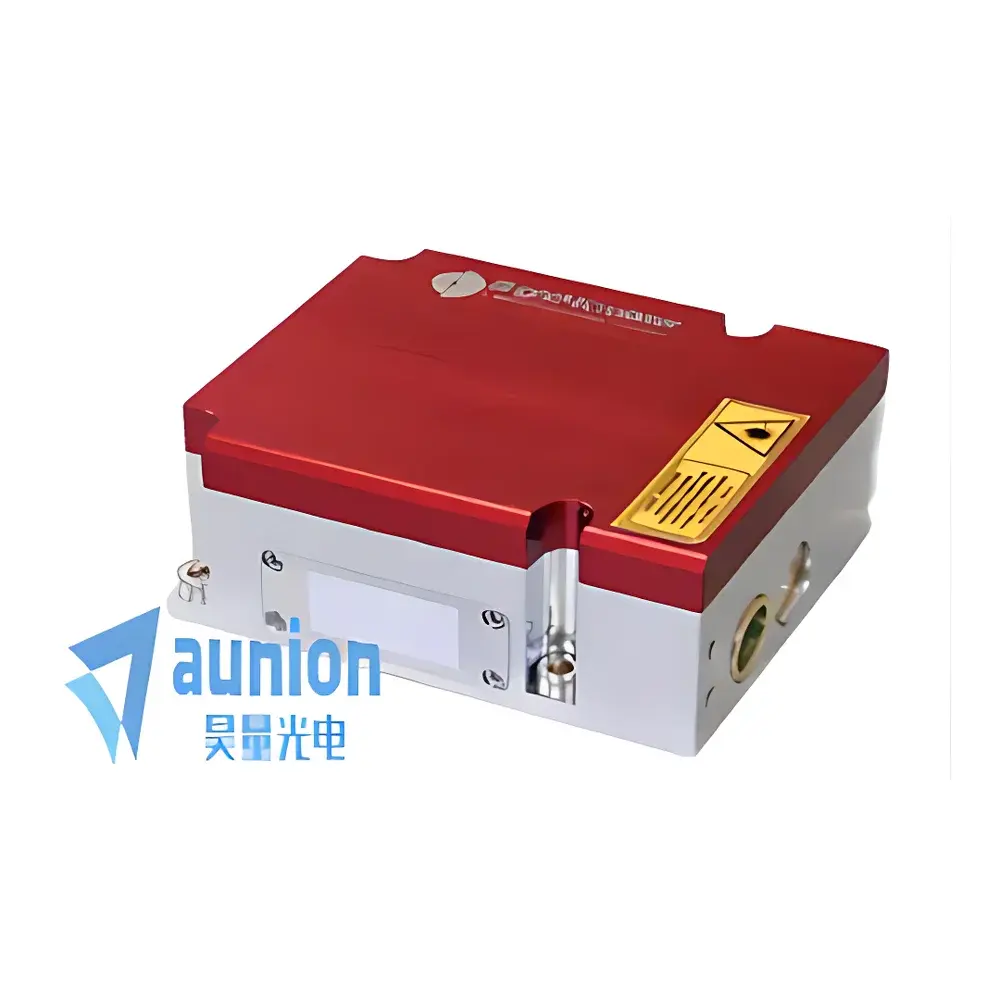
Bright Solutions SB1 Series Nanosecond-to-Subnanosecond Monolithic Microchip Laser
| Brand | Bright Solutions |
|---|---|
| Origin | Shanghai, China |
| Manufacturer Type | Authorized Distributor |
| Product Category | Domestic |
| Model | SB1 Series |
| Price | Upon Request |
| Wavelength Options | 1064 / 946 / 532 / 473 / 355 / 266 / 236.5 nm |
| Pulse Duration | < 2 ns (standard), down to < 400 ps (select variants) |
| Single-Pulse Energy | up to 80 µJ |
| Peak Power | up to 50 kW |
| Repetition Rate | Single-shot to 100 kHz (internally/externally triggered) |
| Beam Quality (M²) | < 1.3 |
| Dimensions | 65 × 54 × 28 mm |
| Weight | < 0.2 kg |
| Operating Temperature | +10 to +40 °C |
| Storage Temperature | −20 to +60 °C |
| Power Supply | DC 15 V, < 3 A |
Overview
The Bright Solutions SB1 Series Nanosecond-to-Subnanosecond Monolithic Microchip Laser is a compact, passively Q-switched diode-pumped solid-state (DPSS) laser engineered for high peak power, exceptional beam quality, and robust temporal stability in demanding scientific and industrial applications. Based on monolithic Nd:YAG or Nd:YVO₄ gain media with semiconductor saturable absorber mirror (SESAM) technology, the SB1 leverages proven DPSS architecture to deliver subnanosecond pulses without external cavity alignment or active electronics. Its monolithic design eliminates sensitivity to mechanical drift and thermal lensing—critical for long-term operation in OEM integration or field-deployable systems. The laser operates across seven discrete wavelengths—including fundamental IR (1064 nm and 946 nm), visible harmonics (532 nm, 473 nm), deep UV (355 nm, 266 nm), and vacuum UV (236.5 nm)—enabling broad spectral coverage for nonlinear frequency conversion, time-resolved spectroscopy, and multi-modal sensing.
Key Features
- Monolithic microchip architecture ensures intrinsic alignment stability and immunity to vibration-induced mode degradation
- Pulse durations tunable from < 2 ns down to < 400 ps via optimized SESAM design and cavity length control
- Single-pulse energy up to 80 µJ at 1064 nm with peak power exceeding 50 kW—enabling efficient nonlinear optical processes such as SHG, THG, and OPO pumping
- Repetition rate flexibility: supports single-shot triggering, internal clocking up to 100 kHz, and full external synchronization with TTL/CMOS signals for pump-probe or gated detection schemes
- Diffraction-limited beam quality (M² < 1.3) enables tight focusing for high-intensity applications including micromachining and LIBS ablation
- Compact footprint (65 × 54 × 28 mm) and low mass (< 0.2 kg) facilitate integration into space-constrained platforms such as airborne LIDAR modules, portable Raman spectrometers, and endoscopic bioimaging systems
- DC-powered operation (15 V, < 3 A) eliminates need for bulky AC-DC converters—ideal for battery-operated or embedded instrumentation
Sample Compatibility & Compliance
The SB1 Series is designed for compatibility with standard optical tables, fiber-coupled delivery systems (via optional collimation and coupling optics), and vacuum-compatible enclosures (with appropriate thermal management). All models comply with IEC 60825-1:2014 Class 4 laser safety requirements when operated above threshold; integrated interlock connectors support fail-safe shutdown in accordance with EN 61511 and ISO 13849-1 functional safety standards. For regulated environments—including pharmaceutical process analytical technology (PAT) and clinical research—the laser’s stable pulse-to-pulse energy (< 1.5% RMS fluctuation over 8 hours) and traceable calibration protocols align with GLP documentation practices. While not FDA 21 CFR Part 11–certified out-of-the-box, the SB1’s deterministic triggering and digital status monitoring enable straightforward audit-trail implementation in validated software frameworks.
Software & Data Management
The SB1 operates in standalone mode with front-panel controls or via RS-232/USB interface using Bright Solutions’ proprietary Laser Control Suite (LCS v3.2+). LCS provides real-time monitoring of pulse energy, repetition rate, temperature diagnostics, and interlock status—with configurable logging intervals and CSV export for traceability. Third-party integration is supported through LabVIEW VI libraries, Python SDK (PySB1), and SCPI command set compliant with IEEE 488.2. All firmware updates are signed and version-locked to ensure reproducibility in multi-instrument deployments. Pulse timing jitter (< 200 ps RMS) and trigger delay stability (< ±500 ps) are fully characterized and documented per unit—essential for time-of-flight measurements and ultrafast pump-probe experiments.
Applications
- Semiconductor inspection and micromachining: High peak intensity enables clean ablation of thin-film layers (e.g., ITO, SiNₓ) with minimal thermal damage
- Time-resolved fluorescence and phosphorescence lifetime imaging (FLIM/PLIM): Subnanosecond gating capability supports TCSPC with >200 ps instrument response function (IRF)
- Raman spectroscopy and coherent anti-Stokes Raman scattering (CARS): Narrow linewidth (< 0.1 nm) and high pulse-to-pulse stability improve signal-to-noise ratio in low-light conditions
- LIDAR and atmospheric remote sensing: Eye-safe 946 nm and 1550 nm (via OPO extension) variants support range-resolved aerosol profiling with < 1 m spatial resolution
- Nonlinear optical parametric generation: Efficient pumping of BBO, LBO, and BiBO crystals for tunable mid-IR output (3–12 µm)
- Holographic data storage and optical trapping: Near-diffraction-limited M² enables precise wavefront shaping and stable optical potential landscapes
- Biophotonics: 473 nm and 532 nm outputs are widely adopted in flow cytometry, optogenetics stimulation, and two-photon excited fluorescence (TPEF) microscopy
FAQ
What cooling method does the SB1 use?
The SB1 employs conductive cooling only—no forced air or liquid circulation required. Thermal management relies on aluminum housing design and optimized thermal interface materials to maintain junction temperature within specification across the full operating range (+10 to +40 °C).
Can the SB1 be synchronized with femtosecond oscillators?
Yes—external triggering accepts TTL/CMOS input with adjustable delay (0–10 ms, 10 ps resolution) and jitter compensation algorithms. Synchronization stability is verified to < ±300 ps RMS over 24 h.
Is wavelength selection user-configurable per unit?
No—each SB1 module is factory-aligned to a single discrete wavelength. Multi-wavelength operation requires separate units or external harmonic generation optics.
Does the laser include built-in pulse energy monitoring?
Standard configuration includes analog photodiode output (0–5 V proportional to pulse energy); calibrated energy meter integration is available as an optional accessory kit.
What is the expected lifetime of the SESAM and pump diode?
Based on accelerated life testing per MIL-HDBK-217F, the pump diode MTTF exceeds 20,000 hours at rated current; SESAM degradation is negligible under normal operating conditions (no measurable change in Q-switching threshold after 1×10⁹ shots).




