
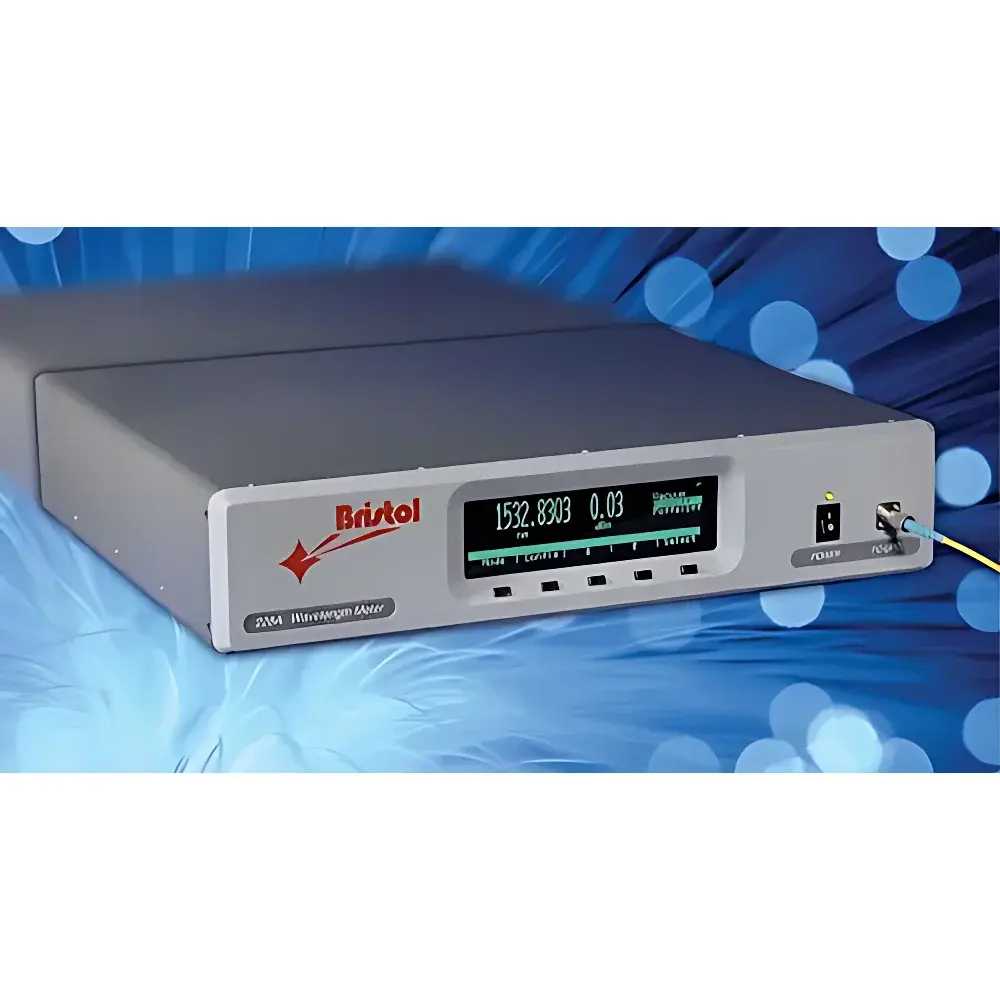
Bristol 228 Series Optical Communication Laser Wavelength Meter
| Brand | Bristol |
|---|---|
| Origin | USA |
| Model | 228 Series |
| Wavelength Range | 700–1650 nm (182–429 THz) |
| Absolute Accuracy | ±0.2 ppm (±0.3 pm @ 1550 nm) |
| Repeatability | ±0.1 ppm |
| Calibration Source | Stabilized He-Ne Laser |
| Measurement Refresh Rate | 10 Hz |
| Power Measurement Accuracy | ±0.5 dB (±30 nm from 1310/1550 nm) |
| Sensitivity | –30 dBm @ 1250–1650 nm |
| Max Input Power | +10 dBm (displayed), +18 dBm (safe) |
| Interface | USB 2.0, Ethernet (GPIB optional) |
| Warm-up Time | <15 min |
| Dimensions (H×W×L) | 89 × 432 × 381 mm |
Overview
The Bristol 228 Series Optical Communication Laser Wavelength Meter is a high-precision interferometric instrument engineered for metrology-grade wavelength characterization of continuous-wave (CW) lasers in dense wavelength division multiplexing (DWDM) systems and optical component manufacturing environments. Operating on the principle of Fourier-transform-based Michelson interferometry, the 228 Series resolves spectral position with sub-picometer resolution across the full telecommunications band—from 700 nm to 1650 nm (182–429 THz). Its core architecture integrates a thermally stabilized, frequency-doubled He-Ne laser as an intrinsic calibration reference, eliminating drift-induced uncertainty and enabling long-term traceability without external recalibration or operator intervention. Designed for integration into production test benches and R&D laboratories, the instrument delivers measurement stability compliant with ITU-T G.694.1 channel grid specifications and supports rigorous quality assurance protocols required by Tier-1 telecom equipment suppliers.
Key Features
- Interferometric wavelength measurement with absolute accuracy of ±0.2 ppm (±0.3 pm at 1550 nm) and repeatability better than ±0.1 ppm
- Real-time internal calibration via a long-life, frequency-stabilized He-Ne laser—no manual alignment or external standards required
- 10 Hz measurement update rate, enabling dynamic monitoring of wavelength drift during laser aging or thermal cycling tests
- Integrated optical power detection with ±0.5 dB accuracy over ±30 nm bandwidth centered at 1310 nm and 1550 nm
- Fiber-coupled input optimized for single-mode SMF-28 and PM fiber interfaces; compatible with FC/APC and FC/PC connectors
- Dual-display resolution options: 0.00001 nm (228A) and 0.0001 nm (228B), selectable per application sensitivity requirements
- Standard communication interfaces include USB 2.0 and 10/100Base-T Ethernet; IEEE-488 (GPIB) available as factory-installed option for SCPI-compliant automation
Sample Compatibility & Compliance
The 228 Series accepts only CW laser sources with coherence lengths exceeding 10 cm—ensuring compatibility with DFB, DBR, ECL, and external cavity diode lasers commonly deployed in transceivers, tunable modules, and optical amplifiers. It is not intended for pulsed, mode-locked, or broadband ASE sources. All models comply with IEC 61326-1 (EMC for laboratory equipment) and IEC 61010-1 (safety requirements for electrical equipment). Firmware implements audit-trail logging and user-access control levels aligned with GLP/GMP documentation practices. While not FDA 21 CFR Part 11 certified out-of-the-box, the system supports export of timestamped, digitally signed measurement records suitable for regulated environments when paired with validated third-party data management software.
Software & Data Management
Bristol provides the Windows-based Wavelength Meter Control Software, offering real-time spectrum visualization, multi-channel logging, statistical trend analysis (e.g., Allan deviation, drift rate), and batch report generation in PDF or CSV format. The SDK includes C/C++, .NET, and LabVIEW drivers supporting TCP/IP and VISA protocols. All measurements embed metadata including instrument serial number, firmware revision, calibration timestamp, ambient temperature, and input power level—enabling full traceability per ISO/IEC 17025 clause 7.7. Data export conforms to ASTM E2971-21 (Standard Practice for Reporting Spectral Measurement Data) and supports direct import into MATLAB, Python (via PyVISA), and JMP for advanced statistical process control (SPC) workflows.
Applications
- Verification of DWDM channel spacing and center wavelength alignment against ITU-T G.694.1 grids
- Characterization of laser wavelength stability under varying drive current and case temperature (e.g., Δλ/ΔT coefficient extraction)
- In-process testing of tunable lasers during wafer-level burn-in and final module calibration
- Calibration transfer between primary wavelength standards (e.g., iodine-stabilized lasers) and field-deployed instruments
- Pass/fail screening of optical filters, multiplexers, and wavelength-selective switches using side-mode suppression ratio (SMSR)-informed passband edge verification
- Support for Telcordia GR-468-CORE reliability qualification testing where wavelength shift must be monitored over 1000+ hours
FAQ
Does the 228 Series require periodic recalibration by the user?
No. The built-in stabilized He-Ne laser serves as a permanent, NIST-traceable reference. Bristol recommends annual verification using a certified external standard only for ISO/IEC 17025 accreditation purposes.
Can the instrument measure lasers outside the 700–1650 nm range?
No. Optical path length and detector responsivity are optimized exclusively for this band. UV or mid-IR lasers require alternative instrumentation such as monochromator-based spectrometers or FTIR systems.
Is fiber polarization sensitivity compensated?
The 228 Series uses polarization-diverse detection; polarization-dependent wavelength error is less than ±0.05 pm for linearly polarized inputs across all azimuth angles.
What is the minimum detectable power for reliable measurement at 1550 nm?
–30 dBm (1 μW) at 1550 nm with SNR > 40 dB. Below this level, measurement uncertainty increases non-linearly due to detector noise floor limitations.
How does the instrument handle multiple longitudinal modes?
It reports the centroid wavelength of the dominant mode. For multi-mode lasers with mode spacing > 1 GHz, optional spectral deconvolution firmware can resolve individual peaks—contact Bristol Applications Engineering for validation.



