
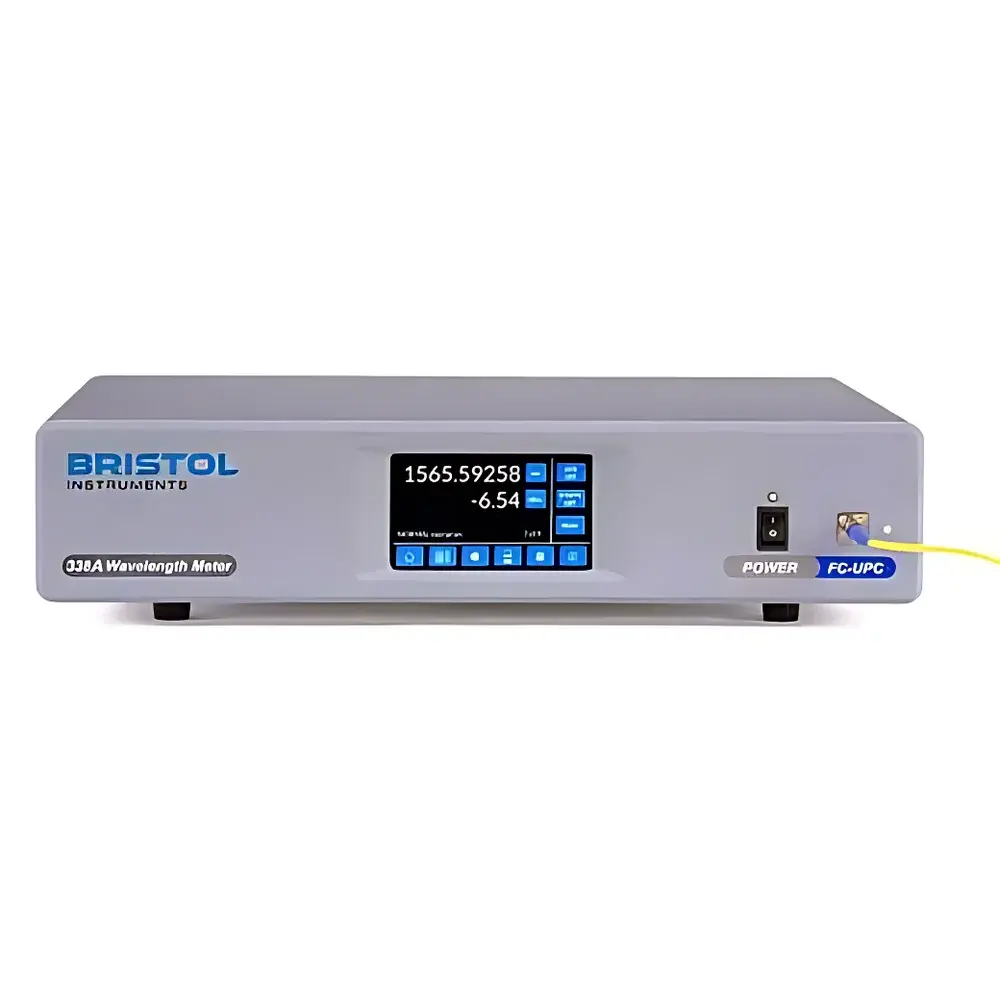
Bristol 338 Series Fast Wavelength Meter
| Brand | Bristol |
|---|---|
| Origin | USA |
| Model | 338 Series |
| Wavelength Range | 1270–1680 nm (179–236 THz) |
| Absolute Accuracy | ±0.2 ppm (±0.3 pm @ 1550 nm) / ±0.65 ppm (±1.0 pm @ 1550 nm) |
| Repeatability | ±0.03 ppm / ±0.1 ppm |
| Max Measurement Bandwidth | 10 GHz (80 pm @ 1550 nm) |
| Calibration Source | Stabilized HeNe Laser (338A) / Standard HeNe Laser (338B) |
| Display Resolution | 0.00001 nm (338A) / 0.0001 nm (338B) |
| Power Accuracy | ±0.5 dB (±30 nm around 1310 nm & 1550 nm) |
| Power Range | –30 dBm (1270–1650 nm), –25 dBm (1650–1680 nm) |
| Saturation | +10 dBm |
| Damage Threshold | +18 dBm |
| Input Connector | FC/UPC or FC/APC |
| Warm-up Time | <15 min (338A), No warm-up required (338B) |
| Interface | USB, Ethernet, GPIB (optional) |
| Measurement Rate | 25 Hz |
| Units | nm, cm⁻¹, THz, dBm, mW, µW |
Overview
The Bristol 338 Series Fast Wavelength Meter is a high-performance optical metrology instrument engineered for real-time, high-accuracy wavelength characterization of laser sources in R&D and manufacturing environments. Based on interferometric heterodyne detection with internal reference stabilization, the 338 Series delivers traceable absolute wavelength measurements across the telecom C-, L-, and extended S-bands (1270–1680 nm). Its dual-mode capability supports both continuous-wave (CW) and modulated (e.g., directly modulated DFB, EML, or pulsed) laser signals without external triggering or signal conditioning—enabling seamless integration into automated test systems for transceiver calibration, wavelength locker validation, and DWDM component verification. The instrument’s core architecture employs a thermally stabilized Michelson interferometer combined with a proprietary phase-tracking algorithm, ensuring robust immunity to environmental vibration and thermal drift while maintaining sub-picometer resolution and long-term measurement stability.
Key Features
- Simultaneous CW and modulated laser measurement at 25 Hz update rate—no averaging or manual mode switching required
- Two precision variants: 338A (stabilized HeNe reference, ±0.2 ppm absolute accuracy, 0.00001 nm display resolution) and 338B (standard HeNe reference, ±0.65 ppm, 0.0001 nm resolution)
- Full spectral coverage from 1270 nm to 1680 nm (179–236 THz), compatible with all major telecom and datacom laser platforms
- Integrated optical power measurement (–30 dBm to +10 dBm) with ±0.5 dB accuracy referenced to NIST-traceable standards
- Fiber-coupled input via FC/UPC or FC/APC connectors; optimized for single-mode fiber (SMF-28, PMF, or polarization-maintaining configurations)
- Zero-warm-up operation (338B) or <15-minute thermal stabilization (338A), supporting rapid deployment in production line settings
- Multi-protocol digital interface: native USB 2.0, 10/100 Ethernet (TCP/IP, SCPI), and optional IEEE-488.2 (GPIB) for legacy ATE compatibility
Sample Compatibility & Compliance
The 338 Series is validated for use with gas lasers (HeNe, Ar⁺), semiconductor lasers (DFB, DBR, VCSEL, EML), tunable lasers (SG-DBR, MEMS-VCSEL), and fiber lasers operating within its specified wavelength and power envelope. It meets IEC 61326-1:2013 requirements for electromagnetic compatibility (EMC) in laboratory and industrial environments. While not certified as a medical device, its measurement traceability aligns with ISO/IEC 17025 principles when operated under documented calibration procedures. Data integrity features—including timestamped readings, configurable measurement logging, and non-volatile memory retention—support GLP/GMP-aligned workflows where audit-ready records are essential. Optional firmware upgrades enable compliance with FDA 21 CFR Part 11 electronic record and signature requirements upon system-level validation.
Software & Data Management
Bristol provides the free, cross-platform Wavelength Meter Control Software (v5.x), supporting Windows, Linux, and macOS. The application enables real-time waveform visualization, statistical trend analysis (mean, std dev, min/max over user-defined intervals), and automated pass/fail reporting against user-specified wavelength and power limits. All measurements are stored in ASCII CSV or HDF5 format with embedded metadata (timestamp, instrument ID, calibration epoch, fiber type, connector polish). Remote control via SCPI commands allows full integration into LabVIEW, Python (PyVISA), MATLAB, or custom CI/CD test frameworks. Firmware updates are delivered digitally and applied via USB or network—no hardware modification required.
Applications
- High-volume testing of optical transceivers (QSFP-DD, OSFP, COBO) during burn-in and final functional test
- Characterization of wavelength drift vs. temperature and current in tunable laser assemblies (TLAs)
- Verification of ITU-T channel spacing (e.g., 50 GHz, 100 GHz grids) and grid alignment in ROADMs and WSS modules
- Calibration and monitoring of external cavity lasers (ECLs) and narrow-linewidth fiber lasers used in coherent communications
- Research-grade spectroscopic source validation in quantum optics, atomic physics, and optical frequency comb referencing
- Production-line feedback control for wafer-level laser trimming and photonic integrated circuit (PIC) testing
FAQ
Does the 338 Series require periodic recalibration?
Yes. Bristol recommends annual calibration using NIST-traceable reference lasers. The instrument stores calibration coefficients in protected memory and supports user-initiated verification routines.
Can the 338 measure linewidth or side-mode suppression ratio (SMSR)?
No. It is designed exclusively for absolute wavelength and optical power determination—not spectral shape analysis. For linewidth or SMSR, a high-resolution optical spectrum analyzer (OSA) is required.
Is polarization sensitivity a concern for accurate measurement?
The 338 Series uses polarization-diverse interferometry; measurement accuracy is independent of input polarization state when using standard SMF input. Polarization-maintaining fiber inputs require alignment but do not degrade absolute accuracy.
What is the typical measurement uncertainty budget at 1550 nm?
For the 338A model: ±0.3 pm (type B uncertainty, k=2) includes contributions from interferometer stability, reference laser drift, detector nonlinearity, and environmental temperature gradients (±0.5 °C).
How does the 338 handle multi-longitudinal-mode (MLM) or broadband ASE sources?
It reports the centroid wavelength of the dominant mode or peak intensity region. For multimode sources, users should confirm spectral purity via OSA prior to wavelength meter use to avoid misinterpretation of composite signals.




