
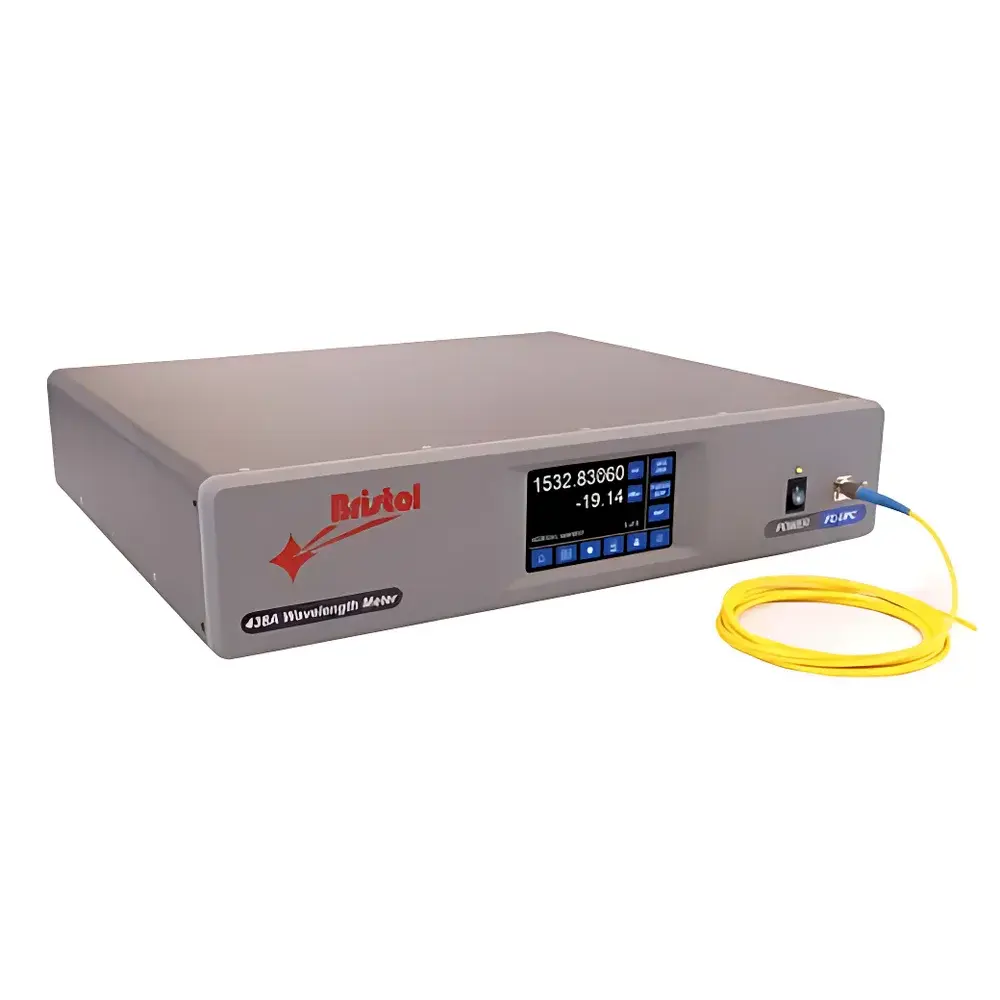
Bristol 438 Series Optical Communication Laser Wavelength Meter
| Brand | Bristol |
|---|---|
| Origin | USA |
| Model | 438 Series |
| Wavelength Range | 1000–1680 nm (179–300 THz) |
| Absolute Accuracy | ±0.2 ppm (438A) / ±0.65 ppm (438B) |
| Power Measurement Range | –40 dBm to +10 dBm |
| Power Accuracy | ±0.5 dB (within ±30 nm of 1310 nm and 1550 nm) |
| Measurement Rate | 4 Hz (250 ms per acquisition) |
| Simultaneous Channels | Up to 1000 |
| Calibration Source | Built-in Stabilized HeNe Laser |
| Interface | USB 2.0, Ethernet (GPIB optional) |
| Display Resolution | 0.00001 nm (438A) / 0.0001 nm (438B) |
| Dimensions (H×W×L) | 89 mm × 432 mm × 381 mm |
Overview
The Bristol 438 Series Optical Communication Laser Wavelength Meter is a high-precision interferometric instrument engineered for real-time, multi-channel wavelength and optical power characterization in dense wavelength division multiplexing (DWDM) systems. Based on Michelson interferometry with active stabilization, the 438 Series delivers traceable, absolute wavelength measurements across the full fiber-optic communication spectrum—from the O-band (1260–1360 nm) through the C-band (1530–1565 nm) and L-band (1565–1625 nm) to extended ranges up to 1680 nm. Its core architecture integrates a built-in, long-life, frequency-stabilized HeNe laser as an intrinsic reference, enabling continuous, autonomous calibration without user intervention or external standards. This eliminates drift-related uncertainty and ensures metrological integrity over extended operational periods—critical for production line validation, R&D lab verification, and network monitoring applications where regulatory compliance and measurement repeatability are mandated.
Key Features
- Simultaneous measurement of up to 1000 DWDM channels at 4 Hz update rate (250 ms per full-spectrum acquisition)
- Interferometric wavelength determination with absolute accuracy of ±0.2 ppm (438A) or ±0.65 ppm (438B), equivalent to ±0.3 pm or ±1.0 pm at 1550 nm
- Real-time optical power monitoring per channel with ±0.5 dB accuracy within ±30 nm of 1310 nm and 1550 nm reference wavelengths
- Native support for multiple display units: nanometers (nm), wavenumbers (cm⁻¹), and terahertz (THz)
- Dual configuration options: 438A (1270–1650 nm) and 438B (1000–1680 nm), both covering ITU-T G.694.1 grid-compliant channels
- Integrated stabilized HeNe laser reference with <1 × 10⁻⁸ relative frequency stability over 24 hours
- Standard USB 2.0 and 10/100/1000BASE-T Ethernet interfaces; GPIB available as factory-installed option for legacy ATE integration
Sample Compatibility & Compliance
The 438 Series accepts free-space or fiber-coupled input from CW or modulated lasers—including DFB, DBR, tunable external cavity lasers (ECLs), and swept-source OCT emitters—provided input power falls within the specified dynamic range (–40 dBm to +10 dBm). No beam conditioning or polarization control is required for standard operation, though optional polarization-maintaining (PM) fiber adapters are available for polarization-sensitive characterization. The instrument conforms to IEC 61326-1 (EMC for laboratory equipment) and meets RoHS 2 directive requirements. Its measurement traceability aligns with NIST-traceable HeNe laser standards, supporting compliance with ISO/IEC 17025 accredited calibration laboratories. While not FDA-certified as a medical device, its data integrity features—including timestamped raw interferogram logging and non-volatile memory retention—facilitate adherence to GLP and GMP documentation practices in regulated photonics manufacturing environments.
Software & Data Management
Bristol’s proprietary WaveMeter Control Software (v5.x) provides a Windows-based GUI for instrument configuration, real-time spectral visualization, pass/fail thresholding, and automated report generation in PDF or CSV format. The software implements audit-trail functionality compliant with FDA 21 CFR Part 11 requirements when deployed with Windows domain authentication and electronic signature modules. Raw interferogram data and calibrated wavelength/power arrays are stored in HDF5 format for post-processing interoperability with MATLAB, Python (h5py), and LabVIEW. Remote operation is supported via TCP/IP socket commands or SCPI over Ethernet/USB, enabling seamless integration into automated test platforms using NI TestStand, Keysight PathWave, or custom Python-based control frameworks. Firmware updates are delivered via signed binary packages with SHA-256 hash verification.
Applications
- DWDM transceiver module final-test validation in Tier-1 optical component manufacturing
- Characterization of tunable laser sources for coherent communications and photonic integrated circuit (PIC) testing
- Calibration reference for optical spectrum analyzers (OSAs) and wavelength selective switches (WSS)
- Long-term drift monitoring of external cavity diode lasers (ECDLs) in quantum optics and atomic physics labs
- ITU channel plan verification during optical network deployment and field service
- Power-balanced channel analysis in ROADM and optical amplifier gain-flattening validation
FAQ
Does the 438 Series require periodic recalibration by an external lab?
No—its internal stabilized HeNe laser serves as a permanent, self-referencing standard. Bristol recommends annual verification against a NIST-traceable source only for ISO/IEC 17025 accreditation purposes.
Can the instrument measure modulated lasers with arbitrary waveforms?
Yes—it captures instantaneous wavelength during each 250 ms acquisition window, making it suitable for slow-frequency modulation (e.g., dithering for lock-in detection) but not for sub-millisecond dynamic tuning analysis.
Is fiber coupling mandatory, or can free-space beams be measured directly?
Both configurations are supported. Free-space input requires alignment to the 2.5 mm entrance aperture; fiber input uses FC/APC or FC/PC connectors with optional PM-fiber variants.
How is measurement uncertainty calculated and reported?
Total uncertainty includes contributions from interferometer stability, HeNe reference drift, detector linearity, and environmental temperature gradients (±0.5 °C), all quantified per ANSI/NCSL Z540.3 and reported in the instrument’s calibration certificate.
What happens if input power exceeds +10 dBm?
An internal neutral-density filter automatically engages above +3 dBm to prevent detector saturation; sustained exposure >+10 dBm may trigger protective shutdown and require manual reset.





