
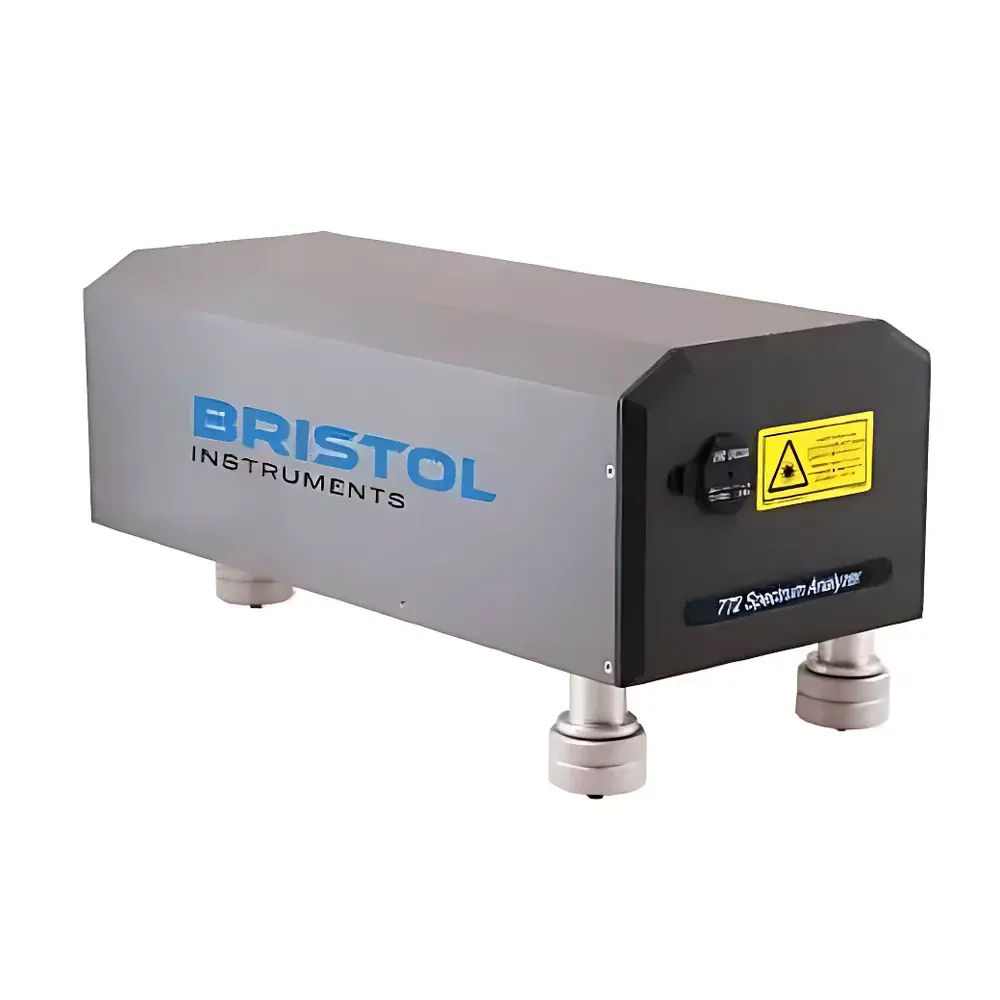
Bristol 772B-MIR Mid- to Far-Infrared Laser Spectrum Analyzer
| Brand | Bristol |
|---|---|
| Origin | USA |
| Model | 772B-MIR |
| Laser Type | CW or Pulsed (Rep. Rate ≥ 100 Hz) |
| Wavelength Range | 1–12 µm |
| Spectral Resolution | 4 GHz |
| Wavelength Accuracy | ±10 ppm (±0.08 nm @ 8 µm |
| Optical Rejection | >20 dB (>30,000 pulses) |
| Minimum Input Power | 0.005–2.5 µW |
| Measurement Time | 2 × Number of Pulses |
| Input | Free-space beam with auxiliary visible alignment guide |
| Display Units | 8-digit readout in nm, µm, cm⁻¹, GHz, THz |
| Calibration | Internal continuous calibration |
Overview
The Bristol 772B-MIR Mid- to Far-Infrared Laser Spectrum Analyzer is a purpose-built optical measurement instrument engineered for high-fidelity spectral characterization of lasers operating in the 1–12 µm wavelength region. Unlike conventional Fourier-transform infrared (FTIR) spectrometers or grating-based monochromators—whose performance degrades significantly with low-repetition-rate pulsed sources—the 772B-MIR employs a proprietary interferometric architecture optimized for both continuous-wave (CW) and pulsed laser emission. Its core design leverages heterodyne detection principles combined with thermally stabilized etalon references and real-time phase-locking algorithms, enabling precise determination of absolute wavelength, spectral linewidth, and frequency stability under non-ideal beam conditions. This makes it uniquely suited for quantum cascade lasers (QCLs), optical parametric oscillators (OPOs), and other emerging mid- to far-IR sources used in trace gas sensing, industrial process monitoring, and fundamental molecular spectroscopy.
Key Features
- Native support for pulsed lasers with repetition rates as low as 100 Hz—enabling reliable spectral acquisition from QCLs and nanosecond-duration OPO outputs without signal averaging artifacts.
- 4 GHz spectral resolution, sufficient to resolve individual rotational-vibrational transitions in high-resolution TDLAS (Tunable Diode Laser Absorption Spectroscopy) applications.
- ±10 ppm absolute wavelength accuracy, traceable to NIST-certified reference lines, with automatic internal calibration maintained during operation to ensure long-term metrological integrity.
- Optical rejection exceeding 20 dB against adjacent spectral orders and stray light—critical for isolating weak emission features in broadband IR backgrounds.
- Multi-unit display capability: simultaneous 8-digit readout in nm, µm, cm⁻¹, GHz, and THz—facilitating direct comparison with HITRAN database entries and spectroscopic literature values.
- Free-space optical input interface with integrated visible alignment guide (e.g., 635 nm diode) for rapid beam coupling and positional repeatability across laboratory or field-deployable setups.
Sample Compatibility & Compliance
The 772B-MIR accepts collimated free-space beams without fiber coupling requirements, accommodating beam diameters from 1 mm to 8 mm and divergence angles up to ±2.5 mrad. It is compatible with polarization-maintaining and unpolarized inputs, though optimal performance is achieved with linearly polarized radiation aligned to the instrument’s designated axis. The analyzer complies with IEC 61000-6-3 (EMC emissions) and IEC 61010-1 (safety for electrical equipment for measurement). While not certified for hazardous environments, its solid-state optical path and absence of moving parts support deployment in ISO Class 5 cleanrooms and GLP-compliant analytical laboratories. Data output formats adhere to ASTM E1421-22 standards for spectral data exchange, and timestamped measurement logs are structured for seamless integration into FDA 21 CFR Part 11–compliant electronic record systems when paired with validated third-party LIMS platforms.
Software & Data Management
The instrument operates via Bristol’s proprietary SpectrumView™ software suite, delivered on Windows-based host PCs with USB 3.0 or Ethernet connectivity. The software provides real-time spectral visualization, automated peak identification using second-derivative thresholding, and batch processing of time-resolved pulse sequences. All raw interferograms and calibrated spectra are stored in HDF5 format with embedded metadata (wavelength calibration coefficients, environmental sensor readings, user annotations). Audit trails log every parameter change, calibration event, and export action—including operator ID, timestamp, and IP address—meeting ALCOA+ principles for data integrity. Export options include CSV, SPC, and JCAMP-DX v6.00 for cross-platform compatibility with OPUS, GRAMS, and Python-based analysis workflows (e.g., SciPy, Astropy).
Applications
- Development and QC testing of quantum cascade lasers targeting industrial gas analyzers (e.g., CH₄, CO, NOₓ, NH₃ detection at 7–11 µm).
- Validation of OPO tuning curves and idler-arm spectral purity in ultrafast IR spectroscopy systems.
- Frequency stabilization feedback for external cavity QCLs requiring sub-MHz locking bandwidths.
- Reference-grade wavelength assignment for metrology labs supporting ISO/IEC 17025-accredited calibrations.
- Field-deployable spectral verification of open-path IR sensors used in landfill methane monitoring and refinery leak detection networks.
FAQ
Does the 772B-MIR require external wavelength references for routine operation?
No. It incorporates an internally mounted, temperature-stabilized reference etalon with continuous real-time correction, eliminating dependency on external gas cells or HeNe lasers.
Can it measure femtosecond OPO output?
It is designed for pulses ≥50 ns duration and repetition rates ≥100 Hz. Sub-ns pulses require temporal gating and are outside its specified operating envelope.
Is fiber-optic input supported?
Not natively. Free-space coupling is mandatory to preserve wavefront fidelity and avoid modal dispersion artifacts inherent in mid-IR fibers.
How often must the system be recalibrated?
The built-in continuous calibration engine maintains accuracy over typical lab temperature fluctuations (±2 °C); annual factory recalibration is recommended for ISO 17025 compliance.
What environmental conditions affect measurement stability?
Ambient temperature gradients >0.5 °C/min or acoustic vibration >50 µm/s RMS may induce fringe drift; operation inside an optical table enclosure is advised for sub-ppm accuracy.




