
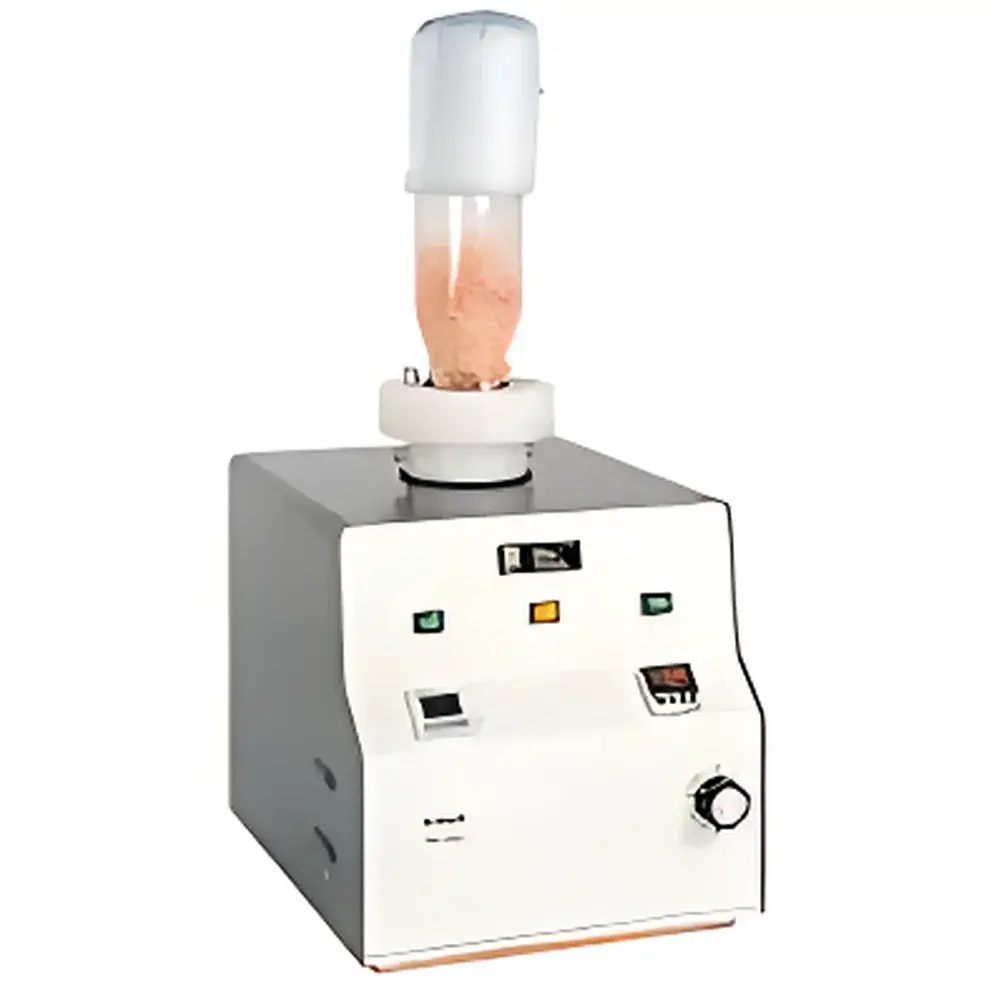
Brookfield 350S Portable Spore Drying Fluidized Bed Dryer
| Origin | UK |
|---|---|
| Manufacturer Type | Authorized Distributor |
| Origin Category | Imported |
| Model | 350S |
| Pricing | Available Upon Request |
| Dimensions (L×W×D) | 37 × 35.5 × 45.5 cm |
| Net Weight | 30 kg |
| Operating Temperature Range | Ambient to 80 °C |
| Airflow Control | 9-step motor-driven turbine with front-panel precision selector knob |
| Filtration | Removable 5 µm washable filter |
| Heating Power | 2 kW |
| Power Supply | Standard 10 A domestic socket (230 V AC, 50 Hz) |
| Chamber Material Options | Borosilicate glass or 316 stainless steel drying tube |
Overview
The Brookfield 350S Portable Spore Drying Fluidized Bed Dryer is a compact, benchtop-scale fluidization system engineered for controlled, low-thermal-stress dehydration of heat-sensitive biological particulates—particularly fungal spores, bacterial endospores, and other microbiological samples requiring preservation of viability and structural integrity. Unlike conventional oven or vacuum drying methods, the 350S employs gentle, uniform fluidization dynamics: ambient or heated air is accelerated through a precisely regulated 9-stage turbine, then directed upward through a vertical drying tube to suspend particles in a stable, evenly distributed fluidized bed. This mode of operation ensures rapid moisture removal while minimizing mechanical shear, thermal degradation, and agglomeration—critical for downstream applications such as aerosol challenge studies, viability assays, cryopreservation preparation, and standardized spore bank generation. Designed and manufactured in the United Kingdom, the unit complies with fundamental engineering safety standards (IEC 61010-1) and integrates thermally stable materials suitable for repeated sterilization cycles.
Key Features
- Motor-driven 9-position airflow turbine with tactile front-panel selector knob for repeatable, operator-independent volumetric flow setting
- Electronic temperature control system with integrated Pt100 RTD sensor and PID algorithm, maintaining ±1.5 °C accuracy across 20–80 °C range
- Dual-material drying tube options: borosilicate glass (for visual process monitoring and chemical inertness) or electropolished 316 stainless steel (for enhanced durability and autoclavability)
- High-efficiency 5 µm particulate filter mounted on rear panel—fully removable, washable, and validated for ≥99.9% retention of spores and microaerosols
- Integrated exhaust collection bag with HEPA-grade retention capability; compatible with ethylene oxide (EtO) or hydrogen peroxide (H₂O₂) decontamination protocols
- Low-power 2 kW heating module optimized for rapid thermal response without excessive energy draw—operates directly from standard 10 A, 230 V AC mains supply
Sample Compatibility & Compliance
The 350S accommodates diverse particulate matrices including but not limited to: conidia and ascospores (e.g., Aspergillus niger, Penicillium chrysogenum), bacterial endospores (Bacillus atrophaeus, Geobacillus stearothermophilus), lyophilized protein powders, pharmaceutical excipients, and food-grade granules. Its design supports GLP-aligned workflows: all temperature setpoints, airflow positions, and run durations are manually recorded via logbook or external data logger (no onboard memory). The unit’s construction meets ISO 9001-certified manufacturing practices; filtration performance aligns with ISO 14644-1 Class 5 cleanroom particulate removal requirements when used with certified exhaust bags. For regulatory submissions involving spore-based validation (e.g., sterilization cycle development per ISO 11138 or USP ), the 350S provides consistent, documentable drying profiles essential for reproducible biological indicator preparation.
Software & Data Management
The 350S operates as a standalone analog-controlled instrument with no embedded firmware, cloud connectivity, or proprietary software. All operational parameters—including airflow stage selection, temperature setpoint, and elapsed drying time—are set manually and verified using calibrated external instrumentation (e.g., digital anemometer, NIST-traceable thermometer). This architecture eliminates cybersecurity vulnerabilities and simplifies 21 CFR Part 11 compliance: users maintain full audit trail integrity via handwritten logs or third-party electronic lab notebook (ELN) integration. Optional accessories include a calibrated thermocouple probe kit and a gravimetric moisture loss adapter for real-time mass tracking during drying runs.
Applications
- Preparation of standardized spore suspensions for bioaerosol generation and inhalation toxicology studies
- Drying of microbial challenge agents prior to lyophilization or storage in desiccated vials
- Controlled dehydration of enzyme powders and vaccine adjuvants where residual moisture content must remain below 3% w/w
- Stabilization of probiotic cultures and starter cultures for food fermentation R&D
- Process development for continuous fluidized-bed drying in GMP pilot-scale pharmaceutical manufacturing
FAQ
Is the 350S suitable for drying live bacterial spores without compromising viability?
Yes—its low-turbulence fluidization profile and precise temperature control (±1.5 °C) enable gentle dehydration that preserves >92% culturability for Bacillus endospores when operated within 45–60 °C at optimal airflow.
Can the drying tube be sterilized in an autoclave?
The stainless steel tube option is fully autoclavable (121 °C, 20 min, 1 bar); the glass tube is heat-resistant up to 500 °C but not recommended for pressurized steam cycles.
Does the unit include data logging capability?
No—the 350S is an analog-operated device. Temperature and airflow are monitored externally using calibrated instruments per user-defined SOPs.
What maintenance is required for the 5 µm filter?
The filter should be rinsed with deionized water and dried before each use; periodic inspection for fiber shedding or seal degradation is recommended every 50 operating hours.
Is the exhaust bag compliant with biosafety level 2 (BSL-2) containment requirements?
When used with certified HEPA-retentive exhaust bags and properly sealed connections, the system meets BSL-2 aerosol containment criteria per CDC/NIH guidelines for non-pathogenic spore handling.



