
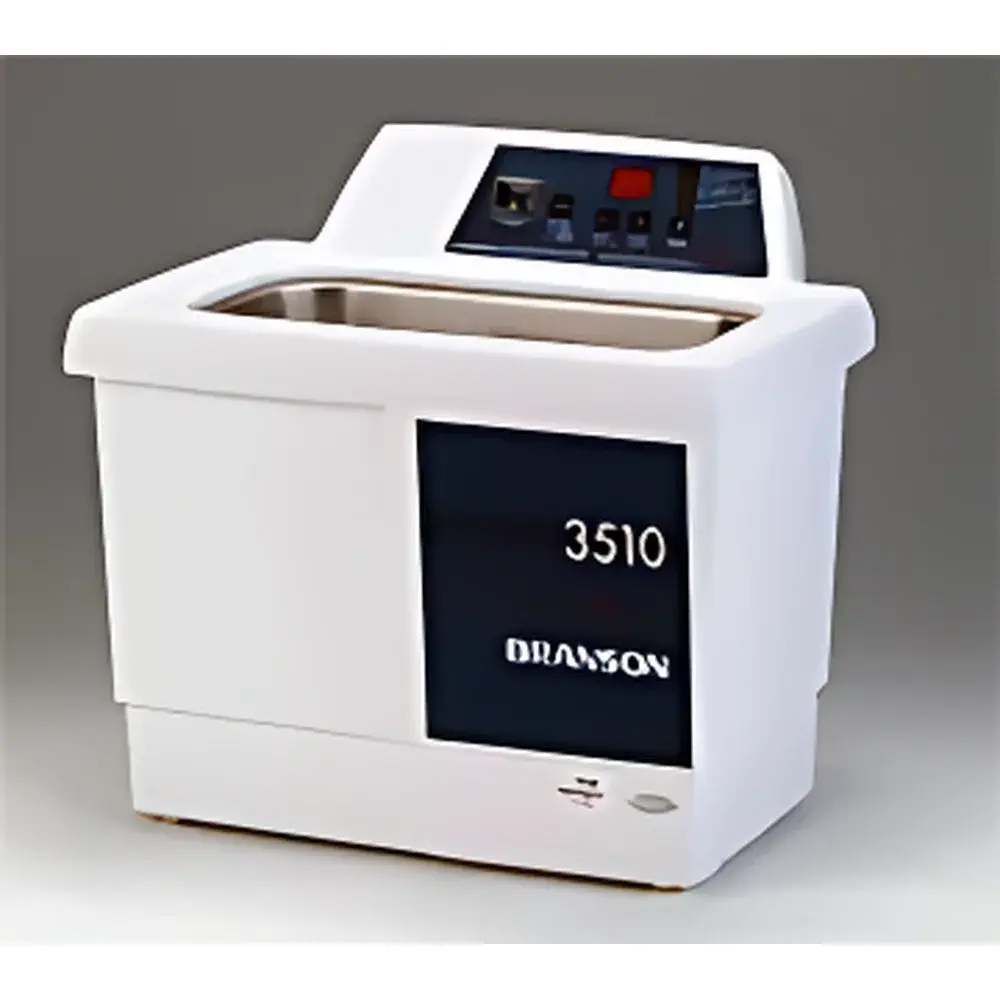
Brookfield B3510E-DTH Ultrasonic Cleaner
| Origin | USA |
|---|---|
| Manufacturer Type | Authorized Distributor |
| Origin Category | Imported |
| Model | B3510E-DTH |
| Price | Upon Request |
| Tank Volume | 5.7 L |
| Chamber Dimensions | 292 × 152 × 152 mm |
| Ultrasonic Frequency | 40 kHz |
| Heating Range | 0–70 °C |
| Timer Range | 1–99 min (digital) |
| Heating Power | 130 W |
| Total Power | 335 W |
| Input Voltage | 220 V, 50/60 Hz |
| Construction Material | Polypropylene (PP) tank and housing |
| Transducer Type | Langevin-type piezoelectric ceramic/metal stack |
| Mounting | Adhesive-bonded vertical transducer array |
| Control Interface | Top-mounted digital panel with dual temperature display (actual & setpoint) |
| Lid Function | Hinged sound-dampening lid with integrated drip tray and quick-drain port |
Overview
The Brookfield B3510E-DTH Ultrasonic Cleaner is an engineered solution for precision cleaning of delicate laboratory components—including glassware, pipette tips, filtration membranes, surgical instruments, and analytical sample holders—where manual scrubbing risks damage or contamination. It operates on the principle of acoustic cavitation: high-frequency (40 kHz) ultrasonic energy generates controlled microbubble formation and implosion within the cleaning solvent, producing localized shear forces that dislodge particulate matter, organic residues, and biofilms without mechanical abrasion. Designed for consistent performance in regulated environments, the unit integrates thermal control, programmable timing, and degassing functionality to support validated cleaning protocols aligned with ISO 13485, ASTM D2603, and USP guidelines for ultrasonic cleaning validation.
Key Features
- Digitally controlled interface with dual LED display showing real-time bath temperature and user-set heating target—enabling precise thermal management across 0–70 °C range.
- Langevin-type piezoelectric transducers bonded vertically to the tank bottom using aerospace-grade adhesive; engineered for long-term stability, minimal power loss, and resistance to delamination under continuous operation.
- Optimized spherical wave propagation architecture—originally developed by the pioneers of industrial ultrasonics—to ensure uniform cavitation distribution throughout the 5.7 L tank volume (292 × 152 × 152 mm internal dimensions).
- Sweep-frequency modulation circuitry eliminates standing wave nodes and hot spots, maintaining consistent energy delivery over extended cycles (1–99 min programmable duration).
- Chemically resistant polypropylene (PP) construction—fully compliant with EPA Method 3550C solvent compatibility requirements—for safe use with aqueous detergents, isopropanol, acetone, and mild alkaline solutions.
- Top-mounted control panel with sealed, rubber-coated push-button switches—prevents ingress of moisture and cleaning agents, extending electronics service life.
- Hinged acoustic lid doubles as a spill-resistant drip tray and incorporates a quick-connect drain port for rapid solvent evacuation between batches.
- Vertical PCB orientation and conformal coating minimize condensation-related corrosion—critical for humid lab environments and repeated thermal cycling.
Sample Compatibility & Compliance
The B3510E-DTH accommodates standard laboratory vessels up to 140 mm in height and 120 mm in diameter, including volumetric flasks, crucibles, syringe filters, and microcentrifuge tubes. Its 40 kHz frequency balances penetration depth and surface resolution—ideal for removing sub-micron contaminants from porous or textured surfaces without erosion. The unit meets IEC 61000-6-3 (EMC emissions) and IEC 61000-6-2 (immunity) standards. Optional accessories—including stainless steel baskets, beaker holders, and ultrasonic cleaning racks—are available to maintain GMP-compliant load configuration and prevent direct contact between parts and tank walls during processing.
Software & Data Management
While the B3510E-DTH operates via embedded firmware without external PC connectivity, its digital timer and temperature controller provide full auditability for routine cleaning SOPs. All parameter settings—including start time, duration, final temperature, and hold period—are retained after power cycling. For laboratories requiring electronic recordkeeping per FDA 21 CFR Part 11, optional data loggers (e.g., calibrated PT100 probe + USB interface module) may be integrated to capture time-stamped bath temperature profiles. Firmware supports GLP/GMP traceability through user-defined batch IDs entered via front-panel keypad prior to cycle initiation.
Applications
- Cleaning of HPLC autosampler vials, LC-MS ion sources, and GC inlet liners to prevent carryover and baseline drift.
- Preparation of TEM grids and SEM stubs prior to metal coating—ensuring contaminant-free surface morphology.
- Removal of proteinaceous residue from electrophoresis combs, gel trays, and blotting apparatus.
- Decontamination of reusable biosafety cabinet tools and centrifuge rotors following BSL-2 protocols.
- Supporting ASTM E2871-22 for ultrasonic cleaning validation in pharmaceutical manufacturing facilities.
FAQ
What is the recommended cleaning solution for this unit?
Aqueous alkaline detergents (e.g., Alconox® Liquinox®) or low-concentration ethanol/water mixtures are optimal. Avoid halogenated solvents unless explicitly approved by Brookfield’s chemical compatibility guide.
Can the unit operate continuously for more than 60 minutes?
Yes—the digital timer supports up to 99 minutes per cycle. For extended cleaning, users may initiate sequential cycles manually or integrate with external programmable logic controllers (PLCs).
Is the heating function required for all cleaning applications?
No. Heating enhances removal of waxy or viscous residues but is not necessary for particulate-only cleaning. The unit allows independent activation of ultrasonics and heating.
How often should the transducers be serviced?
Under normal usage (≤8 hrs/day), no scheduled maintenance is required. Transducer integrity is verified during annual IQ/OQ qualification per ISO/IEC 17025.
Does this model support remote monitoring or network integration?
Not natively. However, analog output signals (0–10 V for temperature, relay status) are accessible via rear-panel terminals for third-party SCADA or building management system integration.



