
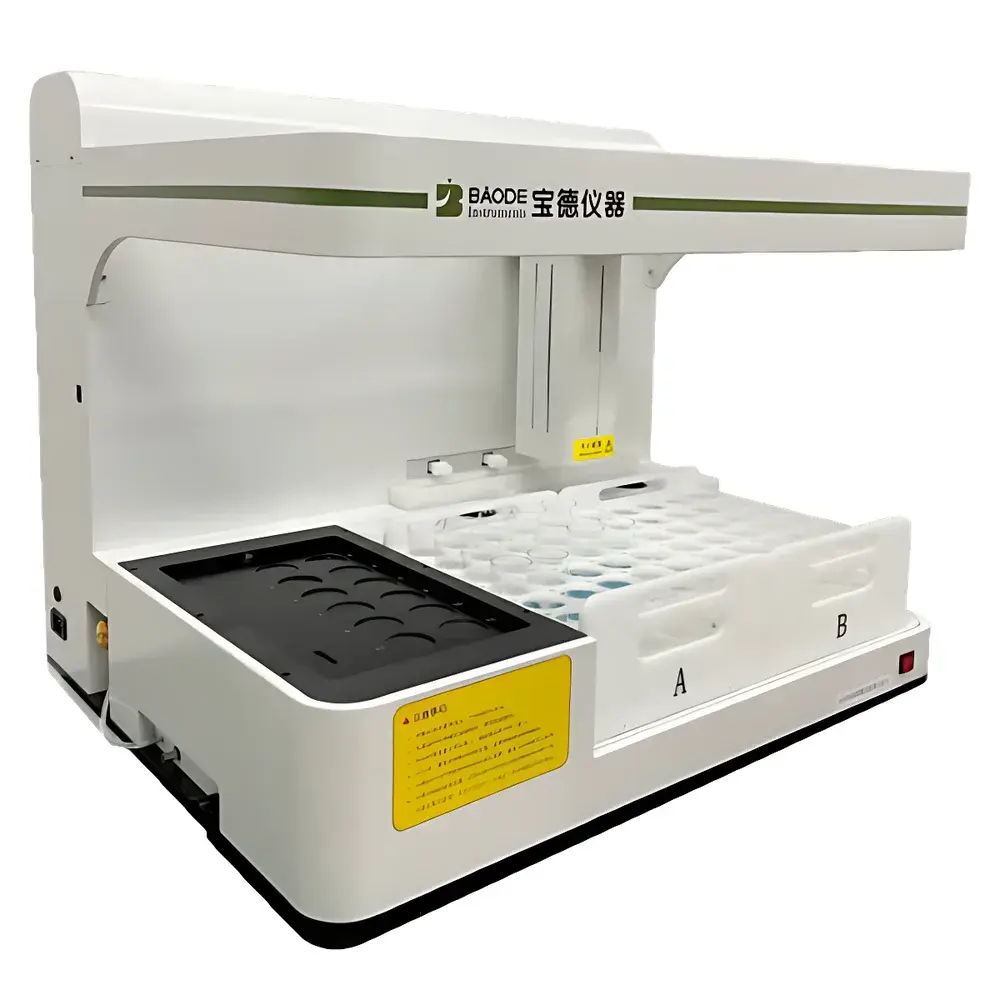
Brookfield BCOD-60A Automated Permanganate Index Analyzer
| Brand | Brookfield |
|---|---|
| Origin | Beijing, China |
| Manufacturer Type | Original Equipment Manufacturer (OEM) |
| Product Category | Domestic |
| Model | BCOD-60A |
| Measurement Principle | Potassium Permanganate Oxidation with ORP Endpoint Detection |
| Instrument Type | Benchtop Laboratory Analyzer |
| Range | 0.05–6.5 mg/L (undiluted) |
| Repeatability | RSD ≤2% at 3.0 mg/L glucose standard |
| Accuracy | Compliant with MEE QC reference materials and manual method t-test validation per Chinese regulatory requirements |
| LOD | 0.05 mg/L |
| Analysis Time | 3–4 min per sample (acidic/alkaline KMnO₄ titration protocols) |
Overview
The Brookfield BCOD-60A Automated Permanganate Index Analyzer is a benchtop laboratory instrument engineered for precise, reproducible quantification of the permanganate index (CODMn) in natural waters, drinking water sources, and treated effluents. It operates on the standardized potassium permanganate oxidation principle—where organic and inorganic reductants in the sample are oxidized under controlled acidic or alkaline conditions—and employs potentiometric endpoint detection via redox potential (ORP) measurement to determine stoichiometric completion of the reaction. This method aligns with internationally recognized oxidative demand paradigms and serves as a critical surrogate for low-level organic contamination assessment where dichromate-based COD (CODCr) methods are overly aggressive or unsuitable. The BCOD-60A eliminates manual titration variability by automating reagent dispensing, heating control, mixing, endpoint recognition, and result calculation—ensuring full traceability and compliance with method-defined procedural constraints.
Key Features
- Fully automated workflow covering sample aspiration, acid/alkali conditioning, KMnO₄ dosing, boiling reflux (optional integrated heater module), cooling, Na₂C₂O₄ back-titration, and endpoint detection
- Dual-mode operation supporting both acidic and alkaline permanganate index protocols per GB 11892–1989 and GB/T 5750.7–2023
- High-precision liquid handling system with gravimetric calibration verification capability for reagent delivery accuracy ±0.5% v/v
- Integrated ORP sensor with real-time potential monitoring and adaptive slope-based endpoint algorithm to minimize over-titration error
- Modular design enabling future expansion to additional redox-based endpoints (e.g., total hardness via EDTA titration, iodine content in salt, chloride by argentometric titration)
- Robust architecture compliant with IP20 environmental rating; designed for continuous operation in ISO/IEC 17025-accredited laboratories
Sample Compatibility & Compliance
The BCOD-60A accommodates aqueous matrices including raw surface water, groundwater, potable water, wastewater effluent, seawater (diluted), and saline industrial process streams. It supports direct analysis without pre-filtration for turbidity ≤10 NTU. All operational parameters—including temperature ramp profiles, reflux duration, and reagent concentration ranges—are programmable to meet matrix-specific adaptations defined in GB/T 5750.4–2023 (physical/sensory parameters), GB/T 5750.7–2023 (organic indicators), and GB/T 13025.7–2012 (iodine in salt). Method validation data confirm equivalence to manual reference procedures per Ministry of Ecology and Environment (MEE) quality control standards, satisfying statistical t-test acceptance criteria (p > 0.05) across certified reference materials. Instrument software maintains full audit trail functionality aligned with GLP and GMP documentation expectations.
Software & Data Management
The embedded analytical software provides intuitive method configuration, sequence scheduling, and real-time status monitoring via a 10.1-inch capacitive touchscreen interface. All measurements are timestamped and linked to user ID, sample ID, reagent lot numbers, and environmental logs (ambient temperature/humidity). Raw ORP curves, derivative plots, and endpoint confirmation markers are stored in vendor-neutral CSV and PDF formats. Data export supports LIMS integration via ASTM E1384-compliant HL7 messaging or secure SFTP transfer. Electronic records comply with FDA 21 CFR Part 11 requirements through role-based access control, electronic signatures, and immutable audit trails with ≥180-day retention history.
Applications
- Routine monitoring of permanganate index in municipal drinking water treatment plants and source water surveillance programs
- Regulatory reporting for environmental agencies requiring GB 11892–1989 compliance in surface water quality assessments
- Multi-parameter redox titration extension for total hardness (EDTA), iodine in edible salt (direct/oxidative iodometry), chloride (Mohr/Volhard), and marine CODMn in estuarine and coastal waters
- Method development and interlaboratory comparison studies in national CDC laboratories and higher education research facilities
- Quality assurance testing in pharmaceutical water systems where low-level oxidizable carbon must be verified against USP and EP 2.2.44 guidelines
FAQ
Does the BCOD-60A support both acidic and alkaline permanganate index methods?
Yes—the instrument includes pre-programmed protocols for both GB 11892–1989 acidic and alkaline variants, with automatic selection of pH adjustment reagents and heating profiles.
What is the minimum detectable permanganate index concentration?
The limit of detection is 0.05 mg/L, validated using ultrapure water blanks and confirmed through signal-to-noise ratio analysis of ORP response curves.
How is method accuracy verified during routine operation?
Each analytical batch includes at least one MEE-certified reference material; deviation from certified value must remain within ±5% to maintain QC release criteria.
Can the system be integrated into an existing laboratory information management system (LIMS)?
Yes—via configurable API endpoints, HL7 message templates, or scheduled CSV exports with customizable field mapping.
Is operator training required prior to deployment?
Comprehensive on-site installation qualification (IQ) and operational qualification (OQ) services include hands-on training for method setup, maintenance routines, and troubleshooting workflows.
Related Products







