
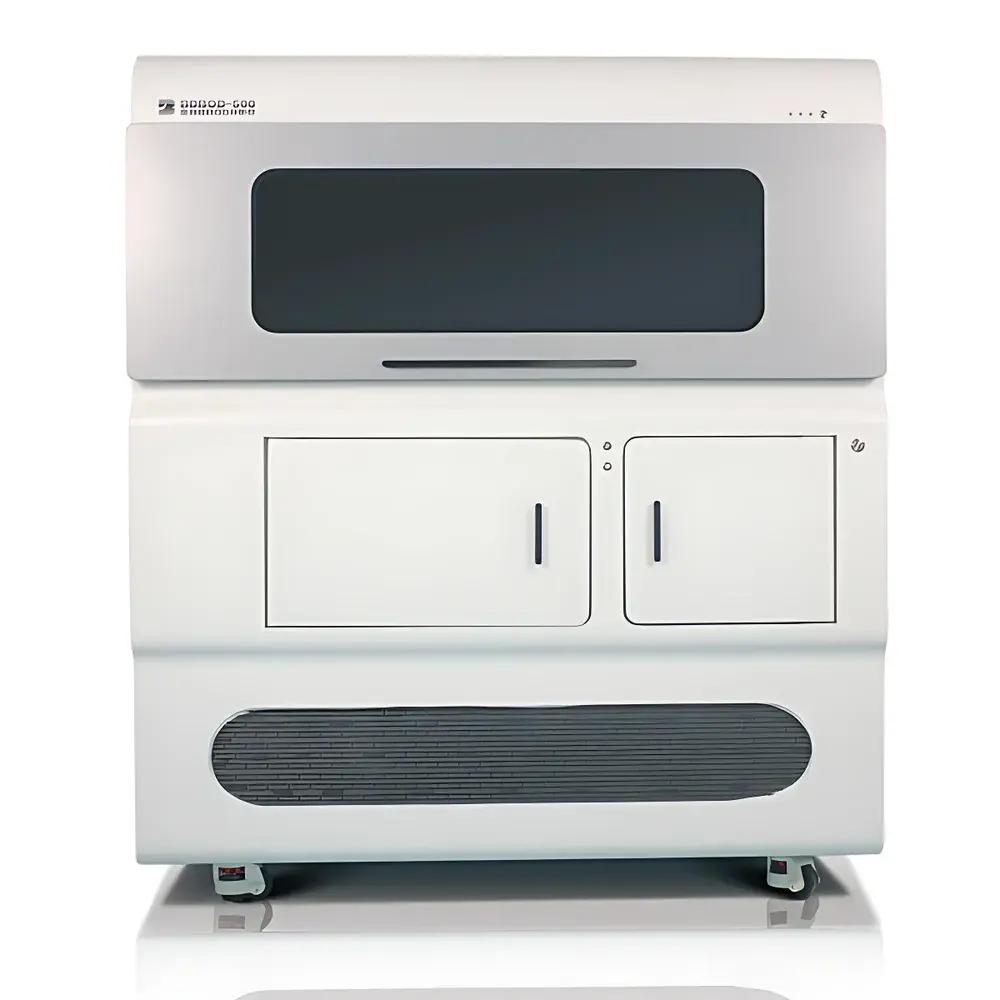
Brookfield BDBOD-500 Automated BOD Analyzer
| Brand | Brookfield |
|---|---|
| Origin | Beijing, China |
| Manufacturer Type | Original Equipment Manufacturer (OEM) |
| Country of Origin | China |
| Model | BDBOD-500 |
| Pricing | Available upon Request |
Overview
The Brookfield BDBOD-500 Automated BOD Analyzer is a fully integrated, laboratory-grade system engineered for precise, high-throughput determination of Biochemical Oxygen Demand (BOD) and Dissolved Oxygen (DO) in aqueous environmental samples. It operates on the principle of closed-circuit respirometry using electrochemical DO sensing—aligned with the fundamental kinetics of microbial oxygen consumption under controlled incubation conditions. Designed to meet the procedural rigor of standardized dilution and seeding methods, the instrument automates all critical steps required for BOD5 analysis per HJ 505–2009, including sample dilution, inoculation, incubation timing, DO measurement at t=0 and t=120 h, and final calculation of BOD5 (mg/L O2). Its architecture integrates temperature-controlled incubation (20.0 ± 0.5 °C), barometric pressure compensation, and salinity correction—ensuring metrological traceability across diverse water matrices such as surface water, municipal wastewater, and industrial effluents.
Key Features
- Monolithic, space-efficient chassis with sealed internal environment to minimize ambient interference during 5-day incubation cycles
- Imported electrochemical dissolved oxygen probe compliant with HJ 506–2009 and ISO 5814:2012 for stable, low-drift DO quantification
- Real-time automatic temperature and atmospheric pressure compensation; programmable salinity correction (0–35 g/L NaCl equivalent)
- Integrated pneumatic air-sparging module for standardized reoxygenation of diluted samples prior to incubation
- Automated liquid handling system featuring dual-X-axis synchronized robotic arm for repeatable pipetting, dilution, probe immersion, and sensor cleaning
- Intelligent dilution algorithm: calculates optimal dilution factor based on preliminary DO depletion rate and user-defined BOD range constraints
- Self-cleaning probe cycle using deionized water rinse and gentle mechanical wiping to prevent biofilm accumulation between analyses
Sample Compatibility & Compliance
The BDBOD-500 accepts standard 300 mL BOD bottles (glass or PET) and supports up to 24 simultaneous samples per batch. It accommodates turbid, colored, or suspended-solid-laden samples without filtration—preserving native microbial consortia essential for representative BOD assessment. All operational protocols adhere to Chinese national standards HJ 505–2009 (BOD5) and HJ 506–2009 (DO), with method equivalence validated against APHA Standard Methods 5210B and ASTM D5210–92. The system’s calibration traceability aligns with ISO/IEC 17025 requirements for testing laboratories, and audit trails support GLP-compliant data integrity for regulatory reporting.
Software & Data Management
The embedded control software provides role-based access, method templates, and full electronic record retention—including raw DO time-series, dilution logs, temperature/pressure metadata, and final BOD5 reports. All data are stored in encrypted SQLite databases with immutable timestamps and operator ID tagging. Export options include CSV, PDF, and XML formats compatible with LIMS integration. Audit trail functionality complies with principles outlined in FDA 21 CFR Part 11 for electronic records and signatures, enabling secure review, approval, and archival without manual transcription.
Applications
This analyzer serves routine and compliance-driven BOD monitoring in municipal wastewater treatment plants (WWTPs), environmental protection agencies, provincial CDC laboratories, hydrological survey institutes, and third-party environmental testing facilities. It is routinely deployed for effluent discharge permitting (e.g., GB 8978–1996), source water quality assessment, biodegradability screening of industrial discharges, and validation of biological treatment efficiency. Its automation reduces analyst exposure to hazardous samples and eliminates inter-operator variability inherent in manual dilution and titration workflows.
FAQ
Does the BDBOD-500 comply with international BOD standards such as ISO 5815 or APHA 5210B?
Yes—the instrument’s electrochemical DO measurement protocol and incubation methodology are technically equivalent to ISO 5815–1:2019 and APHA 5210B, with documented correlation studies available upon request.
Can it handle high-BOD industrial samples exceeding 6,000 mg/L?
Yes—via multi-stage serial dilution driven by its adaptive algorithm, supporting effective ranges from 2 to 6,000 mg/L BOD5 with <±5% repeatability (n=6, certified reference materials).
Is remote monitoring or network connectivity supported?
The system includes Ethernet port and optional Wi-Fi module for secure LAN-based status monitoring and scheduled report delivery via SMTP; no cloud storage or external vendor servers are used.
What maintenance intervals are recommended for the DO probe and fluidic system?
Electrochemical probe membrane replacement every 6 months (or after 500 measurements); pump tubing replacement every 3 months; full system verification using NIST-traceable DO standards biannually.
How is method validation documented for regulatory audits?
Each run generates a compliant electronic certificate of analysis (CoA) with embedded digital signature, calibration history, and deviation flags—exportable as tamper-evident PDF/A-1b files meeting EPA and CNAS archival requirements.







