
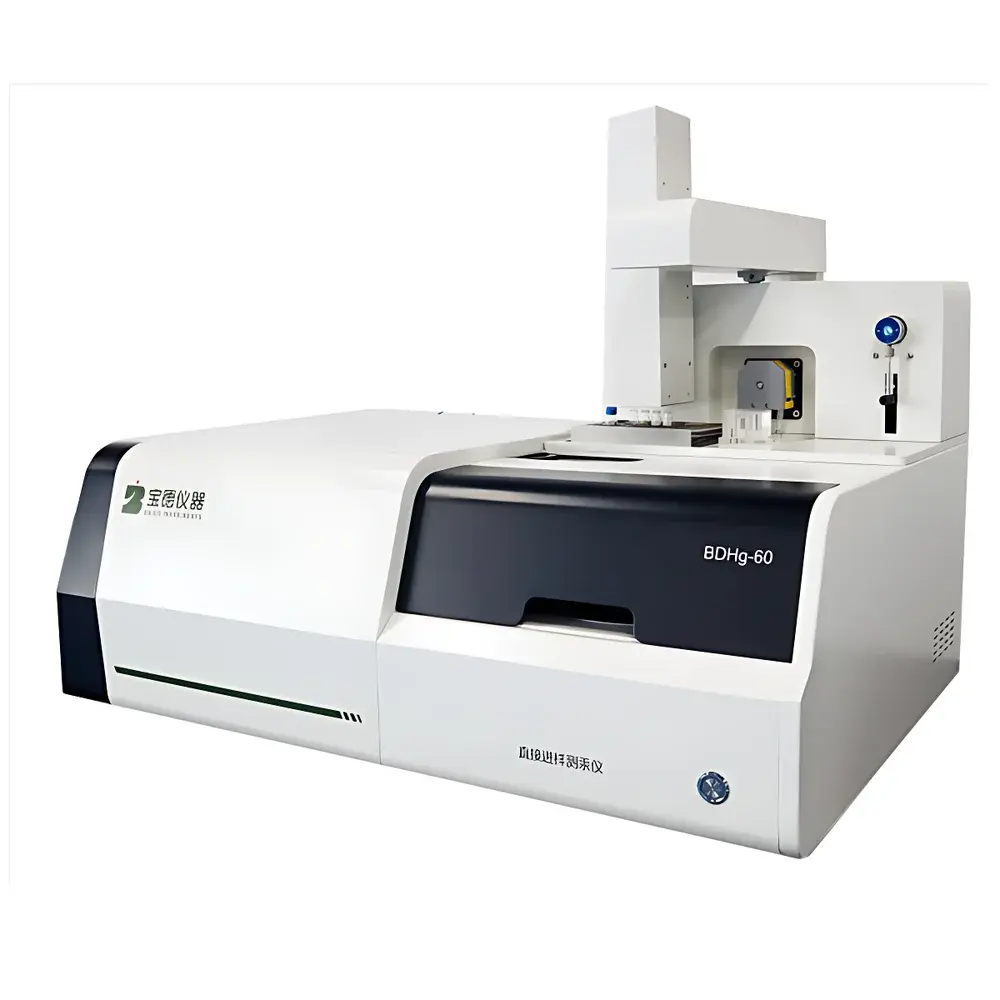
Brookfield BDHg-60 Direct Mercury Analyzer
| Brand | Brookfield |
|---|---|
| Origin | Beijing, China |
| Manufacturer Type | OEM Manufacturer |
| Country of Origin | China |
| Model | BDHg-60 |
| Pricing | Upon Request |
| Measurement Principle | Cold Vapor Atomic Absorption Spectrometry (CVAAS) with Thermal Desorption |
Overview
The Brookfield BDHg-60 Direct Mercury Analyzer is a benchtop elemental analyzer engineered for the rapid, reagent-free quantification of total mercury in solid and liquid matrices. It operates on the principle of thermal desorption coupled with cold vapor atomic absorption spectrometry (CVAAS). In this method, mercury is thermally liberated from the sample matrix within a controlled quartz furnace under inert gas flow, then reduced to elemental mercury vapor via a high-efficiency catalyst. The vapor is subsequently trapped and concentrated on a gold amalgamation trap, thermally released as a sharp pulse, and carried into a dedicated absorption cell where mercury atoms absorb light at 253.7 nm. Detection sensitivity is achieved using a low-noise photomultiplier tube and optimized optical path design. This approach eliminates wet digestion, acid reflux, or chemical reduction steps—thereby removing sources of procedural contamination, memory effects, and analytical bias associated with traditional hydride generation or digestion-based protocols.
Key Features
- Reagent-free analysis: No acids, oxidants, or reducing agents required—reducing lab safety hazards and waste disposal burden.
- Direct solid/liquid sampling: Supports heterogeneous samples including soils, sediments, biological tissues, foodstuffs, cosmetics, and aqueous extracts without homogenization or digestion.
- High-throughput capability: Analysis time ≤3 min for low-matrix samples (e.g., water, urine); ≤5 min for complex matrices (e.g., soil, fish tissue), with true walk-away operation enabled by automated sample loading.
- Enhanced analytical robustness: Patented rapid condensation system minimizes moisture interference and suppresses mercury memory effect; proprietary catalytic converter ensures complete Hg⁰ release across diverse organic/inorganic matrices.
- Real-time process monitoring: Integrated dual-furnace temperature control (catalytic and pyrolysis zones), live spectral display, and continuous absorption signal tracking enable full method transparency and troubleshooting capability.
- Digital workflow integration: RS232/LAN/WiFi interfaces support seamless data exchange with LIMS; electronic balance integration enables automatic mass import—eliminating manual transcription errors.
Sample Compatibility & Compliance
The BDHg-60 accommodates sample masses ranging from 0.01 g to 0.5 g (solids) and 0.1–2.0 mL (liquids), with no upper limit on mercury concentration due to dynamic range optimization via programmable dilution and peak area integration. It complies with internationally recognized regulatory methods including EPA Method 7473 (thermal decomposition–atomic absorption), HJ 923–2017 and HJ 910–2017 (China’s environmental monitoring standards for soil and water), GB/T 31947–2015 (food safety), and SN/T 4697–2016 (import/export commodity testing). Instrument design supports GLP-compliant operation: audit-trail-enabled software logs all user actions, method parameters, calibration events, and instrument status changes. Optional 21 CFR Part 11 compliance packages are available for pharmaceutical and clinical laboratories requiring electronic signature validation and data integrity assurance.
Software & Data Management
The BDHg-60 is operated via a Windows-based application featuring intuitive method setup wizards, preloaded method libraries for common matrices (soil, fish, rice, serum), and customizable reporting templates aligned with ISO/IEC 17025 requirements. All spectra, chromatograms, calibration curves, and QC reports are stored in encrypted SQLite databases with timestamped metadata. Software includes built-in diagnostics: automatic lamp alignment verification, carrier gas pressure monitoring, trap saturation alerts, and furnace temperature deviation warnings. Firmware updates are delivered over LAN/WiFi with version-controlled rollback capability. Raw data export supports CSV, PDF, and XML formats for third-party statistical analysis or regulatory submission.
Applications
The BDHg-60 serves as a primary tool in environmental monitoring labs assessing mercury contamination in soils, sediments, and groundwater per national and regional regulatory frameworks. It is widely deployed in food safety programs verifying compliance with EU Commission Regulation (EC) No 1881/2006 and China’s GB 2762–2022 limits. Public health institutions utilize it for biomonitoring (blood, hair, urine) in occupational exposure studies and epidemiological surveillance. Additional use cases include quality control in battery recycling facilities, catalyst screening in chlor-alkali production, and R&D in geochemical and agronomic research where mercury speciation precursors require total Hg baseline quantification.
FAQ
What sample types can be analyzed without digestion?
Solid samples such as soils, sediments, plant tissues, fish muscle, pharmaceutical tablets, and cosmetic powders—as well as liquids like drinking water, wastewater, urine, and standard reference solutions—can be introduced directly.
Is calibration traceable to NIST or CRM standards?
Yes—calibration is performed using certified mercury reference materials traceable to NIST SRM 3133 or equivalent CRMs (e.g., ERM-CC580, BCR-482); certificate of analysis is provided with each batch.
How is carryover or memory effect managed?
A dual-stage gold trap with patented rapid thermal desorption, combined with an integrated moisture removal condenser and post-analysis blank purge sequence, reduces residual Hg signal to <0.05 ng between runs.
Can the instrument be integrated into an existing LIMS environment?
Yes—via TCP/IP protocol and configurable ASCII/CSV output formats; optional OPC UA gateway support is available for industrial-scale deployment.
What maintenance intervals are recommended?
Catalyst replacement every 10,000 analyses; gold trap regeneration every 500–1,000 runs depending on matrix load; quarterly optical alignment verification and annual full-system performance qualification per ISO/IEC 17025 Annex A.3 guidelines.





