
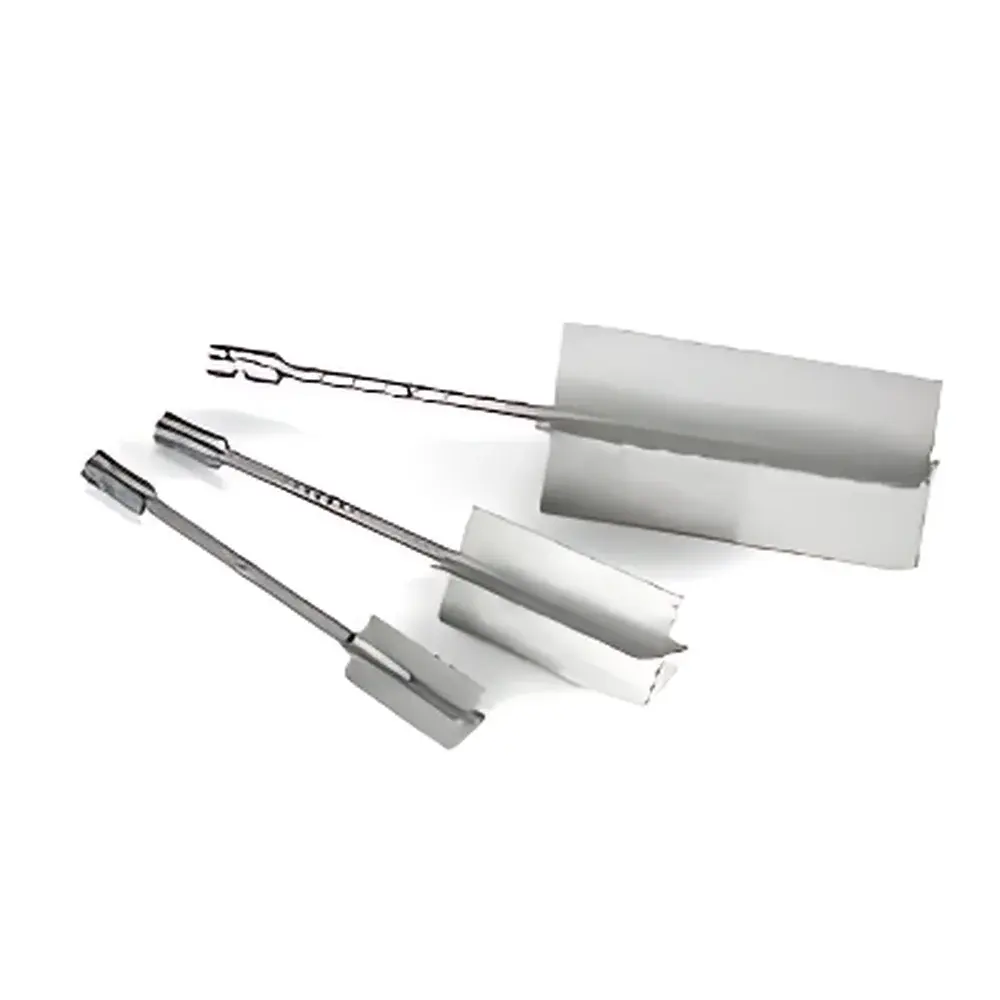
Brookfield Brookfield Paddle-Type Spindle for Viscometers and Rheometers
| Brand | Brookfield |
|---|---|
| Origin | USA |
| Manufacturer Type | Authorized Distributor |
| Product Origin | Imported |
| Model | Paddle-Type |
| Pricing | Upon Request |
Overview
The Brookfield Paddle-Type Spindle is a precision-engineered rotational viscometer accessory designed for use with Brookfield DV series viscometers (LV, RV, HA, HB, and ultra-high-torque models) and compatible rheometers. Based on Couette flow geometry principles, this spindle enables reliable measurement of apparent viscosity, yield stress behavior, and low-shear-rate rheological response in heterogeneous, particulate-laden, or structurally sensitive fluids—including suspensions, slurries, pastes, coatings, and food emulsions. Its paddle geometry minimizes sample disturbance during immersion and maintains particle suspension throughout testing, making it especially suitable for non-Newtonian systems where structural integrity must be preserved. Unlike cylindrical or cone-plate geometries, the paddle design delivers enhanced torque sensitivity at low rotational speeds (down to 0.1 rpm), enabling detection of yield point onset and quasi-static structural breakdown—critical for QC/QA protocols aligned with ASTM D2196, ISO 2555, and USP guidelines.
Key Features
- Optimized hydrodynamic profile reduces shear-induced sample disruption during immersion and measurement
- Standardized dimensional ratios conform to ASTM D1475 and ISO 3219 specifications for paddle-type spindles
- Three-tier standard set (V-71, V-72, V-73) provides broad dynamic viscosity coverage—from 102 to 105 mPa·s across LV, RV, HA, and HB instrument platforms
- Extended-range variants (e.g., 5×HB series) support high-torque applications up to 21.72 × 10⁶ mPa·s (21.72 MPa·s) under controlled shear conditions
- Stainless steel construction ensures chemical resistance, mechanical durability, and compliance with GLP/GMP cleaning validation requirements
- Calibration-traceable geometry enables reproducible inter-laboratory data comparison when used with NIST-traceable Brookfield calibration oils
Sample Compatibility & Compliance
The paddle spindle is validated for use with high-viscosity, shear-thinning, thixotropic, and yield-stress materials that exhibit significant structural recovery or sedimentation tendencies. It is routinely deployed in pharmaceutical suspension stability assessment (per USP ), paint and ink formulation QC (ASTM D1200, D562), ceramic slurry rheology (ISO 18424), and dairy product texture profiling. All spindles are manufactured in accordance with Brookfield’s ISO 9001-certified production processes and meet RoHS Directive 2011/65/EU material restrictions. When paired with Brookfield’s certified calibration standards and documented SOPs, the system supports FDA 21 CFR Part 11-compliant audit trails when operated via Rheo3000 or PC-based ViscoQC software.
Software & Data Management
When integrated with Brookfield’s proprietary software suite—including ViscoQC 3.0, Rheo3000, or the legacy RHEOPLUS platform—the paddle spindle enables automated viscosity sweeps, yield stress extrapolation (via Herschel-Bulkley or Bingham model fitting), and time-dependent thixotropy analysis. Raw torque and rotational speed data are logged at user-defined intervals (minimum 10 ms resolution), supporting export to CSV, Excel, or ASTM E1447-compliant XML formats. Software-generated reports include full metadata stamping (operator ID, timestamp, environmental conditions), instrument calibration status, and uncertainty propagation per GUM (JCGM 100:2018). Audit trail functionality satisfies GLP documentation requirements for regulated environments.
Applications
- Yield stress determination in drilling muds and cementitious grouts
- Stability evaluation of pharmaceutical suspensions and topical gels
- Quality control of architectural coatings and automotive primers
- Rheological fingerprinting of yogurt, chocolate mass, and plant-based dairy alternatives
- Process optimization of ceramic slip casting and battery electrode slurries
- Validation of shear-thinning behavior in polymer melts and nanocomposite dispersions
FAQ
What viscosity range can the V-73 paddle spindle measure on an LV-series viscometer?
On an LV viscometer at 10 rpm, the V-73 spindle covers 938–9,380 mPa·s (0.938–9.38 Pa·s), per Brookfield’s published calibration matrix.
Is the paddle spindle suitable for measuring yield stress?
Yes—its low-shear geometry and extended immersion depth allow stable torque acquisition below 1 rpm, enabling yield point estimation via controlled stress ramp or vane-like creep recovery analysis.
How does the 5×HB series differ from standard HB paddles?
The 5×HB designation indicates a five-fold torque multiplication factor, achieved through optimized lever-arm geometry and calibrated moment arm scaling—enabling measurement of ultra-high-viscosity materials without requiring higher-torque instrument hardware.
Can this spindle be autoclaved?
No—stainless steel construction permits wet-chemical sterilization (e.g., 70% ethanol, 1% SDS), but thermal cycling above 80°C may compromise dimensional stability and calibration integrity.
Does Brookfield provide NIST-traceable calibration certificates for paddle spindles?
Yes—certificates of conformance (including dimensional verification and torque-response validation against reference oils) are available upon request and comply with ISO/IEC 17025:2017 requirements.



