
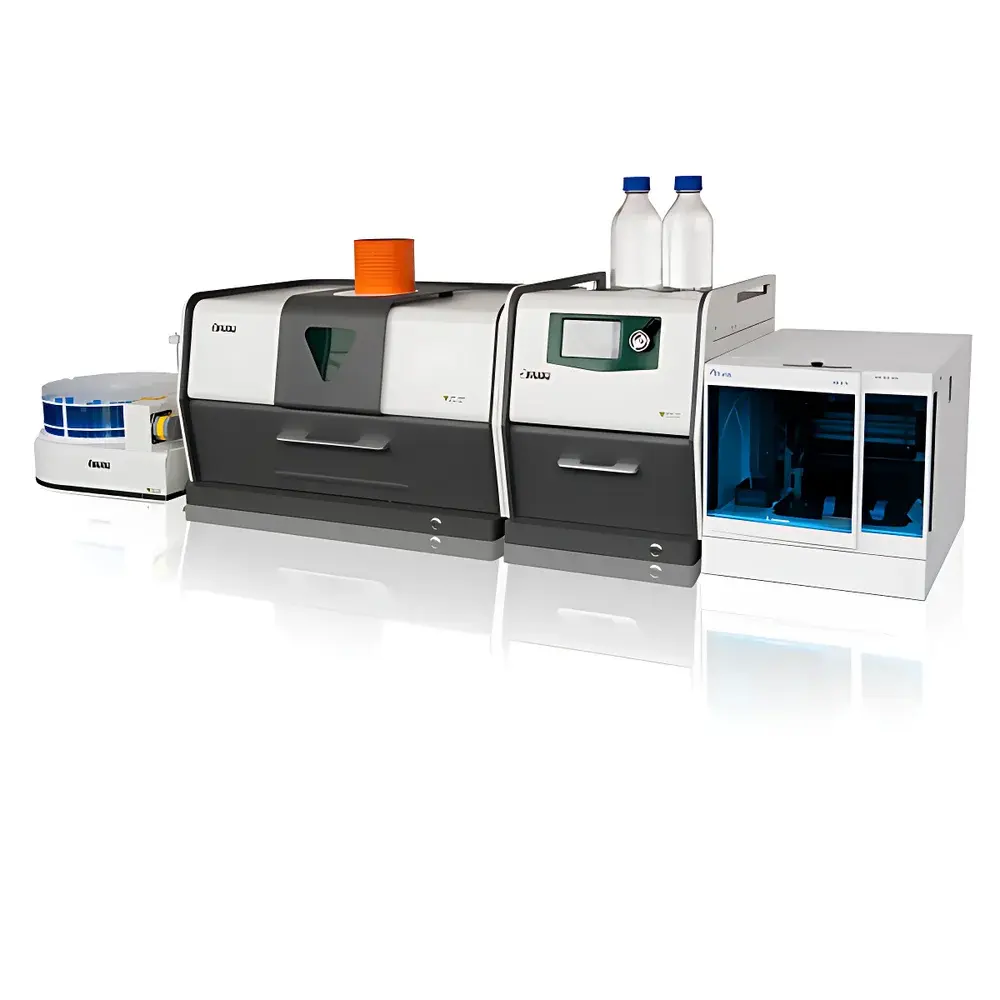
Brookfield BSA-100B Liquid Chromatography–Atomic Fluorescence Spectrometry Hyphenated System
| Brand | Brookfield |
|---|---|
| Origin | Beijing, China |
| Manufacturer | Producer |
| Country of Origin | Domestic (China) |
| Model | BSA-100B |
| Pricing | Upon Request |
| Target Analytes | Speciated trace heavy metals — including As(III), As(V), MMA(V), DMA(V), AsB, AsC, p-ASA, Roxarsone, Hg²⁺, MetHg, EtHg, PhHg, Se(IV), Se(VI), SeCys, SeMeCys, SeMet, Sb(III), Sb(V), and >12 additional organometallic species |
Overview
The Brookfield BSA-100B Liquid Chromatography–Atomic Fluorescence Spectrometry (LC-AFS) Hyphenated System is an integrated analytical platform engineered for the separation, identification, and quantification of elemental species in complex matrices. Unlike total-element analysis, which provides no information on bioavailability or toxicity, the BSA-100B leverages orthogonal detection principles: high-resolution liquid chromatography (LC) for chemical speciation separation, coupled with hydride generation atomic fluorescence spectrometry (HG-AFS) for element-specific, ultra-trace detection. The system operates on the principle that metalloids and heavy metals—such as arsenic, mercury, selenium, and antimony—exhibit markedly different toxicological profiles depending on their oxidation state and molecular structure. By interfacing a robust LC module with the BA-3000 series tri-channel AFS detector (capable of simultaneous three-element detection), the BSA-100B delivers reproducible, matrix-tolerant speciation data at sub-ppt (ng/L) detection levels under optimized hydride/cold vapor generation conditions.
Key Features
- Hyphenated architecture with seamless LC–AFS interface: Pneumatically actuated switching valves and low-dead-volume transfer lines ensure minimal band broadening and analyte degradation during post-column derivatization and atomization.
- Multi-species capability: Simultaneous or sequential detection of ≥12 well-characterized species across four elements—As, Hg, Se, and Sb—with validated retention time stability and peak symmetry under ISO 17025-aligned method conditions.
- On-line photochemical or chemical vapor generation: Integrated UV digestion or NaBH₄/KOH post-column reaction enables efficient conversion of non-hydride-forming species (e.g., AsB, SeMet) into detectable hydride or cold vapor forms.
- Robust hardware design: All-wetted parts constructed from inert PEEK and quartz; temperature-controlled reaction coil and atomizer; dual-stage gas–liquid separator to suppress foam-induced signal drift.
- Compliance-ready operation: Instrument control firmware supports audit trail logging, user access levels, and electronic signature protocols aligned with FDA 21 CFR Part 11 and GLP/GMP laboratory requirements.
Sample Compatibility & Compliance
The BSA-100B accommodates aqueous extracts from diverse sample types—including drinking water, soil leachates, rice flour digests, fish tissue homogenates, urine, serum, herbal decoctions, and cosmetic emulsions—following standardized preparation protocols (e.g., EPA Method 1632 for methylmercury, ISO/IEC 17025-accredited in-house SOPs). It meets performance criteria outlined in ASTM D6724–22 (speciated arsenic in water), USP / (elemental impurities), and GB 5009.11–2023 / GB 5009.17–2023 (Chinese national food safety standards for As/Hg speciation). All calibration curves demonstrate linearity (r² ≥ 0.999) over 3–4 orders of magnitude, with method detection limits (MDLs) consistently ≤ 0.01 µg/L for inorganic As(III)/As(V) and ≤ 0.005 µg/L for MeHg in fortified reagent water.
Software & Data Management
Control and data acquisition are managed via Brookfield’s proprietary SpeciSoft™ v4.2 software, compliant with ISO/IEC 17025:2017 Annex A.2 requirements for data integrity. The software provides real-time chromatogram overlay, automated peak integration using second-derivative baseline correction, species identification via retention time matching against certified reference material (CRM) libraries (e.g., NIST SRM 8622, ERM-BB188), and customizable reporting templates meeting LIMS export formats (CSV, XML, PDF/A-2u). Audit trails record all parameter changes, integration edits, and user logins with timestamps and IP metadata—fully traceable for regulatory inspections or method validation documentation.
Applications
The BSA-100B serves as a primary tool in laboratories conducting risk-based elemental assessment where speciation dictates regulatory action. Key use cases include: monitoring inorganic arsenic in infant rice cereals per EU Commission Regulation (EU) No 2023/915; verifying compliance of seafood with FDA’s MeHg action level (1.0 mg/kg); evaluating selenium speciation in nutraceutical formulations to confirm bioactive SeMet content; quantifying antimony leaching from PET packaging into beverages (EFSA CONTAM Panel guidance); and supporting epidemiological studies linking urinary As metabolites (e.g., DMA/V, MMA/V) to metabolic disease endpoints. It is routinely deployed in national CDC laboratories, accredited food testing centers, university environmental chemistry departments, and pharmaceutical QC units performing elemental impurity profiling per ICH Q3D.
FAQ
What sample preparation methods are recommended prior to LC-AFS analysis?
Standardized acid-assisted extraction (e.g., 0.2% HNO₃ + 0.5% L-cysteine for As species; 0.1% TMAH for SeMet) followed by centrifugation/filtration (0.22 µm nylon) is required. Enzymatic digestion may be used for protein-bound species.
Can the BSA-100B quantify thiol-bound mercury complexes such as Hg–cysteine or Hg–glutathione?
Yes—when coupled with pre-column complexation and optimized pH-controlled elution, these adducts can be resolved and quantified using gradient LC separation and post-column UV photolysis prior to AFS detection.
Is method validation support available for regulatory submissions?
Brookfield provides application notes, CRM compatibility reports, and IQ/OQ/PQ protocol templates aligned with ISO/IEC 17025 and FDA guidance for method transfer and validation.
Does the system support hyphenation with other detectors, such as ICP-MS?
The BSA-100B is configured exclusively for AFS detection; however, its LC module features standard 1/16″ tubing ports and TTL-compatible valve triggers, enabling third-party integration with compatible mass spectrometers under custom engineering supervision.
What maintenance intervals are recommended for long-term operational reliability?
Daily: rinse lines with 5% HNO₃ and deionized water; weekly: inspect/replacement of gas–liquid separator membrane and pump tubing; quarterly: recalibration with multi-species CRMs and verification of hydride generation efficiency using As(III) standard.
Related Products




