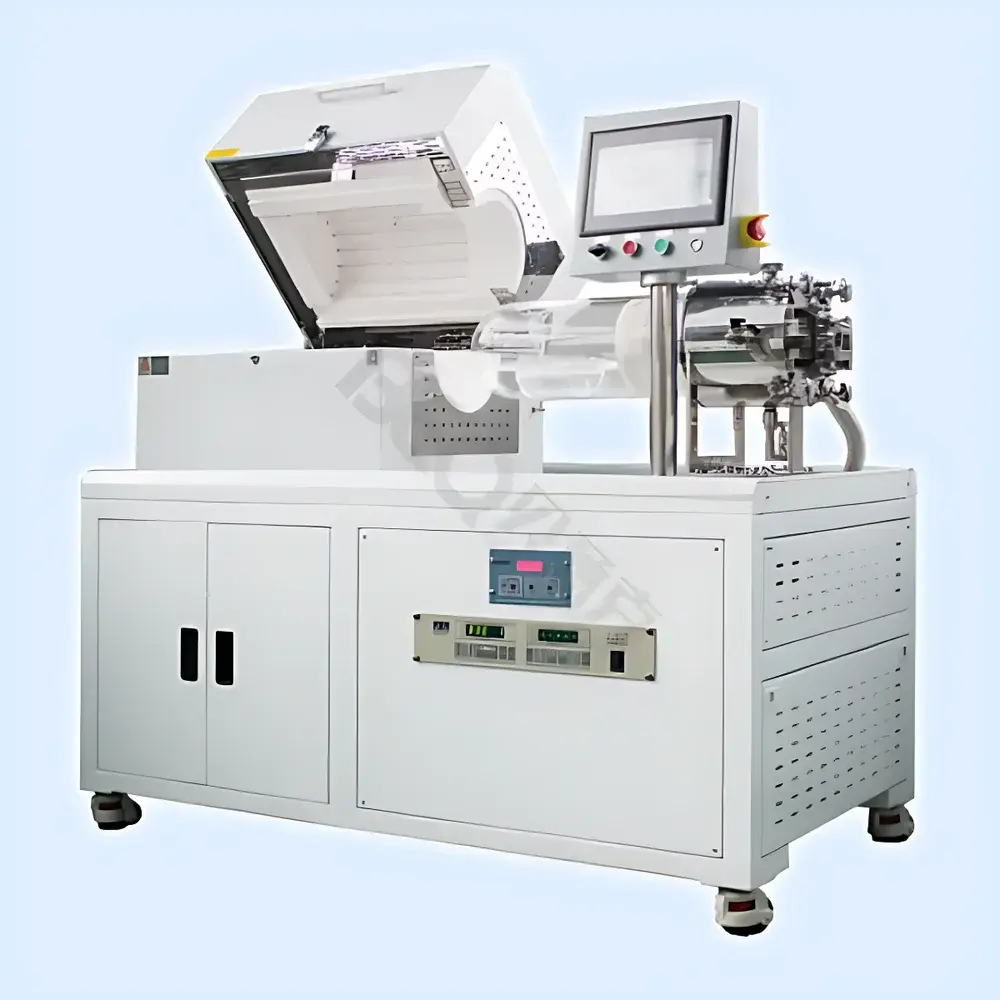
Brookfield BTF-1200C-RTP-CVD Infrared Rapid Thermal Processing System with Integrated CVD Capability
| Brand | BEQ |
|---|---|
| Origin | Anhui, China |
| Model | BTF-1200C-RTP-CVD |
| Temperature Range | 100–1000 °C |
| Max Heating Rate | 50 °C/s |
| Max Operating Temperature | 1200 °C |
| Vacuum Base Pressure | 5.0×10⁻¹ Pa (cold, empty) |
| Heating Zone Length | 230 mm |
| Uniform Zone Length | 120 mm |
| Temperature Repeatability | ±3 °C |
| Control Accuracy | ±0.1 °C |
| Furnace Tube | High-Purity Quartz, Φ90×400 mm, R45 end cap |
| Gas Flow Controllers | Dual-stainless-steel double-ferrule fittings, N₂-calibrated ranges 200/500 sccm, accuracy ±1.5%, repeatability ±0.2%, response time 1–4 s (gas), 10 s (electrical) |
| Vacuum Pump | KF25 inlet/outlet, 165 L/min pumping speed, 1.1 L oil capacity |
Overview
The Brookfield BTF-1200C-RTP-CVD is an integrated rapid thermal processing (RTP) system engineered for semiconductor process development, thin-film annealing, and low-temperature chemical vapor deposition (CVD) applications. It combines high-intensity infrared heating with ultra-fast thermal ramping (up to 50 °C/s), precise closed-loop temperature control via embedded thermocouples, and a modular vacuum/gas delivery architecture. Unlike conventional tube furnaces, this system employs a single-ended, sliding-rail infrared furnace configuration—enabling rapid insertion and removal of wafers or substrates while maintaining thermal stability and minimizing ambient contamination. The core thermal architecture utilizes quartz-encapsulated tungsten-halogen lamps with reflector optimization to deliver uniform radiant energy across the 120 mm isothermal zone. Temperature regulation is achieved through real-time feedback from internal Type K thermocouples, coupled with PID algorithms implemented in an industrial-grade PLC. The system supports both inert annealing (N₂, Ar) and reactive processes (e.g., silane-based Si film growth), with gas flow dynamics optimized for transient thermal cycling and controlled quenching.
Key Features
- High-speed thermal processing: Programmable ramp rates from 0.1 to 50 °C/s, with overshoot limited to ≤3 °C and steady-state stability maintained within ±0.1 °C.
- Integrated vacuum and gas handling: KF25-compatible high-vacuum system achieves ≤5.0×10⁻¹ Pa (cold, empty); dual-gas mass flow controllers (MFCs) support simultaneous or sequential delivery of up to two process gases with N₂-calibrated accuracy of ±1.5% FS.
- Modular RTP-CVD architecture: Removable quartz reaction chamber (Φ90×400 mm, R45 end) allows rapid substrate loading/unloading; manual gate valve and stainless-steel bellows facilitate pressure isolation during thermal cycles.
- Intelligent PLC-based control: Touch-enabled HMI interface enables multi-step recipe programming, real-time data logging, and alarm-triggered safety interlocks—including overtemperature cutoff and thermocouple break detection.
- Thermal quench capability: Post-anneal rapid cooling is enabled by controlled backfilling of inert gas through the inlet port, decoupling cooling kinetics from furnace cooldown inertia.
- Robust mechanical design: All wetted components—including gas lines, fittings, and chamber seals—utilize electropolished 316L stainless steel or high-purity fused quartz to meet semiconductor-grade cleanliness requirements.
Sample Compatibility & Compliance
The BTF-1200C-RTP-CVD accommodates standard semiconductor wafers (up to 6″ diameter), SOI substrates, metal-oxide thin films (e.g., TiO₂, HfO₂), and compound semiconductor layers (GaAs, InP). Its vacuum integrity and gas purity management align with ASTM F1528-22 (Standard Guide for Semiconductor Process Equipment Qualification) and ISO 14644-1 Class 5 cleanroom compatibility when operated in controlled environments. The system’s temperature calibration traceability follows NIST-traceable procedures per ISO/IEC 17025 guidelines. While not certified for GMP manufacturing, its data audit trail, user-access controls, and electronic signature-ready log files support GLP-compliant R&D documentation under FDA 21 CFR Part 11 when deployed with validated software extensions.
Software & Data Management
The embedded control firmware records all thermal profiles, gas flow setpoints, vacuum pressure traces, and alarm events at 100 ms resolution. Data exports in CSV format are fully timestamped and include metadata such as operator ID, recipe name, and cycle duration. Optional Ethernet connectivity enables remote monitoring via Modbus TCP or OPC UA protocols. For regulatory environments, optional validation packages provide IQ/OQ documentation, calibration certificates, and change-control logs—supporting audit readiness for university cleanrooms, national lab facilities, and pre-production pilot lines.
Applications
- Silicon wafer activation annealing post-ion implantation (e.g., dopant activation at 900–1000 °C for <10 s dwell)
- Metal oxide semiconductor (MOS) gate stack densification and interfacial layer engineering
- Low-temperature CVD of silicon nitride (SiNₓ) and amorphous silicon (a-Si) using NH₃/SiH₄ precursors
- Graphene and transition metal dichalcogenide (TMD) substrate pretreatment and defect healing
- Perovskite solar cell layer crystallization (e.g., MAPbI₃ annealing at 100–150 °C with O₂/N₂ blending)
- Thin-film transistor (TFT) back-channel passivation and threshold voltage tuning
FAQ
What is the maximum recommended operating temperature for routine RTP cycles?
The system is rated for continuous operation up to 1000 °C; 1200 °C is specified as absolute maximum and intended only for short-duration qualification tests.
Can the system operate under dynamic gas flow during ramping?
Yes—gas flow can be synchronized with temperature ramps via programmable MFC setpoint profiles, enabling in-situ reaction initiation at defined thermal thresholds.
Is the quartz tube replaceable, and what is its typical service life?
The high-purity quartz tube is field-replaceable; under standard annealing conditions (≤1000 °C, inert atmosphere), expected lifetime exceeds 500 thermal cycles with proper cooldown protocols.
Does the system support automated recipe transfer between instruments?
Yes—recipe files (.csv or .xml) are portable across compatible Brookfield RTP platforms, facilitating method transfer in multi-instrument labs.
What vacuum level is achievable with process gases introduced?
At 200 sccm N₂ flow and full pump speed, base pressure stabilizes at ~1–5 Pa depending on gas species and chamber outgassing history; higher conductance configurations (e.g., larger KF40 ports) are available as custom options.