
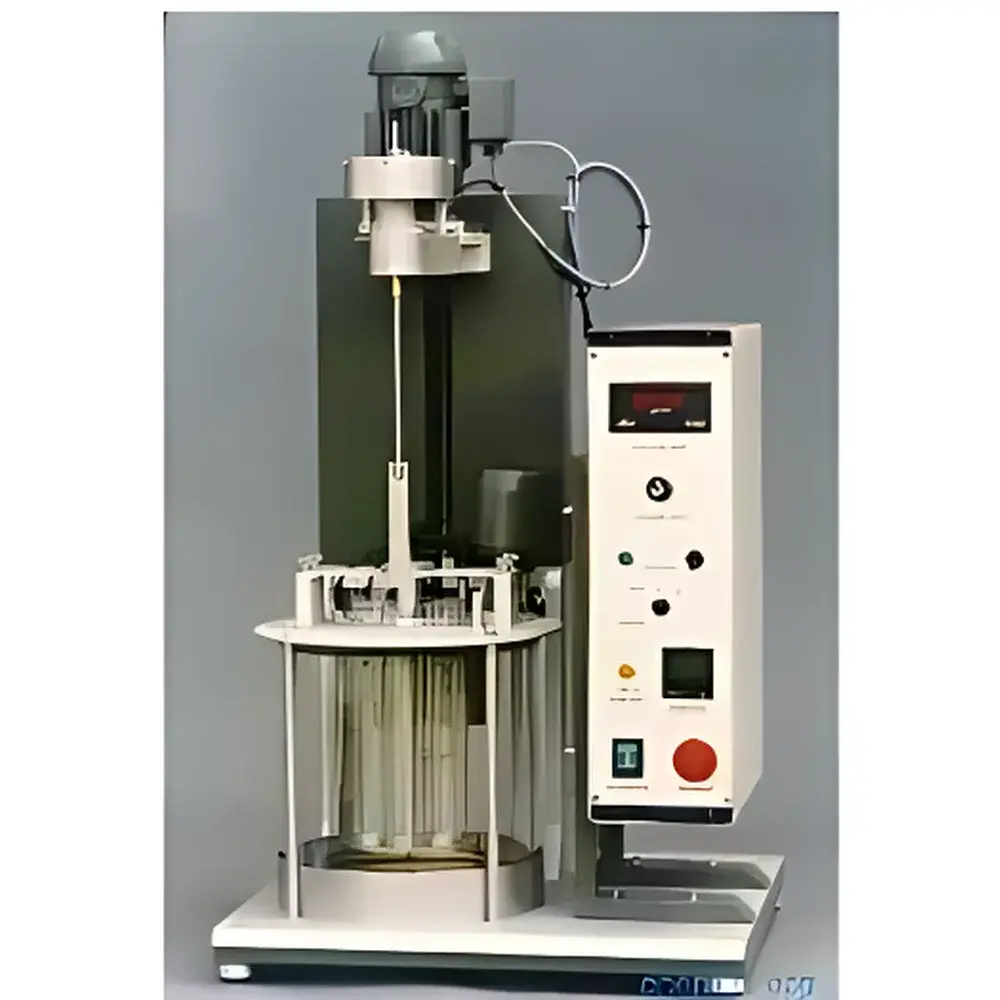
Brookfield D1401 Petroleum Water Separation Characteristics Tester
| Origin | Switzerland |
|---|---|
| Manufacturer Type | Authorized Distributor |
| Origin Category | Imported |
| Model | D1401 |
| Pricing | Upon Request |
Overview
The Brookfield D1401 Petroleum Water Separation Characteristics Tester is a precision-engineered laboratory instrument designed to quantify the demulsification behavior of petroleum-based and synthetic lubricants under standardized conditions. It operates in strict accordance with ASTM D1401, “Standard Test Method for Water Separability of Petroleum and Synthetic Fluids,” which defines the procedure for evaluating the ability of oils to separate from water when subjected to controlled mechanical agitation and thermal stabilization. The test principle relies on the physical separation kinetics of oil–water emulsions within calibrated cylindrical glass vessels, where phase separation is visually assessed at defined time intervals (e.g., 5, 10, 30, and 60 minutes) following a fixed 5-minute agitation cycle. This method is critical for quality assurance in turbine oils, hydraulic fluids, gear oils, and aviation lubricants—where rapid water rejection is essential to prevent corrosion, hydrolytic degradation, and loss of film strength.
Key Features
- ASTM D1401-compliant architecture with integrated digital control system, ensuring repeatability and regulatory traceability
- Stainless steel structural frame with ceramic-coated support platform and borosilicate glass sample cylinders (100 mL, graduated, 250 mm depth)
- Motorized vertical lift mechanism enabling precise positioning of the impeller assembly beneath each cylinder—minimizing operator-induced misalignment and glass breakage risk
- Digital tachometer providing real-time, continuous display of impeller rotational speed (rpm), calibrated per ASTM D1401 requirements
- PID-controlled heating bath with Pt100 RTD sensor (±0.1 °C accuracy), maintaining test temperature stability within ±0.1 °C during operation
- Microprocessor-based controller with LED temperature readout, programmable 5-minute automatic agitation shutdown, and overheat/low-water safety interlocks
- Aluminum alloy hinged lid with six indexed rotational positions for sequential sample loading; integrated alignment guide ensures reproducible impeller–cylinder geometry
- CE-certified electrical design (220 V / 50 Hz, 800 W); compact footprint (500 × 460 × 960 mm); net weight: 40 kg
Sample Compatibility & Compliance
The D1401 accommodates a broad range of base oils and formulated fluids—including mineral, synthetic hydrocarbon (SHC), polyalphaolefin (PAO), phosphate ester, and polyol ester systems—as well as emulsions stabilized by Herschel-type demulsifiers. Its design conforms to the dimensional, thermal, and mechanical specifications mandated by ASTM D1401, including impeller geometry (flat-blade, 1.27 cm width), rotational speed (1500 ± 15 rpm), immersion depth (25 ± 1 mm), and temperature control (typically 54 °C or 82 °C per test condition). All wetted components are chemically inert: borosilicate glass (Pyrex®-equivalent), stainless steel (AISI 304), and ceramic-coated surfaces. The instrument supports GLP-compliant workflows through stable thermal regulation, audit-ready temperature logging capability (when paired with optional data acquisition modules), and full traceability of calibration references (e.g., ASTM-certified thermometers TA009C-N00, TA019C-N00, TA021C-N00).
Software & Data Management
While the D1401 operates as a stand-alone benchtop unit with embedded microcontroller logic, its architecture supports integration into networked QA/QC environments. Temperature and timer outputs are accessible via analog voltage signals (0–5 V DC) for connection to external data loggers or LIMS platforms. Optional calibration accessories—including PT100 simulators (CAL001, CAL002)—enable routine verification of thermal sensor linearity and controller response per ISO/IEC 17025 requirements. The English-language operating manual includes detailed calibration procedures, preventive maintenance schedules, and troubleshooting protocols aligned with ISO 9001 internal audit expectations. Firmware updates (if applicable) are distributed via secure download with version-controlled release notes.
Applications
- Quality release testing of new lubricant batches against OEM and industry specifications (e.g., GEK 32568, Siemens TLV 9013, Rolls-Royce RRES 90061)
- Formulation development for improved demulsibility in steam turbine oils and circulating systems
- Stability assessment of used oils during field service life extension studies
- Root-cause analysis of water-related failures in hydraulic and gearbox applications
- Regulatory submission support for FDA-regulated pharmaceutical manufacturing equipment lubricants (per USP guidance on fluid compatibility)
- Third-party certification testing for ISO 8573-1 compressed air system lubricants
FAQ
What standards does the D1401 fully comply with?
ASTM D1401 is the primary standard; the instrument’s geometry, agitation parameters, temperature control, and vessel specifications meet all mandatory clauses.
Can the D1401 be used for non-petroleum synthetic fluids?
Yes—it is validated for polyglycol, diester, and polyol ester-based synthetics, provided they fall within the viscosity and density ranges specified in ASTM D1401 Annex A1.
Is temperature calibration traceable to national standards?
When used with ASTM-certified thermometers (e.g., TA009C-N00) and calibrated Pt100 simulators (CAL002), the system supports NIST-traceable calibration per ISO/IEC 17025.
What safety protections are built into the heating system?
Dual redundant safeguards: solid-state thermal cutoff at 95 °C and float-switch–activated low-water shutoff prevent dry-heating events.
How is operator error minimized during sample loading?
The indexed aluminum lid and mechanical alignment guide ensure consistent impeller-to-cylinder positioning across all six test positions—eliminating variability from manual centering.






