
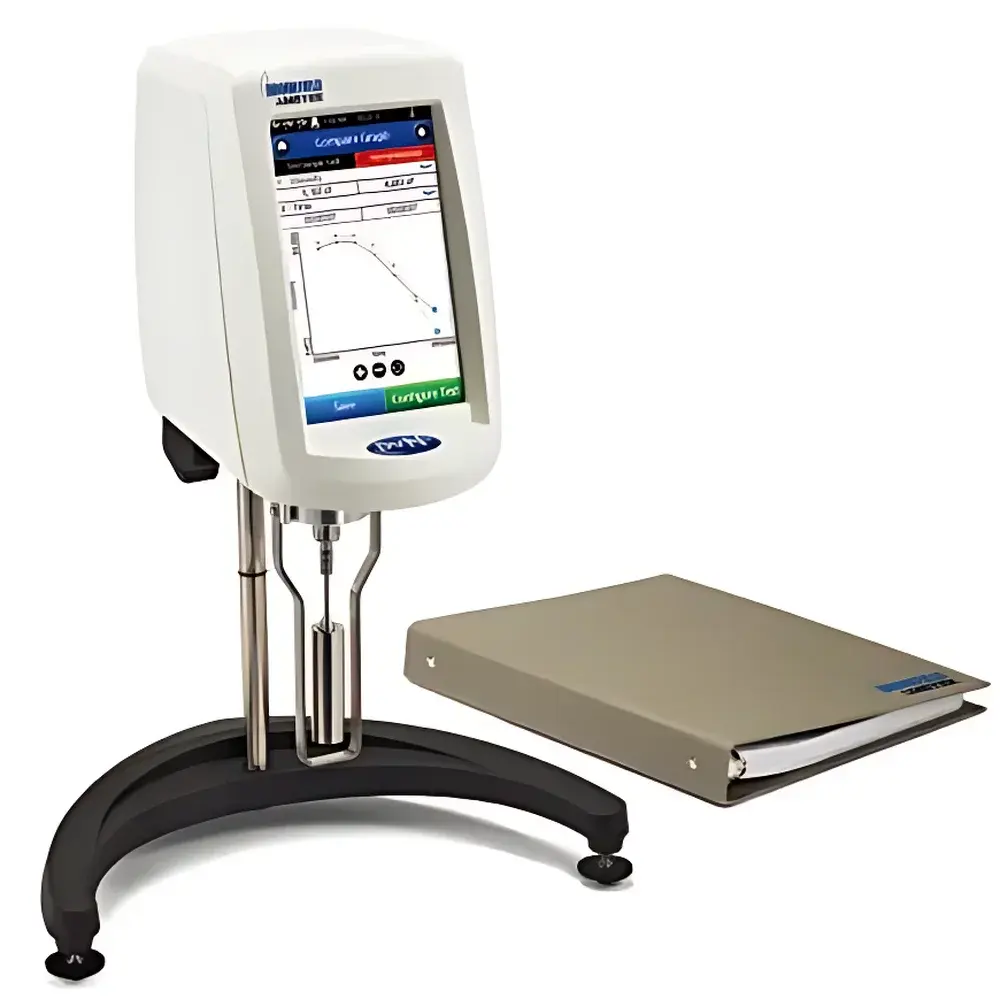
Brookfield DVNext Advanced Rotational Viscometer
| Brand | Brookfield |
|---|---|
| Origin | USA |
| Model | DVNext |
| Viscosity Range (LV) | 0.01–250 cP (mPa·s) |
| Viscosity Range (RV/HA/HB with Optional Spindles) | up to 320M cP |
| Speed Control | 2600 programmable RPM increments (0.01–250 RPM) |
| Display | 7-inch full-color touchscreen |
| Temperature Accuracy | ±1% of full scale (with PT-100 probe) |
| Data Storage | 150 MB internal |
| Compliance | 21 CFR Part 11, GAMP 5 |
| Connectivity | USB, optional LIMS integration |
| Accessories Supported | UL Adapter (1 cP min), Cone & Plate systems, AP/SD temperature baths, RheocalcT software, barcode scanner, gel timer module, DIN adapters, T-spindles, spiral adaptors, small sample adapters |
Overview
The Brookfield DVNext Advanced Rotational Viscometer is a precision-engineered instrument designed for reliable, repeatable viscosity and rheological characterization of Newtonian and non-Newtonian fluids across R&D, QC, and production environments. Based on the well-established Couette principle—where torque generated by fluid resistance to rotational shear is measured—the DVNext delivers high reproducibility in both single-point and multi-step flow curve analysis. Its modular architecture supports interchangeable spindles (LV, RV, HA, HB series), cone-and-plate geometries, and specialized accessories to accommodate diverse sample types—from ultra-low-viscosity solvents (320 million cP with HB-1 spindle). The system operates independently or integrates seamlessly into regulated workflows, meeting core requirements for GLP, GMP, and ISO/IEC 17025-compliant laboratories.
Key Features
- 7-inch full-color capacitive touchscreen interface with intuitive navigation, real-time graphical display of viscosity (cP or mPa·s), temperature (°C/°F), shear rate/stress, % torque, RPM/spindle ID, test status, and model-fitted curves.
- Digital auto-leveling mechanism ensures mechanical stability and measurement fidelity throughout testing—critical for low-torque measurements and long-duration experiments.
- 2600 discrete speed increments (0.01–250 RPM) enable precise shear rate control for yield stress determination, thixotropy assessment (Thix Index), and flow curve generation (e.g., Herschel-Bulkley, Casson, Bingham, Power Law).
- Magnetic coupling spindle attachment system allows rapid, tool-free spindle exchange while maintaining consistent geometry alignment and minimizing operator-induced variability.
- Integrated PT-100 temperature probe (±1% FS accuracy) enables synchronized thermal monitoring; optional connection to AMETEK Brookfield AP/SD-series circulating baths or high-temperature test systems extends operational range from sub-zero to >200°C.
- Onboard 150 MB storage supports method archiving, raw data logging, and PDF report generation with embedded timestamps, electronic signatures, and audit-trail metadata compliant with 21 CFR Part 11 and GAMP 5 guidelines.
Sample Compatibility & Compliance
The DVNext accommodates a broad spectrum of sample forms—including liquids, gels, emulsions, suspensions, melts, and semi-solids—via configurable spindle geometries (spindles, vane, cone-and-plate, T-spindles, spiral adaptors) and volume-optimized fixtures (small-sample adapters, UL adapters, DIN-compliant holders). It meets ASTM D2196, ISO 2555, ISO 3219, and USP for rotational viscosity testing. Its firmware and data management architecture support ALCOA+ principles (Attributable, Legible, Contemporaneous, Original, Accurate), with role-based user access controls, electronic signature enforcement, and immutable PDF export for regulatory submissions.
Software & Data Management
In standalone mode, the DVNext executes multi-step test protocols—including ramped shear, controlled-stress sweeps, and time-dependent recovery—without external hardware. RheocalcT software (optional) provides advanced statistical analysis, comparative reporting, SPC charting, and automated compliance documentation. USB connectivity enables direct PC control, real-time data streaming, and batch export to CSV, Excel, or LIMS via configurable ODBC drivers. All data files include embedded metadata (operator ID, timestamp, instrument serial, calibration history), supporting traceability during FDA or EMA audits.
Applications
- Quality control of coatings, inks, adhesives, and pharmaceutical suspensions per ISO 2555 and USP .
- Yield stress quantification for food products (e.g., ketchup, yogurt) and personal care formulations (toothpaste, lotions).
- Thixotropic index calculation for paints and architectural coatings using ASTM D2196.
- Process validation of polymer melts, battery slurries, and ceramic pastes under controlled thermal conditions.
- Gelation kinetics analysis using optional gel timer module with programmable oscillatory start/stop triggers.
- Regulatory batch release testing requiring 21 CFR Part 11–compliant electronic records and signatures.
FAQ
What spindle configurations are supported for ultra-low-viscosity measurements?
The DVNext achieves a minimum measurable viscosity of 1 cP using the optional Ultra-Low Viscosity Adapter (ULA) with LV spindles; standard LV-1 spindle yields 15 cP minimum.
Can the DVNext perform yield stress analysis without external software?
Yes—built-in mathematical models (Casson, Bingham, Herschel-Bulkley) allow yield stress calculation directly on the instrument using multi-speed flow curves.
Is temperature control integrated or accessory-dependent?
The DVNext includes a PT-100 probe for real-time temperature monitoring; active temperature regulation requires connection to an external AP/SD-series bath or high-temp system.
How does the system ensure data integrity in regulated environments?
Through role-based user authentication, electronic signatures, tamper-proof PDF exports, and full audit-trail logging—including all parameter changes, test executions, and file modifications—as required by 21 CFR Part 11 and Annex 11.
What compliance standards does the DVNext support out-of-the-box?
It natively supports GAMP 5 risk-based validation, ALCOA+ data governance, and alignment with ISO/IEC 17025, ASTM D2196, ISO 2555, and USP methodology requirements.



