
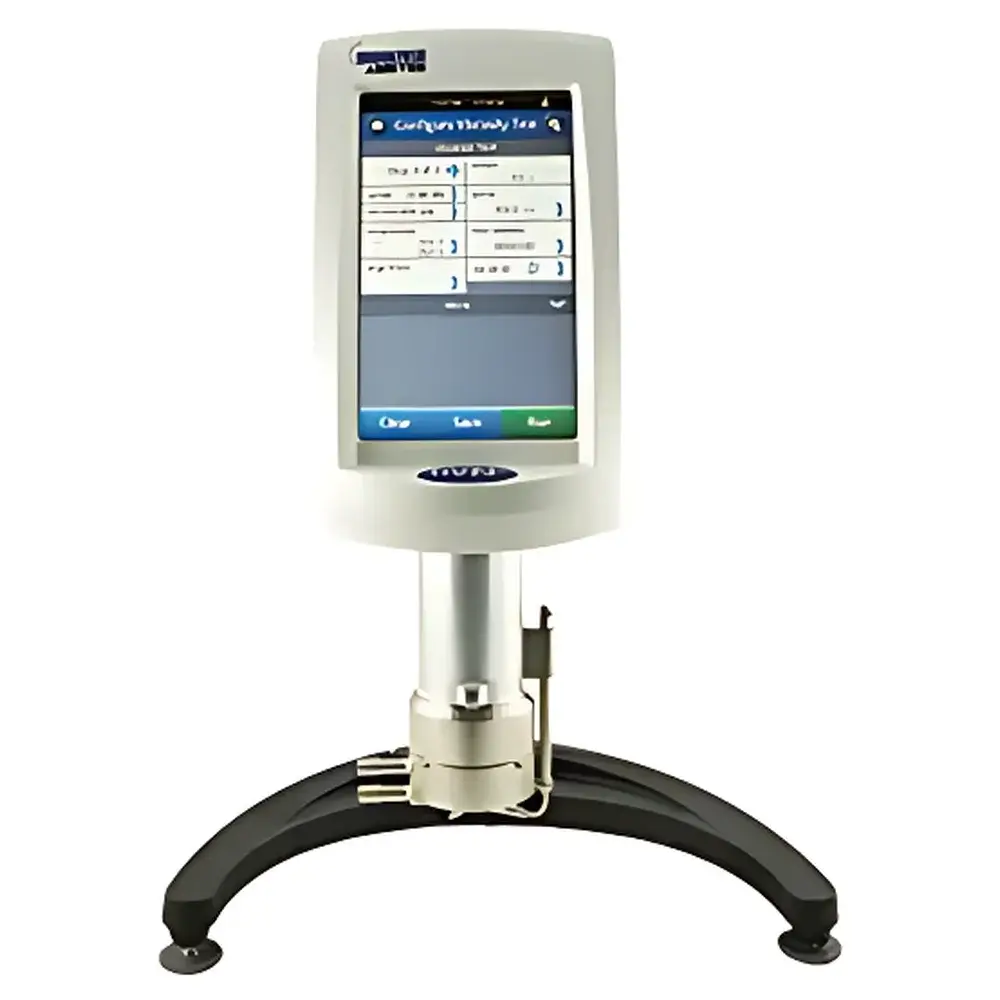
Brookfield DVNXLVCP Advanced Cone-Plate Viscometer
| Brand | Brookfield |
|---|---|
| Origin | USA |
| Model | DVNXLVCP |
| Viscosity Range (mPa·s) | 0.1–3,000 |
| Shear Rate Range | 7.5–92,000 s⁻¹ (depending on cone geometry) |
| Sample Volume | 0.5–2.0 mL |
| Speed Range | 0.01–250 rpm (2600 discrete steps) |
| Accuracy | ±1.0% of reading |
| Repeatability | ±0.2% |
| Cone/Plate Gap Adjustment | Motorized touchscreen-controlled |
| Display | 7-inch full-color capacitive touch screen |
| Compliance | FDA 21 CFR Part 11, GAMP 5-ready (configurable at order), GLP/GMP-supportive audit trail |
| Data Storage | 150 MB internal memory |
| Interface | USB host/device, RS-232 (optional) |
| Temperature Control | Integrated Peltier interface for external bath (AP/SD series) or high-temp systems |
| Mathematical Models | Casson, Bingham Plastic, Power Law, Thixotropy Index (TI), Yield Stress estimation |
Overview
The Brookfield DVNXLVCP is a high-precision, motorized cone-plate viscometer engineered for controlled-shear-rate rheological characterization of low-to-medium viscosity fluids under defined gap geometry. Operating on the principle of steady-state rotational viscometry in Couette flow geometry, it measures torque generated by fluid resistance between a precisely angled conical rotor and a flat plate—enabling direct calculation of shear stress and shear rate without geometric correction factors. This architecture delivers superior sensitivity for yield stress detection, thixotropic loop analysis, and time-dependent viscosity profiling, particularly for samples with limited volume (as low as 0.5 mL). Designed for QC laboratories, R&D centers, and regulated manufacturing environments, the DVNXLVCP supports both standalone operation and computer-integrated workflows compliant with pharmaceutical and industrial quality standards.
Key Features
- 7-inch high-resolution capacitive touchscreen interface with real-time graphical display of viscosity (mPa·s), % torque, temperature (°C/°F), rotational speed, shear rate (s⁻¹), and test status
- Motorized, software-guided cone-plate gap adjustment—eliminating manual micrometer calibration and ensuring repeatable 1-µm-level gap control across all cone geometries (CPA-40Z to CPA-52Z)
- Integrated mathematical modeling engine supporting Casson, Bingham Plastic, Power Law, and Thixotropy Index (TI) calculations directly on-device—no external software required for preliminary analysis
- Dual-mode operation: fully autonomous single-step or multi-step protocols stored internally; or PC-synchronized via USB with optional Rheo3000 data acquisition software for automated sequence execution and raw torque/time export
- GAMP 5-aligned firmware architecture with configurable user roles, electronic signatures, date/time-stamped PDF reports, immutable audit trails, and 21 CFR Part 11 compliance options (selected at time of order)
- Onboard 150 MB non-volatile storage for method files, calibration logs, raw datasets, and annotated test reports—exportable via USB mass storage mode
- Peltier-cooled temperature interface compatible with AMETEK Brookfield AP/SD-series recirculating baths and high-temperature test systems (up to 200°C with appropriate accessories)
Sample Compatibility & Compliance
The DVNXLVCP accommodates Newtonian and non-Newtonian liquids—including coatings, inks, adhesives, pharmaceutical suspensions, cosmetic emulsions, and food formulations—across five standardized cone geometries (CPA-40Z through CPA-52Z), each optimized for specific shear rate windows and sample volumes (0.5–2.0 mL). Its cone-plate configuration ensures uniform shear field distribution and eliminates wall-slip artifacts common in cylindrical geometries. The instrument meets ISO 2555, ASTM D2196, and USP requirements for rotational viscosity measurement. When configured with GAMP-compliant firmware, it satisfies GLP and GMP documentation integrity requirements, including role-based access control, electronic signature validation, and tamper-proof audit trail generation per FDA 21 CFR Part 11 Annex 11 guidelines.
Software & Data Management
Data acquisition and reporting are supported via native touchscreen interface or optional Rheo3000 software (Windows-based), which enables method scripting, real-time graph overlay, statistical batch comparison, and automated report generation in PDF/XLSX formats. All datasets include embedded metadata: operator ID, timestamp, environmental temperature, cone geometry ID, gap setting, and calibration certificate reference. Internal storage maintains full traceability—each file carries cryptographic hash verification to prevent unauthorized modification. Audit logs record every parameter change, user login/logout event, and report export action with IP address (if network-enabled) and hardware timestamp.
Applications
- Yield stress quantification in toothpastes, gels, and drilling muds using Bingham or Casson model fitting
- Thixotropic recovery assessment in paints and printing inks via controlled shear ramp-hold-recovery sequences
- QC release testing of syrups, injectables, and ophthalmic solutions per USP and Ph. Eur. 2.2.28
- Formulation development of shear-thinning polymer dispersions where low-shear viscosity dictates leveling behavior
- Stability evaluation of colloidal suspensions through time-sweep measurements at fixed shear rate
- Temperature-dependent viscosity mapping using integrated bath synchronization and Peltier feedback control
FAQ
What cone geometries are compatible with the DVNXLVCP?**
The instrument supports five standard cone-plate sets: CPA-40Z (0.5 mL, 7.5–11,000 s⁻¹), CPA-41Z (2.0 mL, 2.0–11,000 s⁻¹), CPA-42Z (1.0 mL, 3.84–6,000 s⁻¹), CPA-51Z (0.5 mL, 3.84–48,000 s⁻¹), and CPA-52Z (0.5 mL, 2.0–92,000 s⁻¹).
Is temperature control built into the base unit?**
No—the DVNXLVCP features a Peltier-driven temperature interface port for external thermal regulation. It requires connection to an AMETEK Brookfield AP/SD-series recirculating bath or high-temperature system for active temperature control.
Can yield stress be measured without third-party software?**
Yes. The onboard firmware includes Bingham and Casson model regression tools that compute yield stress directly from steady-shear flow curves, with confidence intervals and residual error reporting.
How is 21 CFR Part 11 compliance implemented?**
Compliance is enabled via factory-configured firmware options, including electronic signature enforcement, audit trail encryption, role-based permission tiers, and write-protected PDF report generation—all validated during IQ/OQ protocol execution.
What is the minimum sample volume required for valid measurement?**
0.5 mL is the operational minimum, achievable with CPA-40Z and CPA-51Z/52Z cones—validated per ISO 2555 Annex B for gap-dependent volume sufficiency.



