
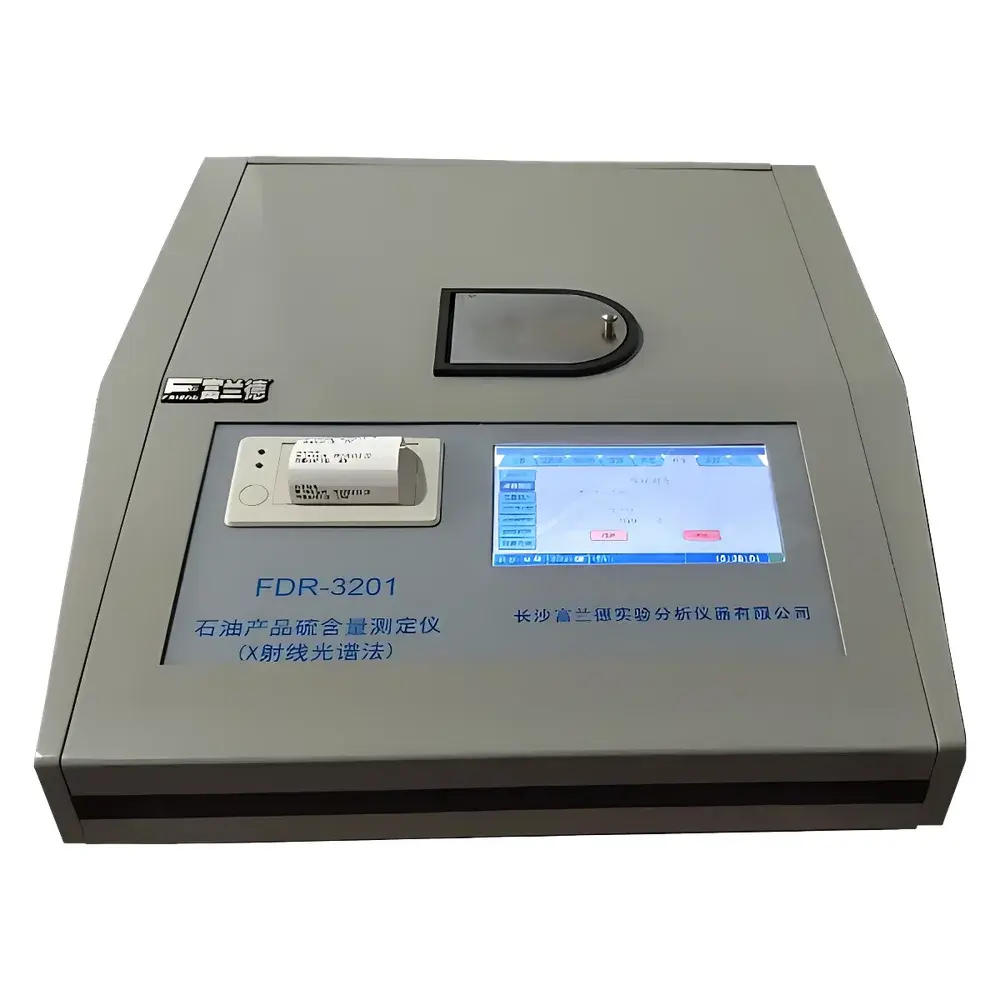
Brookfield FDH-3201 High-Temperature Foam Characteristics Tester for Lubricating Oils
| Brand | Brookfield |
|---|---|
| Model | FDH-3201 |
| Temperature Control | ±0.1 °C at 150 °C |
| Temperature Range | 150 °C (fixed setpoint) |
| Heating Method | Oil bath with stainless steel heater |
| Bath Vessel | Borosilicate glass cylinder, Φ300 × 450 mm |
| Air Flow Control | Precision mass flow meter |
| Sample Stations | Dual-tube configuration |
| Power Supply | AC 220 V / 50 Hz |
| Total Power | 2.5 kW |
| Temperature Sensor | Pt100 RTD |
| Controller | Microprocessor-based PID with digital display |
| Air Filtration | Glass wool–packed filter |
| Insulation | High-efficiency thermal insulation |
| Compliance | ASTM D6082, ISO 6247, IP 146 |
Overview
The Brookfield FDH-3201 High-Temperature Foam Characteristics Tester is a dedicated benchtop instrument engineered to evaluate the foaming tendency and foam stability of lubricating oils under controlled elevated-temperature conditions—specifically at 150 °C, as mandated by internationally recognized test standards. It operates on the principle of air sparging: a precisely regulated stream of filtered, dry air is introduced into a preheated oil sample contained in a vertically oriented borosilicate glass cylinder. The resulting foam volume is measured visually or via calibrated scale markings after defined aeration and drainage intervals. This methodology directly reflects real-world engine and gearbox operating environments where thermal degradation, oxidation, and surfactant depletion critically influence foam behavior. The FDH-3201’s fixed-temperature design ensures strict adherence to ASTM D6082 (Standard Test Method for Foaming Characteristics of Lubricating Oils), ISO 6247 (Petroleum products — Determination of foaming characteristics), and IP 146 (Foaming characteristics of lubricating oils), eliminating variability associated with ramping or multi-point temperature profiles.
Key Features
- Two independent test stations housed within a single integrated chassis, enabling parallel evaluation of reference and test samples or duplicate determinations for statistical validation.
- Borosilicate glass cylinder (Φ300 mm × 450 mm height) conforming to dimensional requirements specified in ASTM D6082, ensuring optical clarity, thermal shock resistance, and chemical inertness toward hydrocarbon-based lubricants.
- Oil bath heating system with stainless steel immersion heater and high-efficiency thermal insulation, minimizing energy loss and ambient heat emission while maintaining stable thermal uniformity across both test tubes.
- Microprocessor-based PID temperature controller with Pt100 RTD sensor feedback, delivering ±0.1 °C accuracy at the nominal 150 °C operating point—critical for reproducible bubble nucleation kinetics and gas solubility dynamics.
- Precision mass flow meter for consistent air delivery (typically 94 ± 5 mL/min per tube, per ASTM D6082), calibrated traceably to NIST standards; includes integrated glass wool–packed air filter to remove particulates and moisture prior to sample contact.
- Digital temperature display with intuitive interface, supporting GLP-compliant operation through non-volatile parameter logging and user-accessible calibration offset adjustment.
Sample Compatibility & Compliance
The FDH-3201 accommodates standard 100 mL or 200 mL lubricant samples (including engine oils, gear oils, hydraulic fluids, and turbine oils) without modification. Its geometry and thermal profile are validated for use with mineral, semi-synthetic, and fully synthetic base stocks—including polyalphaolefins (PAO), esters, and polyglycols—provided viscosity remains within the practical range for stable foam column formation (typically 5–150 cSt at 40 °C). The instrument meets mechanical and procedural requirements of ASTM D6082 Type A (high-temperature method), ISO 6247 Clause 6, and IP 146 Annex A. When operated within documented SOPs and paired with certified reference materials (e.g., ASTM SRM 2781), data generated supports regulatory submissions under FDA 21 CFR Part 11 (when integrated with compliant LIMS), ISO/IEC 17025-accredited testing laboratories, and OEM technical specifications requiring third-party verification.
Software & Data Management
While the FDH-3201 operates as a stand-alone hardware platform, its temperature and flow parameters are fully configurable and auditable via front-panel controls. All operational settings—including setpoint, dwell time, and flow rate—are stored in non-volatile memory. Optional RS-232 or USB-to-serial interface enables connection to laboratory PCs running custom data acquisition scripts or validated chromatography/LIMS platforms. Audit trails may be generated manually or automatically to satisfy GLP/GMP documentation requirements, including operator ID, date/time stamp, calibration history, and deviation logs. No proprietary software bundle is required; raw output consists of discrete numeric values (foam height in mL at 0 s, 5 min, and 10 min post-aeration) compatible with Excel, JMP, or Minitab for statistical process control (SPC) analysis.
Applications
- Quality control release testing of finished lubricants against OEM foam specifications (e.g., GM 6397M, Ford WSS-M2C930-A, VW TL 521 82).
- R&D screening of antifoam additive packages (e.g., silicone polymers, alkyl acrylates) under accelerated thermal stress.
- Investigation of foam-related field failures, including oil aeration in hydraulic systems, crankcase frothing, and pump cavitation onset thresholds.
- Stability assessment of re-refined or recycled base oils subjected to multiple thermal cycles.
- Validation of batch-to-batch consistency in large-volume manufacturing environments where foam performance correlates with filtration efficiency and air release time.
FAQ
What standards does the FDH-3201 support?
ASTM D6082, ISO 6247, and IP 146—each specifying identical test geometry, temperature, airflow, and timing protocols for high-temperature foam evaluation.
Is the temperature adjustable beyond 150 °C?
No. The FDH-3201 is configured exclusively for 150 °C ±0.1 °C operation to ensure full compliance with referenced standards; it is not a variable-temperature rheometer or general-purpose thermal chamber.
Can the instrument accommodate non-standard sample volumes?
Only the prescribed cylinder dimensions and fill levels (e.g., 100 mL oil + 100 mL headspace) yield valid results per ASTM D6082; deviations invalidate comparative data.
Does the air filtration system require scheduled replacement?
Yes. Glass wool filters must be inspected before each test series and replaced when visibly discolored or compressed to maintain consistent airflow resistance and particle retention efficiency.
Is external calibration certification included?
The unit ships with factory calibration documentation for temperature (Pt100) and flow (mass flow meter); users are responsible for periodic third-party verification per ISO/IEC 17025 or internal QA schedules.






